
In April 2026, the Roundhill Memory ETF (DRAM) has emerged as the fastest-growing thematic ETF of the year, crossing $1 billion in assets under management (AUM) just 10 trading days after its April 2 debut. As the global AI infrastructure build-out hits a critical memory bottleneck, the fund has become the primary vehicle for investors seeking exposure to the high-bandwidth memory (HBM) titans. While the ETF surged over 18% in early April trading, a rare divergence has appeared: while long-term contract prices for AI giants are skyrocketing, consumer spot prices are falling off a cliff.
As the memory industry shifts from a cyclical commodity to a strategic AI constraint, the market is weighing record-breaking Q1 earnings from Samsung and SK Hynix against the ETF Omen, a historical tendency for niche funds to launch at cycle peaks.
This guide breaks down the DRAM price prediction for 2026 using data from Bloomberg, TrendForce, and Roundhill Investments, and how to trade DRAM ETF futures with Tether (USDT) on BingX TradFi.
Top 5 Things for DRAM ETF Investors to Know in 2026
As the memory sector navigates a high-stakes environment of Agentic Commerce and hardware shortages, investors must monitor these five factors:
- The $1 Billion Milestone: DRAM’s unprecedented asset gathering signals that institutional dip-buyers have officially pivoted from logic chips (Nvidia) to the physical storage layer.
- Prepayment Mania: For the first time in history, Microsoft and Google are signing 5-year supply agreements with 10%–30% upfront prepayments to secure HBM capacity.
- The Spot vs. Contract Split: A massive divergence exists where DDR4 spot prices plunged 30% in April, while AI-grade DRAM contract prices are projected to rise 58%–63% in Q2.
- Extreme Concentration: The top three holdings, Micron, Samsung, and SK Hynix, command over 70% of the ETF, making it hyper-sensitive to South Korean market dynamics.
- The ADR Dilution Risk: SK Hynix has applied for a U.S. listing (ADR). Once live, it may divert capital away from the DRAM ETF as investors gain direct access to the stock.
What Is the Roundhill Memory ETF (DRAM)?
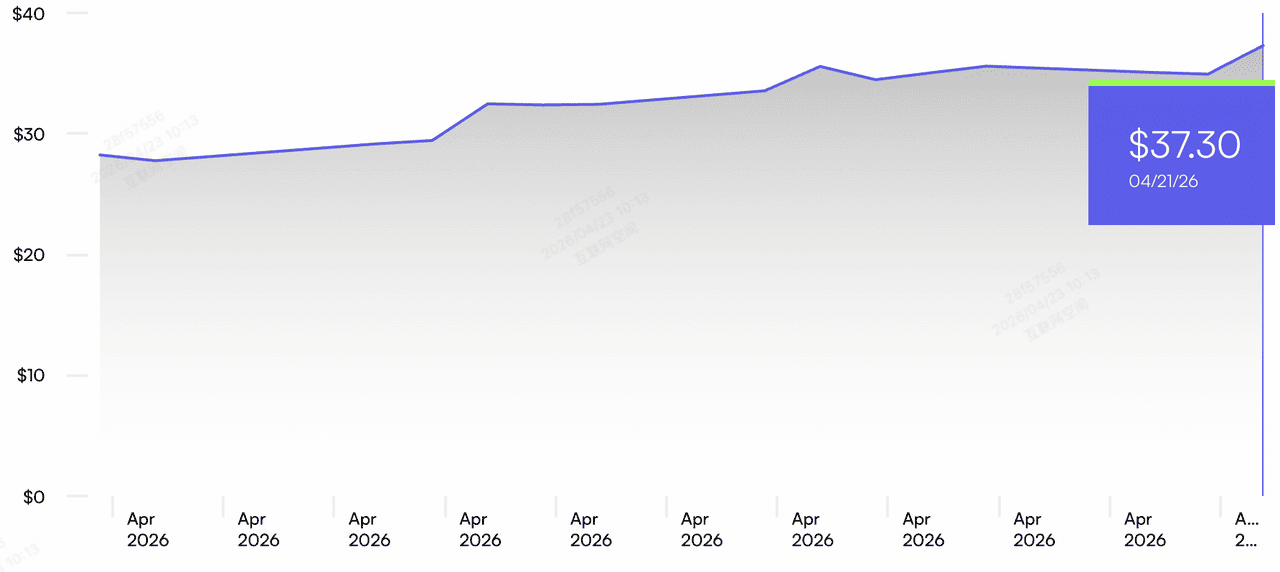
DRAM ETF market price as of April 2026 | Source: Roundhill Memory ETF
The Roundhill Memory ETF (DRAM) is the first U.S.-listed ETF providing targeted exposure to global memory semiconductor companies. Unlike broad semiconductor indices like the SOXX, which are dominated by design firms and foundries, DRAM requires companies to derive at least 50% of their revenue from memory and storage to be included.
The fund is currently anchored by the Big Three of storage: Micron (MU), Samsung Electronics, and SK Hynix. In 2026, these firms represent the backbone of AI data centers, producing the High-Bandwidth Memory (HBM) required for LLMs to function. The ETF is actively managed with an expense ratio of 0.65% and utilizes Total Return Swaps to gain exposure to South Korean stocks that do not trade directly on U.S. exchanges.
A Review of the Memory Sector Performance in 2025
In 2025, the memory sector outperformed the broader Nasdaq 100, driven by the AI Multiplier Effect. While 2024 was about training models, 2025 was the year of Inference at Scale, which required massive upgrades to server-side DRAM. Micron Technology saw its stock surge as it hit record yields on its 1-gamma node, while Samsung recovered from its 2024 earnings slump to post a 755% increase in operating profit by Q1 2026. This Memory Supercycle set the stage for Roundhill to launch the DRAM ETF into a market hungry for pure-play storage exposure.
Roundhill Memory (DRAM) ETF 2026 Investment Outlook: $50 Bull Run vs. $28 Bear Case
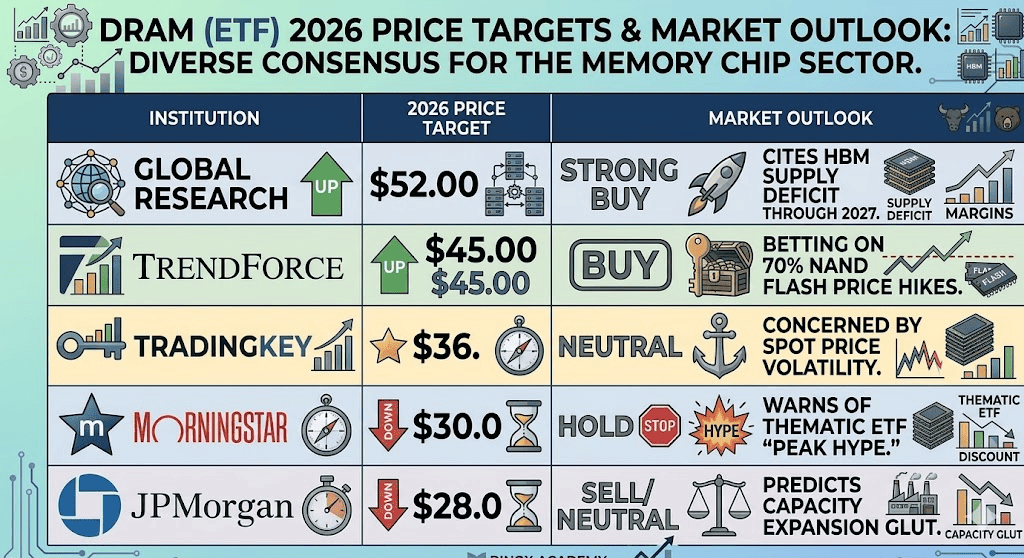
Roundhill Memory (DRAM) ETF forecasts for 2026 by various Wall Street analysts
Navigate the high-stakes volatility of the memory supercycle by weighing these three probability-weighted scenarios for the DRAM ETF through the remainder of 2026.
The Bull Case: Roundhill Memory ETF's $52 Bottleneck Breakthrough
DRAM ETF's bullish narrative hinges on the Zero-Sum Constraint in manufacturing. As titans like SK Hynix and Samsung pivot nearly all production capacity to High-Bandwidth Memory (HBM3e/HBM4) to satisfy AI demand, they are inadvertently starving the consumer and enterprise PC markets. With Big Tech capital expenditure projected to grow 40% in 2026, the supply floor remains structurally firm, preventing any meaningful price depreciation.
Practical exposure in this scenario focuses on the realized 46% growth in IT earnings, driving the DRAM ETF to decisively clear the $50 resistance. If contract prices sustain their 30% quarter-on-quarter hikes and the Prepayment Mania expands to second-tier cloud providers, the ETF targets a $52 year-end finish, fueled by record-breaking operating margins that could exceed 35% across the Big Three holdings.
The Base Case: DRAM's $35 – $42 Range-Bound Grind
The base case positions the DRAM ETF in a healthy distribution phase as the market digests its initial 18% post-launch surge. While AI demand remains the secular driver, technical analysts identify $35 as the key psychological support level. In this stock-picker’s environment, the fund oscillates as investors rotate capital between specialized memory plays and broader Magnificent Seven tech giants to manage sector-specific concentration.
From an investment standpoint, this scenario assumes the 10-year Treasury yield stays near 4.5%, acting as a valuation ceiling that prevents aggressive P/E expansion. Investors should look for a mean-reverting trend where the ETF drifts toward a $40 target. Growth is supported by steady fundamental earnings, but tempered by the reality that new fabrication capacity (fabs) scheduled for 2027 will begin to weigh on long-term supply-side sentiment.
The Bear Case: DRAM ETF's $28 'RAMmageddon' Trap
The bear case is triggered by CapEx Fatigue among hyperscalers. If Microsoft, Meta, or Amazon signal a slowdown in AI server clusters during Q3 earnings, the massive HBM capacity currently under construction would transform into a catastrophic supply glut. This risk is amplified by software breakthroughs like Google’s TurboQuant algorithm, which claims a 6x increase in memory compression, potentially slashing the physical RAM requirements of future data centers.
Technically, this downside scenario centers on a decisive break below the $32 support, which would likely activate systematic trend-following sell programs. Such a breach would expose the fund to a retest of its $28 IPO zone, effectively wiping out all 2026 gains. In this hard-landing environment, the divergence between falling spot prices and rising contracts would collapse, forcing a rapid de-rating of memory multiples toward historical cyclical lows.
Roundhill Memory ETF (DRAM) Analyst Forecasts and Price Targets for 2026
|
Institution |
2026 Price Target (DRAM) |
Market Outlook |
|
Global Research |
$52.00 |
Strong Buy: Cites HBM supply deficit through 2027. |
|
TrendForce |
$45.00 |
Buy: Betting on 70% NAND flash price hikes. |
|
TradingKey |
$36.00 |
Neutral: Concerned by spot price volatility. |
|
Morningstar |
$30.00 |
Hold: Warns of thematic ETF "peak hype." |
|
JPMorgan |
$28.00 |
Sell/Neutral: Predicts capacity expansion glut. |
How to Trade Roundhill Memory ETF (DRAM) on BingX TradFi
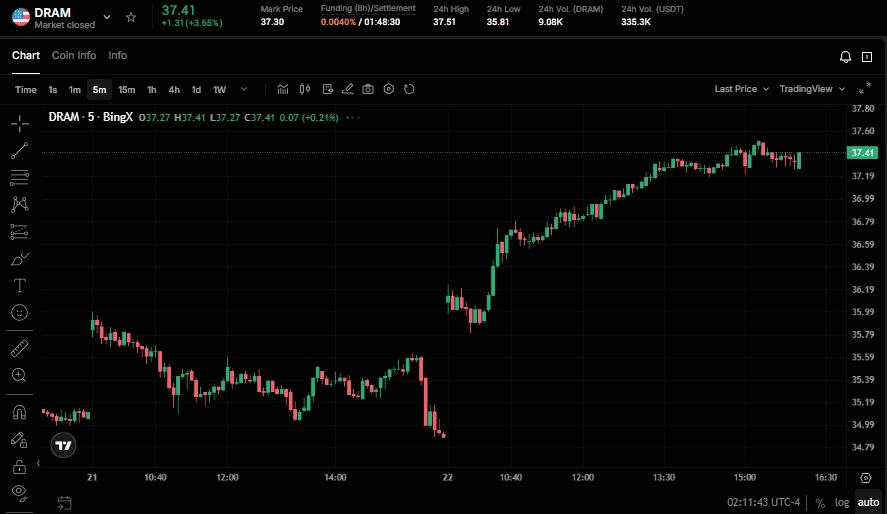
DRAM/USDT perpetual contract on BingX futures market
Maximize your precision in the semiconductor market by leveraging BingX AI integrations to identify optimal entry points during the 2026 memory supercycle.
- Access TradFi: Log in to your BingX account, navigate to the TradFi section, and select Stocks.
- Locate DRAM: Search for the DRAM/USDT perpetual contract to open the trading interface.
- Configure Leverage: Set your preferred leverage, e.g., 2x–10x, to amplify your exposure to the high-beta memory sector.
- Execute Strategy: Select Open Long if you anticipate a supply-side breakthrough or Open Short to hedge against a potential cyclical downturn.
- Manage Risk: Define your Take-Profit (TP) and Stop-Loss (SL) levels based on key support and resistance zones.
For traders seeking more granular exposure, BingX TradFi also offers high-liquidity perpetual contracts on direct AI infrastructure stocks, including Micron (MU), SanDisk (SNDK), NVIDIA (NVDA), and Intel (INTC), allowing you to trade the underlying manufacturers alongside the ETF.
Top 5 Risks to Watch for DRAM Investors in 2026
As the memory sector transitions from a cyclical commodity to a strategic AI backbone, investors must remain vigilant regarding these five structural and macroeconomic threats to the DRAM ETF’s 2026 trajectory.
- Geopolitical Concentration: With nearly 50% of the fund’s weight tied to South Korean giants, any escalation in regional tensions or supply chain disruptions in the Pacific remains a primary Black Swan risk.
- The Compression Threat: Breakthroughs in AI software efficiency, such as Google’s TurboQuant, could fundamentally reduce the physical memory capacity required per server, potentially dampening long-term demand.
- CapEx Fatigue: If major cloud hyperscalers signal a pause in AI infrastructure spending during mid-2026 earnings, the massive HBM capacity currently under construction could quickly transform into a supply glut.
- Thematic Peak Hype Omen: Historically, the launch of a niche, high-performing thematic ETF often coincides with peak investor euphoria, making the fund susceptible to a 'sell the news' correction.
- Financial Instrument Risk: The DRAM ETF’s use of Total Return Swaps to access non-U.S. listings introduces counterparty and structural complexities that may behave unpredictably during periods of extreme market illiquidity.
Final Thoughts: Is Roundhill Memory ETF (DRAM) a Good Buy in 2026?
The DRAM ETF is a high-conviction bet on the physical layer of the AI revolution. At current levels, it is an attractive vehicle for those who believe the Memory Supercycle is in its third inning. However, for conservative traders, the widening gap between falling spot prices and rising contract prices suggests a wait-and-see approach until the $35 support is firmly tested.
Risk Reminder: Trading thematic ETFs involves significant sector concentration risk. The memory industry is historically cyclical. Always utilize stop-losses and ensure this satellite position does not exceed 5-10% of your total portfolio.
Related Reading
- Nasdaq 100 (NAS100) Forecast 2026: 27,000 AI Breakthrough or 22,000 Stagflation Trap?
- S&P 500 Forecast 2026: 7,600 Bull Run or a 6,000 Energy-Driven Crash?
- Micron (MU) Stock Price Forecast 2026: Can AI Memory and DRAM Demand Push MU to $500?
- SanDisk (SNDK) Price Prediction 2026: AI Memory Supercycle or $913 Technical Peak?