

The financial landscape of March 2026 represents the conclusion of a decade-long transition from the speculative origins of blockchain technology to its current status as the foundational infrastructure for global finance. At the center of this metamorphosis stands Chris Larsen, the co-founder and Executive Chairman of Ripple Labs, whose financial trajectory serves as a primary case study for the institutionalization of digital wealth.
As of early 2026, Larsen’s net worth is a composite reflection of macro-regulatory shifts, most notably the resolution of the multi-year SEC litigation, the resilience of the XRP Ledger (XRPL) during the Bitcoin Polar Vortex, and a strategic pivot toward climate philanthropy. His status in 2026 underscores a career defined not just by early adoption, but by the successful integration of digital assets into the plumbing of the global banking system.
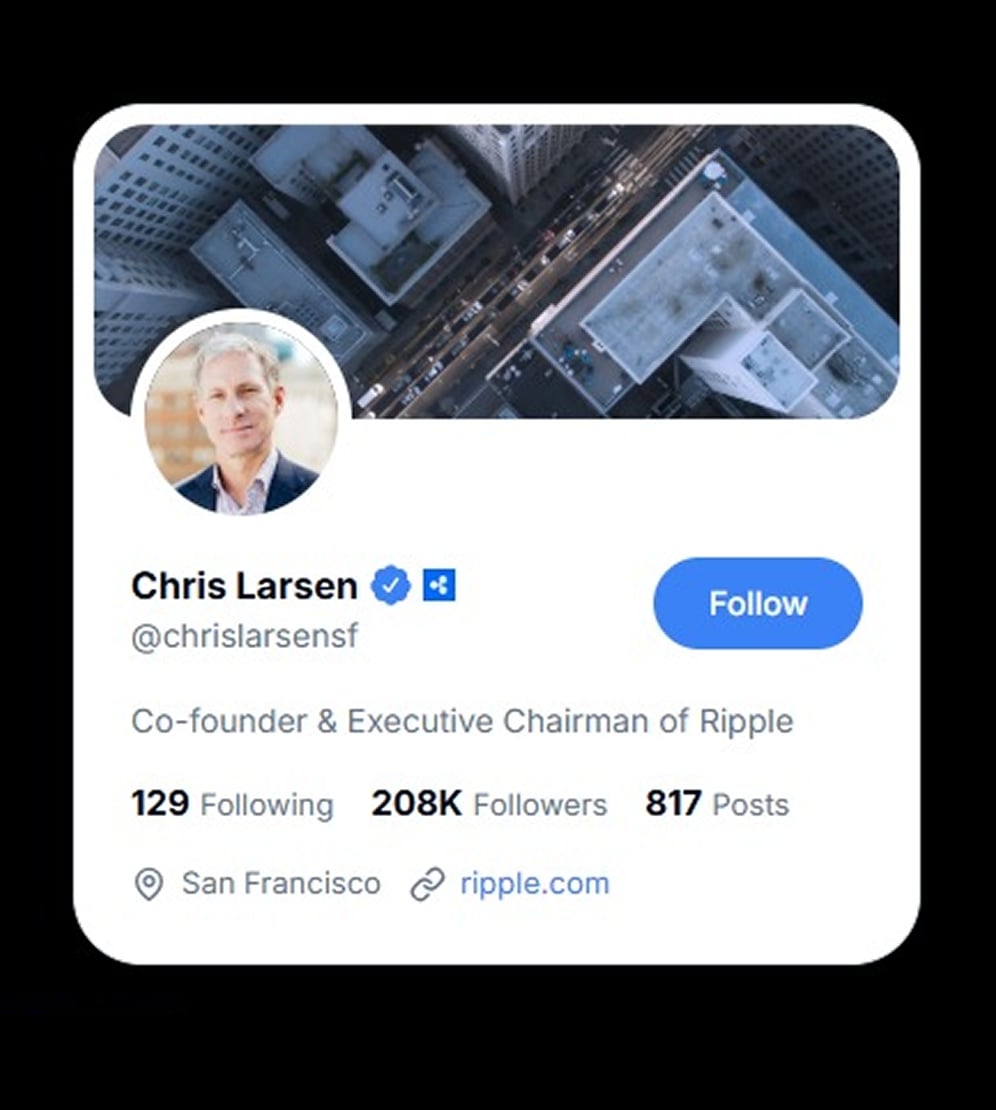
Source: x.com
Who Is Chris Larsen?
Chris Larsen is a veteran Silicon Valley entrepreneur often credited with being a pioneer of financial democratization. Before co-founding Ripple (originally OpenCoin) in 2012, Larsen established himself as a fintech disruptor by co-founding E-Loan, one of the first online mortgage lenders, and Prosper Marketplace, the first peer-to-peer lending marketplace in the United States.
In the context of 2026, Larsen has evolved from a startup founder into a Fintech Architect. While his CEO successor, Brad Garlinghouse, handles the day-to-day operations and public-facing regulatory battles, Larsen remains the visionary Executive Chairman. He has spent the last several years bridging the gap between decentralized protocols and Tier-1 banking institutions, while simultaneously becoming one of San Francisco’s most influential (and occasionally controversial) civic philanthropists.
How Did Chris Larsen Build His Wealth?
Larsen’s path to a $15.3 billion fortune is built on three foundational pillars that have matured significantly by 2026:
1. The Ripple Labs Equity Stake
The primary engine of Larsen’s wealth is his 18% equity stake in Ripple Labs. Following a landmark $500 million strategic investment round led by Fortress Investment Group and Citadel Securities in late 2025, Ripple’s corporate valuation tripled to $40 billion. Unlike many crypto founders whose wealth is tied solely to volatile tokens, Larsen’s equity represents ownership in a profitable software and payments company that generates revenue through transaction fees, enterprise licenses, and its stablecoin, RLUSD.
2. Personal XRP Treasury
Larsen maintains one of the largest personal treasuries of digital assets in the world. As of March 2026, he holds approximately 2.7 billion XRP. While his paper wealth once spiked to astronomical levels in 2018, the 2026 valuation is grounded in a liquid, post-regulatory framework. The introduction of XRP ETFs in November 2025 has provided a significant price floor, allowing for more stable valuation of these holdings.
3. Strategic Institutional Vehicles: Evernorth
In a move to U.S.-dollarize his holdings, Larsen allocated 50 million XRP to the Evernorth treasury, a firm specializing in XRP-based institutional services. Evernorth’s planned Nasdaq listing via a SPAC merger in Q1 2026 has provided Larsen with a regulated, public-market proxy for his digital wealth, effectively shielding a portion of his estate from the Polar Vortex volatility seen in the broader crypto market.
Chris Larsen's Net Worth in 2026: Key Estimates
| Metric | March 2026 Status | Qualitative Influence |
| Consensus Estimate | $15.80 Billion | Top 200 wealthiest individuals globally |
| Bloomberg Estimate | $15.30 Billion | Comprehensive valuation based on late 2025 data |
| Ripple Labs Equity | $7.20 Billion | Based on 18% stake of $40B valuation |
| XRP Token Holdings | $6.30 Billion | 2.7B XRP at real-time liquid market value |
| Traditional Portfolio | $1.80 Billion | Disclosed real estate and non-crypto assets |
| Strategic Allocations | $500 Million | 50M XRP dedicated to the Evernorth treasury |
The variance between the $15.3 billion (Bloomberg) and $15.8 billion (Consensus) figures is largely due to the liquidity-adjusted framework used for his XRP holdings. Traditional financial trackers apply a governance discount to large token stashes that cannot be sold instantly without impacting the market, whereas real-time trackers often use the spot price.
Analyzing the Impact of the Bitcoin Polar Vortex on Chris Larsen's Wealth
The 2025-2026 financial year was defined by the Bitcoin Polar Vortex, a period where Bitcoin failed to act as a digital gold hedge against geopolitical instability. While Bitcoin faced a systemic drawdown, dropping significantly from its highs, Chris Larsen’s wealth demonstrated a rare decoupling.
The Decoupling of XRP and BTC
In early 2026, XRP experienced a 25% price jump in the first week of January, even as Bitcoin remained under pressure. This was driven by:
- Regulatory Clarity: The resolution of the SEC lawsuit in August 2025, resulting in a $125 million fine.
- The GENIUS Act: Landmark legislation that fundamentally rerated valuation multiples for utility-based tokens.
- RLUSD Success: Ripple’s stablecoin RLUSD reached a $1.4 billion market cap, proving the network's functional utility beyond speculation.
For Larsen, this meant his net worth remained resilient while other crypto leaders, such as Michael Saylor, who is almost entirely tied to Bitcoin price action, saw their fortunes contract during the mining sector collapse of early 2026.
Comparison Analysis: Crypto Industry Titans (March 2026)
| Leader | Primary Entity | Est. Net Worth | Primary Wealth Source |
| Elon Musk | SpaceX / xAI / Tesla | $839.0 Billion | Industrial AI and Space Infrastructure |
| Changpeng Zhao (CZ) | Binance | $110.0 Billion | 90% Equity in Global Exchange |
| Pavel Durov | Telegram / TON | $17.0 Billion | Social-Sovereign Integration |
| Chris Larsen | Ripple Labs | $15.3 Billion | Institutional Settlement and XRP |
| Brian Armstrong | Coinbase | $14.2 Billion | Public Exchange Equity |
| Michael Saylor | MicroStrategy | $9.4 Billion | Massive Bitcoin Treasury |
| Justin Sun | TRON / HTX | $9.2 Billion | Yield Protocols and TRX Staking |
| Vladimir Tenev | Robinhood | $4.8 Billion | Public Equity and AI Ventures |
| Cameron Winklevoss | Gemini | $2.6 Billion | Gemini Equity and BTC Reserves |
| Anatoly Yakovenko | Solana Labs | $1.2 Billion | SOL Tokens and Protocol Equity |
| Vitalik Buterin | Ethereum | $1.1 Billion | Liquid ETH Holdings |
| Jesse Powell | Kraken | $1.0 Billion | Significant Kraken Founder Stake |
| Arthur Hayes | BitMEX / Maelstrom | $0.4 Billion | Macro-Trading and Venture Capital |
The 2026 global rich lists reflect a radical realignment of global wealth. Digital asset founders are no longer footnotes on the financial pages; they have surpassed many titans of the traditional economy. A comparative analysis of Chris Larsen’s financial profile against his peers reveals the divergent strategies employed by the architects of the post-regulatory digital economy.
The Institutional vs. The Ecosystem Builders
While Chris Larsen ($15.3B) has focused on institutional settlement layers, others like Changpeng Zhao (CZ) ($110B) and Justin Sun ($9.2B) have built massive retail and utility ecosystems. Sun, in particular, has mirrored some of Ripple's strategy by taking "Tron Inc." public on the Nasdaq to act as a regulated TRX treasury, though his fortune remains more closely tied to the high-velocity stablecoin traffic on the TRON network.
The Technical and Sovereign Visionaries
The 2026 landscape also highlights the "sovereign" wealth of leaders like Pavel Durov ($17B) and Elon Musk ($839B). Durov’s integration of the TON blockchain into Telegram has created a social-financial hybrid that competes directly with traditional banking. Meanwhile, technical founders like Anatoly Yakovenko ($1.2B) have seen their net worth stabilize as networks like Solana transitioned from speculative high-speed chains to critical infrastructure for tokenized Real-World Assets (RWAs).
Strategic Equity and Market Infrastructure
The valuation of exchange equity remains a primary wealth driver for leaders like Brian Armstrong ($14.2B), Jesse Powell ($1.0B), and Cameron Winklevoss ($2.6B). Powell’s net worth is poised for a significant liquidity event as Kraken prepares for its 2026 IPO, while the Winklevoss twins have leveraged their Gemini equity and massive Bitcoin reserves to weather the Polar Vortex. In contrast, Arthur Hayes ($0.4B) represents the "Maelstrom model—pivoting from exchange leadership to high-conviction macro-trading and venture capital.
5 Key Factors Driving Chris Larsen’s 2026 Valuation
1. The Institutionalization of XRP
By March 2026, XRP is no longer viewed merely as a speculative asset. The successful launch of XRP ETFs has brought in over $1.3 billion in institutional inflows. These products act as a volatility floor. According to 2026 market data, XRP Ledger utility has a 0.48 correlation with Bitcoin, much lower than the 0.96 correlation seen in Robinhood (HOOD) or the 0.88 in Coinbase (COIN), proving that utility-driven assets can survive a crypto winter.
2. The Ripple IPO Anticipation
With the SEC hurdles cleared, the path to a Ripple IPO is the single largest hidden driver of Larsen’s net worth. While Ripple remains private in early 2026, the $40 billion valuation established by Citadel and Fortress serves as a benchmark. Analysts suggest that a successful public listing could see Ripple’s valuation soar to $100 billion, which would potentially triple Larsen’s equity wealth.
2. RLUSD Stablecoin Revenue
The launch of RLUSD has provided Ripple (and by extension, Larsen) with a non-volatile cash flow engine. Reaching a $1.4 billion valuation by early 2026, RLUSD allows Ripple to facilitate cross-border settlements for Tier-1 banks without immediate exposure to XRP’s price swings. This diversification adds a layer of traditional fintech value to Larsen’s holdings.
4. Strategic Philanthropy: The Clean Break Fund
Larsen has transitioned much of his liquid wealth into the Clean Break Fund (formerly the Larsen Lam Climate Change Foundation). By investing in Carbon Dioxide Removal (CDR) technologies and startups like Heirloom and Twelve, Larsen is converting digital wealth into "hard" infrastructure assets. This move is seen as a long-term hedge, diversifying his portfolio into the burgeoning green-tech sector.
5. The U.S. CLARITY Act Catalyst
The 2026 regulatory landscape is awaiting the final passage of the Clarity Act. If signed into law by the April 2026 deadline, it would categorize XRP as a commodity under the CFTC. Standard Chartered has projected an $8 target for XRP if this passes. For Larsen, who holds 2.7 billion tokens, such a price target would increase his token-based wealth by nearly 400%.
XRP Price Sensitivity and Net Worth Projection (Q1 2026)
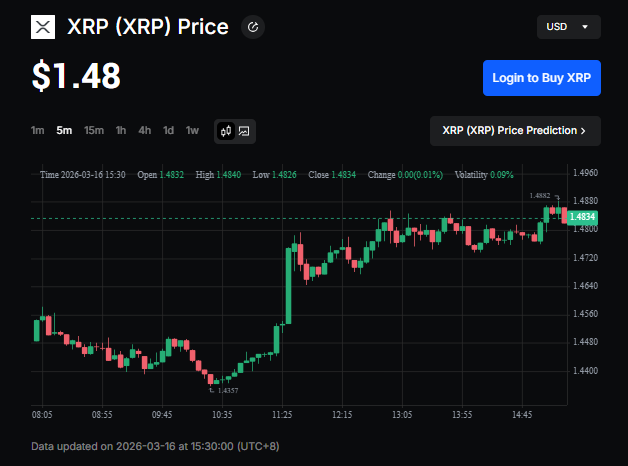
Because a significant portion of Chris Larsen’s wealth is held in digital assets, his net worth is subject to high-beta fluctuations. However, by March 2026, the "Larsen Curve" has become less volatile due to the institutional dampening effect of XRP ETFs and consistent revenue from RLUSD.
Larsen’s fortune reacts to market shifts based on his 2.7 billion XRP personal holdings and his 18% equity stake in Ripple.
The Clarity Act and Institutional Catalysts
In 2026, the primary lever for Larsen's wealth is the Clarity Act. If passed by the anticipated April deadline, analysts expect a regulatory risk premium to vanish, triggering a supply shock as Tier-1 banks move from pilot programs to full-scale payment rail integration.
| XRP Price Point | Value of 2.7B XRP Stake | Total Net Worth | Market Context & Catalyst |
| $1.40 | $3.78 Billion | $12.78 Billion | Bearish Floor: SEC appeal rumors or "Polar Vortex" contagion. |
| $2.33 | $6.30 Billion | $15.30 Billion | Current Pivot: Institutional accumulation via ETFs. |
| $5.50 | $14.85 Billion | $23.85 Billion | Bullish Breakout: Ripple announces a Fed Master Account. |
| $8.00 | $21.60 Billion | $30.60 Billion | "The Standard": Full Tier-1 bank domestic integration. |
The Ripple Valuation Multiplier and Liquidity
A surge in XRP price often elevates Ripple Labs' corporate valuation. If XRP reaches $8.00, Ripple’s valuation could soar toward $120 billion, potentially making Larsen’s 18% equity worth over $20 billion alone.
Furthermore, while conservative trackers like Bloomberg apply a 20% liquidity discount to large token stashes, the $1.3 billion in daily ETF liquidity available by March 2026 has significantly reduced this illiquidity penalty, bringing Larsen's paper wealth closer to realized value.
What Are the Key Risks to Chris Larsen’s Wealth?
Despite the regulatory renaissance, several risks persist:
- The Federal Reserve Master Account: Ripple is pursuing a Federal Reserve master account in late 2026. A rejection would be a major blow to the institutional settlement narrative, likely hurting Ripple’s private valuation.
- Geopolitical Stability: While XRP has decoupled from Bitcoin, a total collapse in global trade would still impact the volume of cross-border payments, Ripple’s core business.
- Civic Liability: Larsen’s heavy investment in San Francisco’s surveillance and revitalization of over $27 million in combined donations has created political friction. Future regulatory or tax changes at the local level could impact his physical portfolio worth $1.8 billion
Conclusion
Chris Larsen’s net worth in 2026 is a testament to the Institutionalization Revelation. At an estimated $15.3 billion to $15.8 billion, he has successfully transitioned from a crypto baron to a fintech architect. His wealth is no longer a product of simple token speculation; it is anchored in the corporate value of a company that serves as the bridge between the old world of finance and the new.
Whether he is viewed as the man who took on the SEC and won, or as a billionaire reshaping the climate tech landscape, Larsen’s fortune remains the ultimate barometer for the adoption of a decentralized financial future. If Ripple successfully executes its IPO or achieves Federal Reserve integration by 2027, Larsen could realistically challenge the top 50 richest people on earth, rivaling the founders of Google and Microsoft.
Related Reading
- Who Owns the Most XRP in 2026? Top 10 XRP Rich List Revealed
- What Are the Top 10 XRP Wallets to Store Ripple (XRP) in 2026?
- Who Are the Top 10 Crypto Billionaires in 2026? Net Worth and Portfolios Revealed
- What Is Vladimir Tenev’s Net Worth in 2026?
- Vitalik Buterin’s Net Worth in 2026: How Much Does the Ethereum Co-Founder Own?
- What Is Michael Saylor’s Net Worth in 2026?
FAQs on Chris Larsen’s Net Worth
1. How much is Chris Larsen worth in 2026?
As of March 2026, his net worth is estimated at approximately $15.3 billion to $15.8 billion.
2. How much XRP does Chris Larsen own?
As of March 2026, he holds an estimated 2.7 billion XRP personally, with an additional 50 million XRP allocated to the Evernorth strategic treasury.
3. Is Ripple a public company in 2026?
As of early March 2026, Ripple Labs remains private with a valuation of $40 billion, though it is widely anticipated to pursue an IPO following the passage of the Clarity Act.
4. How did the Bitcoin Polar Vortex affect Larsen's holdings?
Unlike many crypto leaders, Larsen’s wealth remained stable or grew due to the decoupling of XRP from Bitcoin, driven by institutional utility and the launch of XRP ETFs.
5. What is Larsen’s largest non-crypto asset?
His 18% equity stake in Ripple Labs, valued at roughly $7.2 billion, is his single largest source of wealth.