
ASML Holding (ASML) entered March 2026 as the undisputed gatekeeper of the global semiconductor industry. Following a record-breaking 2025, where net bookings hit an unprecedented €13.2 billion in Q4 alone, ASML is no longer just a supplier; it is the physical foundation of the AI revolution. The company is currently scaling its next-generation High-NA (High Numerical Aperture) systems, which are essential for producing the sub-2nm chips required by NVIDIA and Apple.
By March 2026, ASML's Installed Base Management, the high-margin service and upgrade segment, has grown to match the company’s entire total revenue from 2017. While the stock has faced minor volatility due to its 48x P/E multiple, institutional sentiment remains exceptionally bullish. Bank of America recently raised its price target to $1,886, citing a massive capacity step-up in foundry and memory, while a new €12 billion share buyback program provides a persistent floor for earnings per share (EPS).
The ASML stock forecast for 2026 is defined by two competing narratives:
- The High-NA Inflection: After years of R&D, Intel and Samsung are officially qualifying High-NA systems for high-volume manufacturing, unlocking a multi-year equipment replacement cycle.
- The Geopolitical Discount: As China revenue is guided to drop from 33% to roughly 20% due to allied export controls, the market is pricing in a normalization of the Chinese market.
For traders, ASML in 2026 offers a monopoly-play on AI infrastructure. This guide breaks down the ASML stock price prediction for 2026 using data from TIKR, BofA, and Nasdaq, and how to trade ASML stock on BingX.
Top 5 Things for ASML Investors to Know in March 2026
- The 1,000W Light Source Breakthrough: A recent physics milestone in EUV light generation is projected to increase chip production efficiency by 50% to 330 wafers/hour by 2030.
- High-NA Qualification: Intel’s January 2026 acceptance of the EXE:5200B system marks the start of the 1.4nm (Angstrom) era, forcing competitors to follow suit.
- The €38.8 Billion Backlog: With orders stretching into 2027, ASML has rare revenue visibility that protects it from short-term consumer electronics slumps.
- China Revenue De-risking: Management has aggressively guided for a lower China exposure of 20%, reducing the impact of potential future trade war shocks.
- New €12 Billion Buyback: Effective as of late January 2026, this program targets a significant reduction in share count through December 2028.
What Is ASML Holding NV (ASML)?
ASML is a Dutch multinational and the world's leading supplier of photolithography systems. It is the only company in the world capable of manufacturing Extreme Ultraviolet (EUV) lithography machines. These truck-sized, $350 million machines are the only tools that can print the intricate patterns required for the world's most advanced AI, 5G, and high-performance computing chips.
In 2026, ASML has transitioned from a hardware vendor to a Service-Led Tech Giant. Through its Installed Base Management, it ensures that the world's fabs (TSMC, Intel, Samsung) operate at maximum uptime, creating a recurring revenue stream that scales with every machine sold.
ASML (ASML) Stock Performance in 2025: A Recap
ASML’s 2025 performance was a masterclass in market dominance. While legacy dry lithography saw stagnant growth, the EUV segment surged 39% to €11.6 billion. The stock gained nearly 90% over the year, significantly outperforming the broader tech sector as hyperscalers (Microsoft, Meta, Google) accelerated their custom AI chip designs.
The core of this outperformance was the Backlog Surge. By the end of 2025, ASML’s total net sales reached €32.7 billion with a robust 52.8% gross margin. This financial strength allowed the company to launch its massive 2026 buyback program even as it invested record amounts into the Veldhoven-based High-NA production lines.
ASML vs. Micron vs. Applied Materials: 2026 Semiconductor Stock Comparison
|
Feature |
ASML Holding (ASML) |
Micron (MU) |
Applied Materials (AMAT) |
|
Market Position |
Lithography Monopoly |
Memory (HBM) Leader |
Broad Fab Equipment |
|
2026 Context |
High-NA Production Ramp |
HBM Sold Out for 2026 |
Advanced Packaging Focus |
|
Forward P/E Ratio |
42.6x |
13.0x |
21.5x |
|
Net Margin |
29.40% |
18-22% (Cyclical) |
26.50% |
|
Primary Catalyst |
1.4nm Node Shift |
50% Memory Price Spikes |
Chiplet Architecture |
In 2026, the semiconductor divergence is defined by monopoly power versus cyclical velocity. ASML remains the industry’s toll booth, boasting a record €38.8 billion backlog and a 100% market share in EUV lithography, making it a high-moat defensive play with a premium 48x P/E. Conversely, Micron (MU) offers superior near-term capital appreciation potential as High-Bandwidth Memory (HBM) remains sold out through the year; trading at a significantly lower 13x forward earnings, Micron is the alpha choice for traders betting on 80%+ DRAM price hikes and triple-digit earnings growth.
Applied Materials (AMAT) serves as the middle-ground efficiency play, trading at 21.5x P/E and pivoting heavily toward advanced packaging and Gate-All-Around (GAA) transistor architectures. While ASML provides the printing machines, AMAT provides the materials engineering required to make those 2nm patterns functional, resulting in a more diversified revenue stream and a higher 26.5% net margin than Micron. For a balanced 2026 portfolio, use ASML for long-cycle stability, Micron for aggressive AI-driven growth, and AMAT as a lower-volatility proxy for global fab expansion.
Practical tip for semiconductor stock investors: In 2026, ASML remains the quality pick with the highest moat, but it trades at a significant premium. For traders seeking higher volatility and lower valuation, Micron is the alpha choice for the 2026 memory supercycle.
ASML (ASML) 2026 Investment Outlook: The Bull vs. Bear Case
Navigating ASML’s 2026 outlook requires balancing its absolute monopoly on next-generation lithography against the friction of high-multiple valuations and shifting global trade policies. This section weighs the explosive upside of the High-NA rollout against the structural risks of geopolitical de-risking and market saturation.
The Bull Case: The High-NA Standard to $1,886
The Super-Bull narrative for 2026 hinges on the successful transition from R&D to high-volume manufacturing (HVM) for High-NA EUV. With Intel already qualifying the EXE:5200B system, ASML is effectively forcing a generational tax on the entire foundry ecosystem; any chipmaker wishing to compete at the 1.4nm (Angstrom) node must pay the $350 million-per-unit entry fee. This isn't just about selling more machines; it's about the 1,000W light source breakthrough, which solves the historical bottleneck of EUV throughput. By increasing wafer output by 50%, ASML dramatically lowers the cost per transistor for its customers, granting the company immense pricing power and a clear path toward a 60% gross margin target.
If the AI-driven demand for sub-2nm logic and next-gen DRAM stays ahead of supply, ASML’s valuation will likely decouple from traditional semiconductor cycles. Investors are pricing in a move toward a $1,886 price target, predicated on the company hitting the upper bound of its €60 billion 2030 revenue guidance. In this scenario, ASML isn't just an equipment vendor; it is the ultimate pick-and-shovel monopoly for the trillion-dollar AI infrastructure buildout.
The Bear Case: Geopolitical Friction and China Drag to $1,150
The primary threat to ASML’s premium valuation is the Splintered Net theory. China accounted for nearly 33% of revenue in early 2025, but tightening Dutch and U.S. export controls are aggressively squeezing this high-margin revenue stream. If ASML's China exposure drops below the guided 20% floor due to expanded allied sanctions on legacy DUV (Deep Ultraviolet) tools, the company faces a structural revenue hole that Western demand may not immediately fill. A China shock would not only hit the top line but would likely cause multiple contractions as the market re-evaluates ASML's long-term growth ceiling.
Furthermore, the stock’s current 48x P/E multiple leaves zero room for execution error. Any technical delay in the complex High-NA rollout, or a move by major customers like TSMC to extend the life of Standard EUV through multi-patterning could trigger a sharp de-rating. In a scenario where geopolitical friction intensifies or the AI capex cycle takes a breather, the stock could see a technical correction toward the $1,150 support zone, representing a 17% decline from current levels.
The Base Case: The Backlog Floor to $1,486
ASML’s €38.8 billion order backlog acts as a massive financial shock absorber, making the business virtually recession-proof through late 2027. Even if new orders moderate, ASML is entering a harvesting phase where it fulfills existing record-breaking bookings while scaling its highly profitable Installed Base Management segment. This service-led revenue now accounts for a significant portion of earnings, providing a predictable, high-margin floor that shields the bottom line from the typical volatility of the semiconductor equipment market.
The most likely path is a steady climb toward the $1,486 midpoint, driven by a 15% revenue CAGR and the compounding effect of the €12 billion share buyback program. By returning massive amounts of capital to shareholders while maintaining a monopoly on the industry's most critical technology, ASML is positioned as a low-beta Quality play. While it may lack the explosive short-term upside of undervalued memory stocks, its role as the indispensable foundation of the chip industry makes it a core holding for institutional investors in 2026.
ASML Stock Price Prediction for 2026: Analyst Targets
| Source/Institution | 2026 Price Target | Market Outlook |
| Bank of America | $1,886.00 | Super-Bullish: Cites sector-wide tight capacity. |
| BofA Securities (EUR) | €1,454.00 | Bullish: Record bookings confirm AI thesis. |
| Consensus Mean | $1,398.13 | Buy/Neutral: Reflects 2026 normalization. |
| UBS | €1,500.00 | Bullish: Lithography dominance remains unchallenged. |
| Bear Case Target | $1,150.00 | Cautious: Potential China export further shocks. |
How to Trade ASML Holding NV (ASML) Stock on BingX
BingX AI offers real-time sentiment analysis and automated technical insights to help you navigate the high-precision entry points required for the 2026 semiconductor supercycle.
Long or Short ASML Futures on BingX TradFi
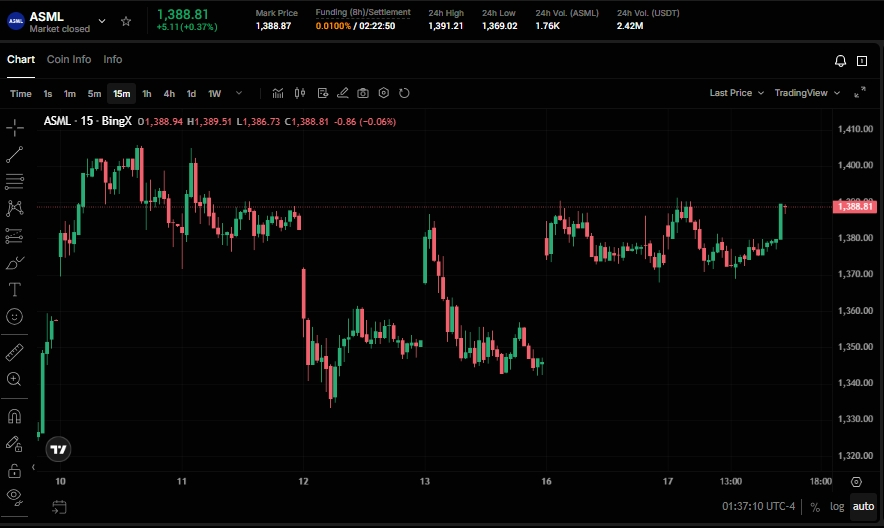
ASML stock perpetual contract on the futures market
For traders looking to hedge against geopolitical shocks or capitalize on earnings volatility, BingX TradFi provides professional-grade futures instruments with flexible leverage.
- Access TradFi: Enter the BingX TradFi portal and search for ASML perpetual contract under the Stocks category.
- Directional Play: If TSMC confirms a High-NA order acceleration, a Long position allows you to maximize gains. Conversely, if export controls tighten, Shorting ASML futures can protect your spot portfolio.
- Risk Management: Utilize the BingX AI-Powered Stop-Loss to automatically adjust your exit point based on Average True Range (ATR) forecasts.
- Leverage with Caution: While futures allow for capital efficiency, the high 1.43 Beta of ASML means volatility is significant; keep leverage modest, e.g., 3x–5x, to withstand intraday noise from molten tin light source updates.
5 Key Risks for ASML Stock Traders in 2026
While ASML’s market dominance is unrivaled, traders must navigate a high-stakes landscape of geopolitical gatekeeping, extreme engineering hurdles, and shifting capital expenditure cycles.
- The China Floor and Export Tightening: As of early 2026, ASML has guided for China to represent roughly 20% of total revenue, down from over 30% in previous years. Any further allied restrictions on mid-critical immersion DUV tools could break this floor, forcing ASML to find alternative buyers in a Western market that may already be saturated with capacity.
- High-NA Cost-to-Benefit Friction: While Intel has leaned into High-NA, TSMC, the world’s largest foundry, has historically been more conservative regarding the high price tag of approx. $350M+ per unit and the complexity of double-patterning alternatives. If TSMC delays mass adoption of High-NA until 2027 or 2028, ASML’s high-margin growth engine for 2026 could see a significant valuation de-rating.
- The 1,000W Reliability Threshold: The recent physics breakthrough involving doubling the speed of molten tin droplets is essential for high-volume manufacturing, but it introduces extreme mechanical stress. For traders, the risk is a fleet-wide reliability issue; if these high-power light sources face unplanned downtime in customer fabs, ASML’s Installed Base Management margins will be eaten up by warranty costs and service penalties.
- The Rise of EUV-Bypass Technologies: While ASML holds a monopoly today, the high cost of EUV is driving intense R&D into alternatives. Keep a close watch on U.S. startups like xLight (accelerator-based light sources) and Canon’s nanoimprint lithography (NIL); while they are not immediate threats to sub-2nm logic, any successful low-cost alternative for 3D NAND or DRAM could erode ASML’s long-term total addressable market (TAM).
- AI Capex Indigestion: By late 2026, the first massive wave of AI data center construction may reach a plateau. If Hyperscalers like Microsoft, Meta, and Amazon AWS pivot from aggressive build-out to utilization and optimization, the demand for the latest EUV-scanned chips could cool, leading to a cyclical breather that hits ASML's order bookings, the stock’s most sensitive metric.
Conclusion: Should You Invest in ASML Holding Stock in 2026?
ASML enters 2026 as a unique infrastructure monopoly, where its valuation is less a reflection of traditional consumer cycles and more a direct tax on the global AI build-out. For long-term investors, the transition to High-NA EUV and the 1,000W light source breakthrough provide a clear technological roadmap toward a €60 billion revenue target by 2030. The primary practical appeal lies in the company’s €38.8 billion backlog, which offers a rare earnings floor in a volatile semiconductor market. If you are seeking a high-conviction Quality play with structural pricing power and a massive €12 billion share buyback tailwind, ASML remains the premier institutional choice for exposure to sub-2nm logic and next-gen DRAM.
However, active traders must weigh this dominance against a 48x P/E premium and the intensifying China decoupling narrative. Success in trading ASML in 2026 requires disciplined entries near the $1,331 technical support level and a close watch on TSMC’s High-NA adoption timeline. While ASML is recession-proof in terms of its order book, its stock price remains sensitive to geopolitical shocks and shifts in hyperscaler capex. Investors should treat ASML as a core foundational holding, but one that requires a multi-year horizon to fully capture the margin expansion promised by the 1.4nm era.
Risk Reminder: All investments involve high risk. ASML is subject to stringent international export controls, geopolitical friction between the U.S. and China, and extreme engineering complexities. A failure to meet High-NA qualification milestones or a significant reduction in Chinese market access could lead to a material de-rating of the stock. Always use stop-losses and diversify your portfolio.
Related Reading
- Palantir (PLTR) Stock Outlook for 2026: Can AI-Driven Enterprise Supercycle Take PLTR to $235+?
- Oracle (ORCL) Stock Price Outlook for 2026: Can AI Cloud Infrastructure Take ORCL Back to Its Highs?
- Alphabet (GOOGL) Stock Outlook 2026: Can Gemini and Google Cloud AI Drive GOOGL Cross $420?
- Nvidia (NVDA) Stock Price Outlook for 2026: Can Blackwell and Vera Rubin Take NVDA Back to $300?
- Broadcom (AVGO) Stock Outlook for 2026: AI Infrastructure King or Margin Victim?