At the start of 2026, crude oil was the forgotten commodity, with the EIA and J.P. Morgan forecasting a structural oversupply that would drag prices toward $58/bbl. However, the appointment of hardliner Mojtaba Khamenei as Iran's Supreme Leader and the subsequent maritime blockade amid the US-Israel-Iran war have triggered the most significant supply shock since the 1970s. By March 9, Brent futures hit a session high of $119.50, forcing every institutional analyst to tear up their spreadsheets.
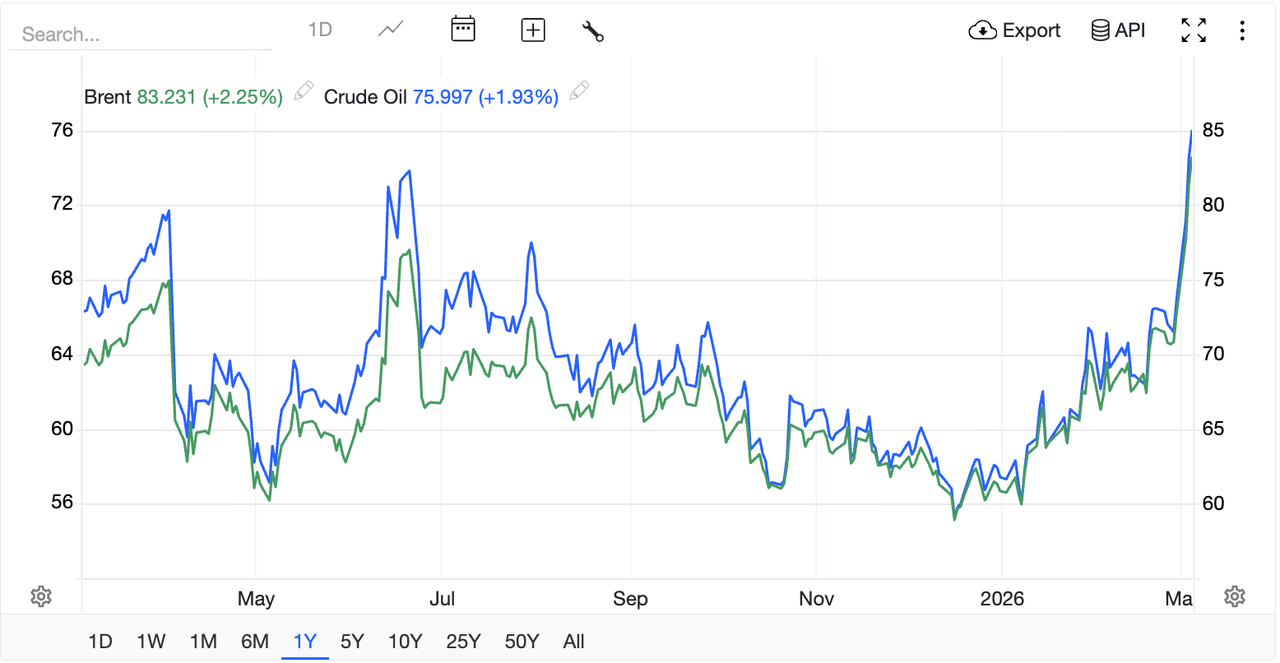
Brent and WTI prices surge on US-Israel-Iran war and Strait of Hormuz closure | Source: EBC Financial Group
The crude oil price forecast for 2026 has split into two parallel realities: the Physical Reality that global inventories are still building and the Geopolitical Reality that 20% of global supply is physically trapped. For traders, this creates a market defined by fat-tail risks and unprecedented intraday volatility.
This guide breaks down the oil price prediction for 2026 using real-time data from Goldman Sachs, J.P. Morgan, and Reuters, alongside analysis of the $90 Liquidity Void. You will also learn how to trade these moves using USDT-margined WTI and Brent oil perpetuals on BingX TradFi.
5 Key Highlights About Crude Oil Markets in March 2026
• Historic Surge: On March 9, 2026, WTI posted its biggest weekly gain in history of 35.6%, while Brent jumped to $108.20 following the Hormuz blockade.
• Hormuz Bottleneck: Roughly 20 million bpd of global oil production is at risk; Iraq and Kuwait have already cut output by 70% and declared force majeure due to storage exhaustion.
• The $100 Floor: J.P. Morgan notes that regime changes in oil nations historically trigger a 76% price spike, suggesting a new structural "war premium" is now in play.
• The $90 Gap: Technical structures show a massive liquidity void between $90–$95; a sudden ceasefire or G7 emergency reserve release could trigger a $20 flash crash.
• Advanced Risk Tools: Traders are utilizing Guaranteed Stop-Losses and VPC (Volume Price Confirmation) with BingX AI to navigate the extreme slippage common in $15 daily candle ranges.
What Is Crude Oil: WTI and Brent?
Crude oil is the world’s most essential industrial feedstock, refined into transportation fuels like gasoline, diesel, jet fuel and petrochemicals used in everything from plastics to fertilizers. Unlike Bitcoin, oil is a physical-first market where prices are governed by the Prompt Spread, the price difference between immediate physical delivery and future contracts.
In March 2026, this spread has entered Extreme Backwardation, where immediate barrels are trading at a record $14.20 premium over next-month futures. This screaming physical market indicates that buyers are desperate for any available tanker as the Strait of Hormuz blockade effectively traps 20% of global supply.
WTI vs. Brent Crude Oil: Choosing Your Benchmark to Trade
While both represent Light Sweet crude, they respond to different macroeconomic triggers. On BingX, choosing the right perpetual depends on which geopolitical or domestic data you are tracking:
| Feature | WTI (West Texas Intermediate) | Brent Crude |
| Origin | US-based (Cushing, Oklahoma) | North Sea (Global Benchmark) |
| Primary Driver | US Shale output and SPR releases | OPEC+ policy and Middle East stability |
| 2026 Context | Heavily influenced by Trump’s energy tariffs | Directly impacted by the Hormuz Blockade |
| Price Profile | Typically trades at a $4–$7 discount to Brent | The Global Standard for 80% of oil trades |
| Volatility | Lower; buffered by record Permian output | Extreme; carries the highest War Premium |
Practical Tip: In the current conflict as of March 2026, Brent is the superior instrument for trading military escalations. WTI is often used by traders looking for relative value entries, as it is less susceptible to immediate physical blockades in the Persian Gulf but follows Brent’s broader parabolic trend.
Crude Oil 2026 Outlook: The Energy Supercycle vs. The Surplus Baseline
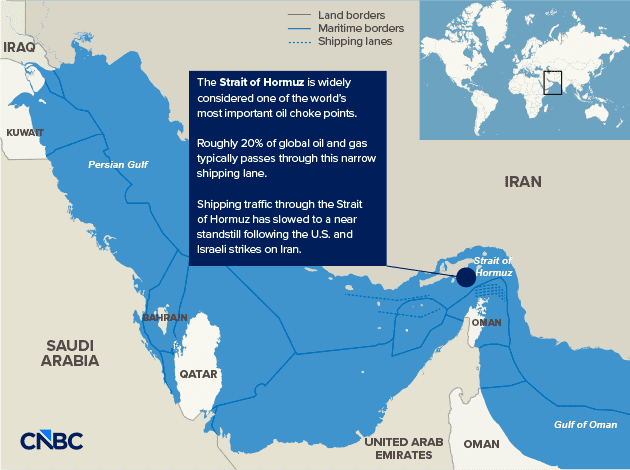
Why is Strait of Hormuz vital for oil prices? | Source: CNBC
Historically, oil moves in boom-bust cycles. The 2026 forecast is currently a tug-of-war between institutional bears and geopolitical bulls.
• The Pre-March Bearish Baseline: The IEA projected demand growth of only 930 kb/d, while supply growth led by the U.S. and Guyana was set to exceed it. This created a fair value estimate of $58–$60.
• The Geopolitical Black Swan in March: The closure of the Strait of Hormuz removed the buffer. When 20% of global oil cannot reach the market, the $60 baseline becomes irrelevant, replaced by a scarcity-driven parabolic regime.
Crude Oil Price Forecasts for 2026: Bull vs. Bear Outlook
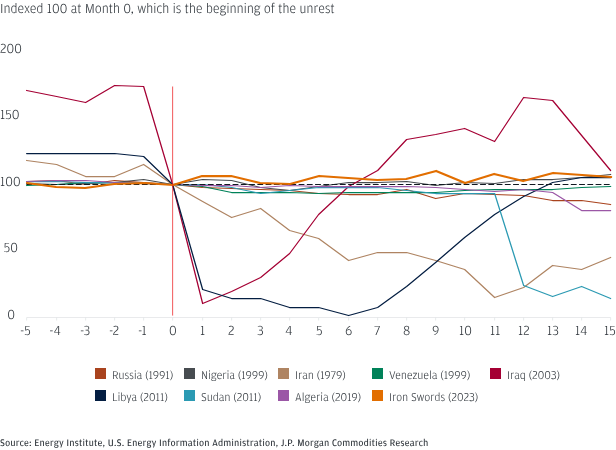
Historical impact of geopolitical tensions on crude oil production | Source: JP Morgan
Institutional forecasts have been hiked aggressively following the outbreak of the U.S.-Iran conflict.
| Institution | 2026 Crude Oil Price Target | Market Outlook |
| Rakuten Securities | $130 - $150/bbl | Super-Bullish: Predicts $150 if the Hormuz blockade lasts >4 weeks. |
| Goldman Sachs | $100 - $120/bbl | Bullish: Raised Q2 baseline to $76; $100+ is likely as global stocks drop. |
| Standard Chartered | $70 - $74/bbl | Cautious Bull: Hiked 2026 avg to $70; warns of "asymmetric upside risk." |
| J.P. Morgan | $110 - $120/bbl | Neutral/Bullish: Sees $60 as fair value but $120 as a conflict peak. |
| EIA (Annual Avg) | $58/bbl | Bearish: Maintains that structural surplus will eventually win. |
The Bull Case: The Hormuz Squeeze to $150
The bull narrative centers on Operational Disruption. Qatar's Energy Minister warned that if tankers cannot pass, Gulf exporters will halt production entirely within days. Standard Chartered confirms this trend, noting that Iraq has already shut in major fields like Rumaila as storage tanks hit capacity. If the UAE and Saudi Arabia are forced into shut-ins, the loss of 6 million bpd could become a structural deficit, catapulting Brent toward $140–$150/bbl. Furthermore, Standard Chartered highlights that supertanker freight rates to China have doubled to over $400,000 per day, making oil transit economically prohibitive even if the Strait is technically open.
The Bear Case: The SPR Mean-Reversion to $90
Conversely, Goldman Sachs and Reuters warn that triple-digit prices will trigger rapid demand destruction. Under this scenario, the current war premium is viewed as transitory. If the G7 coordinates a massive emergency reserve release and the U.S. Navy successfully implements President Trump's shipping insurance and escort program, the physical bottleneck could ease. This would likely lead to a violent liquidation of long positions on BingX, causing a rapid gap-fill toward the $90 liquidity void and a eventual return to the $70–$80 range.
How to Trade Crude Oil Futures with USDT on BingX TradFi
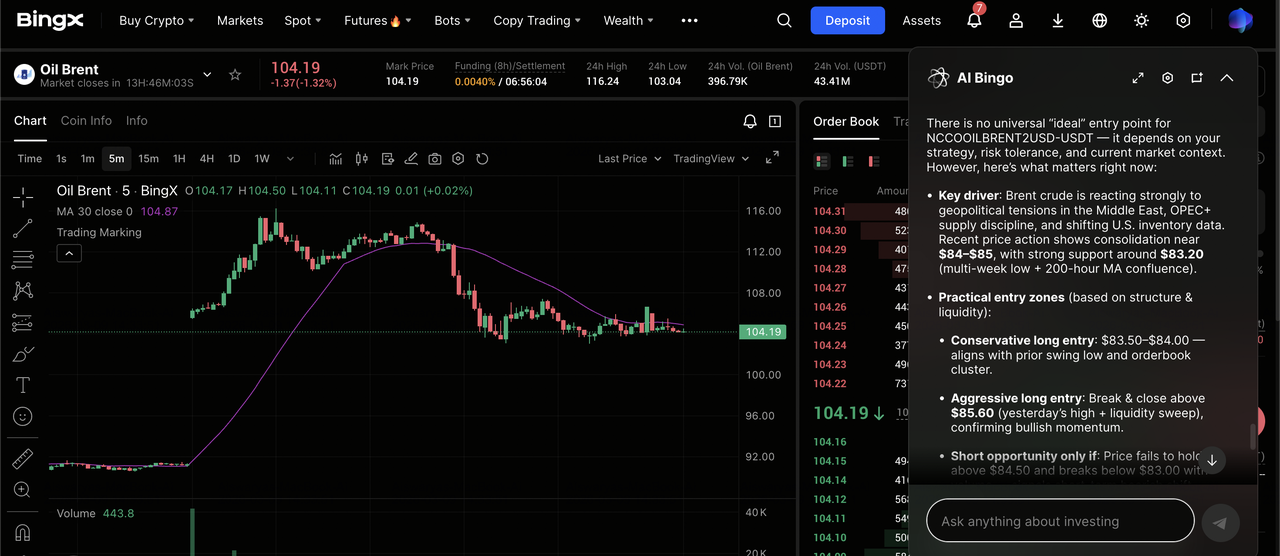
Brent oil perpetual contract on the futures market featuring BingX AI analysis
Trading crude oil on BingX allows you to gain exposure to global energy prices using your USDT balance as collateral, bypassing the need for traditional brokerage accounts or physical delivery.
1. Access the TradFi Market: Log in to your BingX account and navigate to the Wealth or TradFi section. From the market list, select either WTI/USDT or BRENT/USDT perpetuals.
2. Analyze the Prompt Spread: Before opening a position, check the current price action. In the high-volatility environment of March 2026, look for Backwardation, where the current price is higher than the future price, as this often signals a continuing supply squeeze.
3. Choose Your Leverage: Select your leverage carefully. While BingX offers higher tiers, the current $10–$15 daily price swings in oil make 2x–5x leverage the standard for professional risk management.
4. Set Gap-Resistant Orders: Use Limit Orders to ensure you enter at your desired price. Because oil markets gap over weekends, always set a Guaranteed Stop-Loss and a Take-Profit level immediately upon opening the trade to protect your collateral from sudden Monday morning re-openings.
5. Monitor and Execute: Track your position in real-time. Given the current Hormuz crisis, stay alert for news on tanker throughput or SPR releases, as these headlines can trigger instant $5–$10 reversals.
5 Key Risks for Oil Traders Watch in 2026
Successful oil trading in 2026 requires transitioning from a crypto-only mindset to understanding the unique structural hazards of the global energy market.
1. The Sunday Gap Liquidity Trap: Unlike crypto’s 24/7 cycle, oil markets close on Friday and reopen Sunday night (UTC). In March 2026, weekend escalations in the Middle East have caused Monday morning gaps of $10–$18 per barrel. If your stop-loss is triggered by a gap, it may execute at a significantly worse price than intended, leading to larger-than-expected losses.
2. Strategic Petroleum Reserve (SPR) Short Signals: The U.S. administration frequently uses SPR releases as a psychological and physical tool to cap price rallies. Any headline regarding a multi-million barrel release is a high-probability sell signal that can instantly stall a bullish breakout, regardless of the conflict's intensity.
3. Hormuz Re-opening and The Flash Crash: The current $110+ price is heavily supported by a fear premium. The moment a maritime safe corridor or a ceasefire is confirmed, this premium will evaporate; technical models suggest an immediate 15% correction to fill the $90 liquidity void within a single trading session.
4. Hardline Regime Continuity: The appointment of Mojtaba Khamenei in Tehran has signaled to markets that a diplomatic thaw is off the table. Traders should treat any rumors of rapid peace talks with skepticism, as the current Iranian leadership is incentivized to maintain high prices to fund their defensive posture.
5. Force Majeure and Shut-in Cascades: As Iraq and Kuwait hit 100% storage capacity, they are forced to declare force majeure, legally canceling deliveries. Watch for well shut-ins; if production facilities are physically turned off, they cannot be restarted instantly once the war ends, which could keep prices structurally high even after a peace deal is reached.
Conclusion: Is Crude Oil a Buy in 2026?
Determining if crude oil is a buy in 2026 requires distinguishing between a short-term tactical trade and a long-term investment. In the immediate term, the market is a high-conviction volatility play driven by the Hormuz blockade; as long as shipping remains paralyzed, the path of least resistance for Brent is toward the $120–$140 range. However, for those with a longer horizon, the structural surplus forecasted by the IEA and EIA suggests that once the war premium dissipates, prices are likely to gravitate back toward the $60 baseline. For BingX traders, the most practical approach is agility: prioritizing momentum-based entries during military escalations while maintaining the readiness to pivot if U.S. SPR releases or diplomatic breakthroughs signal a mean-reversion toward the $90 liquidity gap.
The successful trader in this environment must operate with a risk-first mindset. Unlike the relatively steady climbs seen in 2025, the 2026 market is defined by nonlinear moves, vertical spikes followed by violent corrections. While the current scarcity narrative is dominant, the emergence of secondary supply and industrial demand destruction at triple-digit prices will eventually cap the upside. The 2026 trade is not about buying and holding for the year, but about capturing the asymmetric volatility created by the Persian Gulf crisis while utilizing strict capital preservation techniques to survive the inevitable price gaps at each session open.
Risk Reminder: Trading crude oil perpetuals involves an extremely high level of risk. The War Premium is sentiment-driven and can evaporate instantly with a single headline. The use of leverage can result in the rapid loss of your entire collateral. Never trade more than you can afford to lose and always utilize stop-loss orders to manage your exposure.
Related Reading
1. How to Trade Crude Oil Futures Using Crypto: A Complete Beginner’s Guide (2026)
2. How to Trade Forex, Commodities, Stocks, and Indices With BingX TradFi: A Beginner’s Guide (2026)
3. How to Trade Commodities With Crypto in 2026 as Oil, Gold, Silver, and TradFi Go On-Chain
4. What Is TradFi (Traditional Finance) On-Chain: A Beginner's Guide
5. WTI and Brent Crude Oil Surge Over 20%: Will the $90 Gap Fill Before a $140 Spike?