


Arista Networks (ANET) reported second-quarter results on August 4, 2026 that beat the supplied revenue and earnings estimates. Its latest completed-session close was $193.18 on August 18, down 4.28% for the session. Revenue reached $3.0357 billion, up 12.1% sequentially and 37.7% year over year, while non-GAAP diluted EPS was $1.02. Management guided Q3 revenue to about $3.3 billion, non-GAAP operating margin to 48% to 49% and non-GAAP EPS to $1.06 to $1.08.
The results were not the problem. Arista paired its first revenue quarter above $3 billion with a 49.9% non-GAAP operating margin, but investors still have to judge the durability of cloud and AI fabric spending. Its new 1.6 Tbps AI fabric platforms broaden the opportunity while increasing the importance of customer deployment timing, supply execution and competition.
The ANET stock forecast for 2026 now centers on two competing views:
- The AI-fabric conversion case: Revenue growth, the Q3 guide and new 1.6 Tbps platforms indicate that higher-bandwidth AI networks can expand Arista's revenue pool while preserving a high operating-margin profile, supporting the $289 Barclays target if shipments and customer deployments keep scaling.
- The concentration-and-multiple case: A premium networking valuation can reset even with healthy reported growth if a small set of cloud customers moderates orders, inventory rises faster than shipments or the market applies a lower multiple to a less predictable infrastructure cycle.
This guide breaks down the ANET stock forecast, 2026 price scenarios, key risks, and research from Barclays, Rosenblatt, Needham, UBS, Wells Fargo, TD Cowen and Morgan Stanley, drawing on the August 4, 2026 second-quarter release, plus how to trade ANET stock futures on BingX TradFi with USDT collateral.
Top 5 Things for Arista Networks Investors to Know in August 2026
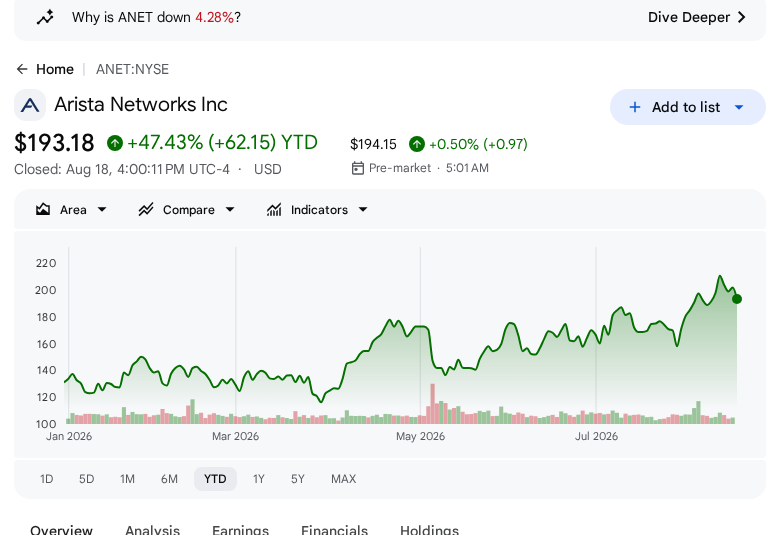
- Q2 revenue reached $3.04 billion, up 37.7% year over year. Arista crossed the $3 billion quarterly revenue mark while also growing 12.1% from Q1. The next test is whether the roughly $3.3 billion Q3 revenue guide can turn that acceleration into a sustained run rate.
- Non-GAAP EPS of $1.02 beat the $0.886 estimate. GAAP diluted EPS also reached $0.95, showing that profitability remained strong as revenue moved above $3 billion. The key question is whether earnings can keep pace as the company continues scaling.
- Non-GAAP operating margin reached 49.9%. GAAP operating margin was 45.4%, up from 44.7% a year earlier. Investors should watch whether the Q3 non-GAAP margin guide of 48% to 49% can preserve this level of operating leverage.
- Q3 guidance points to another quarter of strong growth. Management expects about $3.3 billion in revenue and non-GAAP EPS of $1.06 to $1.08. Delivering within these ranges would strengthen the case that AI networking demand remains durable.
- Analyst price targets now range from $220 to $289. Seven August analyst actions raised targets after Q2, but the wide spread shows that Wall Street still disagrees on how much AI networking growth is already priced in. With ANET closing at $193.18 on August 18, the main debate is now about how long this growth cycle can last.
What Is Arista Networks (ANET)?
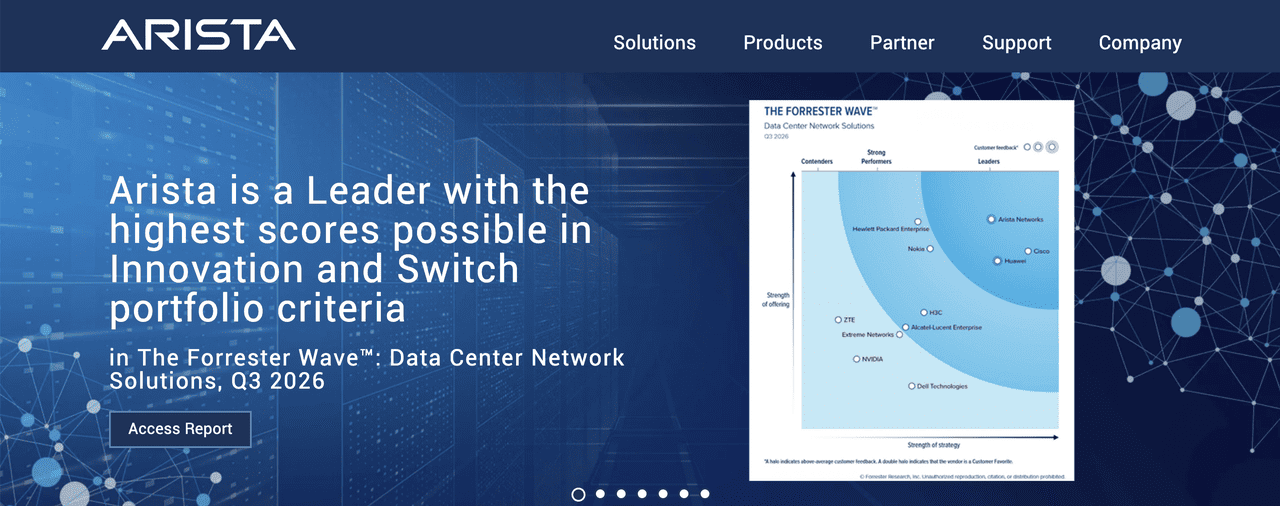
Arista Networks is a AI networking company that builds high-speed switches, routers, and software for large cloud, AI, data center, campus, and routing environments. Its technology helps connect servers, GPUs, and storage systems across high-performance networks, with Ethernet-based infrastructure and its EOS operating system at the center of the platform. In Q2, product revenue reached $2.61 billion and service revenue was $430.5 million, showing that hardware remains the main revenue driver.
The growth story now depends on whether Arista can keep capturing spending as AI clusters require faster and more complex network fabrics. The company is expanding into 800G and 1.6-terabit systems, including its 7060XE7 platforms and liquid-cooled configurations designed for AI environments. Arista also ended June with about $2.29 billion in cash, $11.05 billion in marketable securities, and $2.54 billion in inventory. For investors, the key question is whether AI networking demand can sustain strong growth and margins while inventory, customer spending, and competition remain important signals to watch.
Read More: Top AI Networking Stocks 2026: AI Fabric, Switches, Copper, Fiber, and Optics Connectivity
Arista Networks (ANET) Q2 2026 Earnings: What Drove AI-Fabric Growth and the Valuation Debate
- Revenue crossed $3 billion with strong sequential growth. Q2 revenue reached $3.04 billion, up 37.7% year over year and 12.1% from Q1, beating the supplied $2.83 billion estimate. The result showed that growth was not coming only from an easy year-over-year comparison.
- Product demand remained the main growth engine. Product revenue reached $2.61 billion, while service revenue contributed $430.5 million. That mix keeps Arista closely tied to the timing of cloud and AI infrastructure deployments, since changes in customer build schedules can quickly affect hardware shipments.
- Operating margins stayed near 50%. GAAP operating margin reached 45.4%, while non-GAAP operating margin was 49.9%, both above year-ago levels. The next test is whether Arista can keep non-GAAP margins within its 48% to 49% Q3 guidance range as revenue continues to scale.
- Q3 guidance keeps the growth test elevated. Management guided to about $3.3 billion in revenue and non-GAAP EPS of $1.06 to $1.08. Delivering within those ranges would strengthen the case that current AI-networking demand can continue beyond a single strong quarter.
- New 1.6-terabit platforms expand Arista’s AI opportunity. The company introduced AI-fabric systems including liquid-cooled 7060XE7 platforms designed for scale-up, scale-out, and scale-across networks. Their adoption could support higher-value deployments, but execution now depends on customer upgrades, supply availability, and the pace of new AI data center builds.
Arista Networks Q2 2026 Financial and Consensus Profile: Revenue, EPS and Margins
Arista's Q2 print showed a revenue and earnings beat, with Q3 now testing whether AI-networking demand can remain highly profitable.
|
Financial Metric |
Guidance / Consensus |
Reported / Actual |
Surprise |
|
Q2 2026 Revenue |
$2.83028 billion estimate |
$3.0357 billion |
Beat. Up 37.7% year over year |
|
Q2 2026 Product Revenue |
Not reported |
$2.6052 billion |
Primary growth engine |
|
Q2 2026 Operating Margin |
Not reported |
45.4% GAAP; 49.9% non-GAAP |
Margin expansion year over year |
|
Q2 2026 Diluted EPS |
$0.886 estimate |
$0.95 GAAP; $1.02 non-GAAP |
Beat. Non-GAAP result above estimate |
|
Q3 2026 Revenue Guide |
Not reported |
About $3.3 billion |
Next confirmation point |
|
Q3 2026 Non-GAAP EPS Guide |
Not reported |
$1.06 to $1.08 |
Forward profitability guide |
Q2 GAAP net income was $1.2129 billion and non-GAAP net income was $1.3017 billion. Inventory of $2.5353 billion makes the next report a test of whether stock is converting into demand-backed shipments while revenue and margin meet the stated guide.
Arista Networks (ANET) 2026 Investment Outlook: $289 Bull Case vs. $164 Bear Case
Arista's outlook for the rest of 2026 depends on one central question: whether Q2 growth and the Q3 guide prove a durable, high-margin AI-networking buildout, or whether the market begins to price a less predictable hyperscaler deployment cycle.
The Bull Case: AI Fabric Adoption Pushes ANET Toward $289
The bull case starts with Arista’s strongest operating signals: its first $3 billion revenue quarter, 37.7% year-over-year growth and a 49.9% non-GAAP operating margin. The launch of 1.6 Tbps AI fabric platforms, including liquid-cooled configurations, gives the company another product cycle to capture as hyperscalers and enterprises build larger AI clusters and require faster network fabrics.
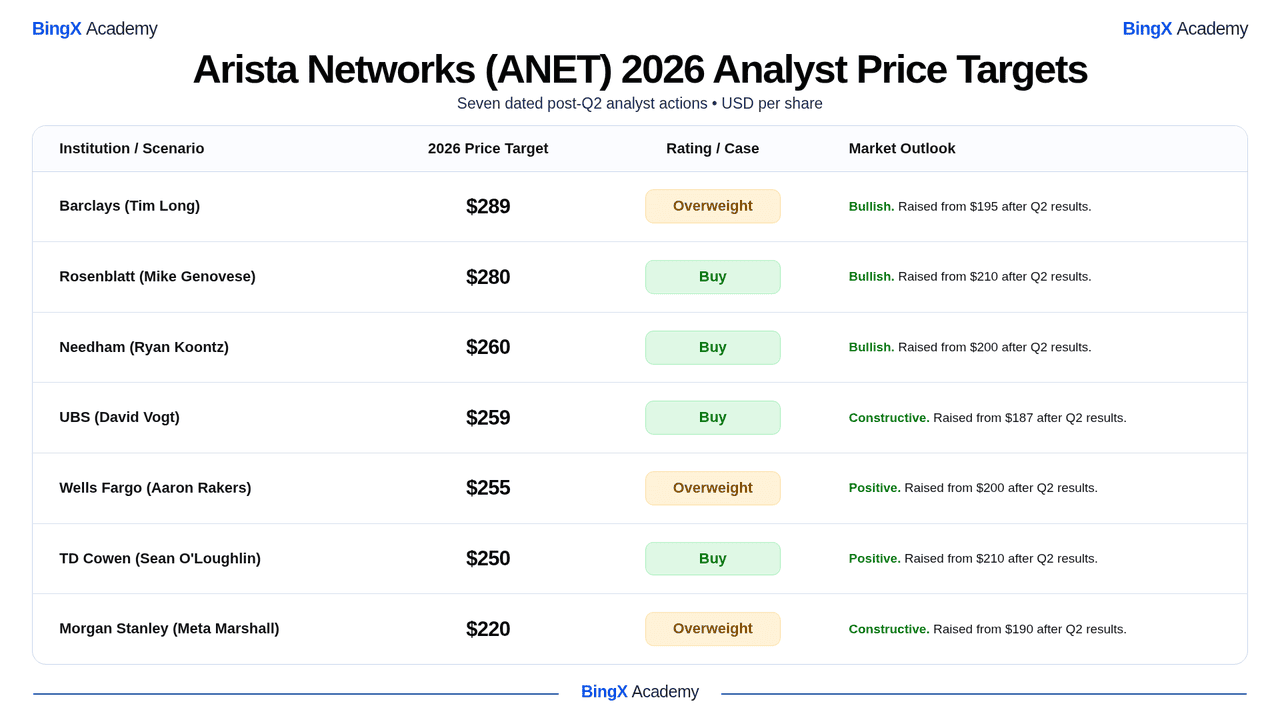
For this scenario to hold, Q3 revenue needs to land near the roughly $3.3 billion guide, with non-GAAP operating margin staying within the 48% to 49% range and new AI platforms moving from launch into meaningful customer deployments. Barclays analyst Tim Long’s $289 target, raised from $195 on August 5, provides an external reference point rather than an article prediction. The bull case weakens if customer deployment timing slips, inventory builds without matching shipments, or margin pressure breaks the link between strong platform demand and earnings growth.
The Base Case: Strong Growth and Valuation Discipline Keep ANET Between $220 and $250
The base case assumes Arista continues to grow at a strong pace but needs several more quarters of execution before the market supports a materially higher valuation. The Q3 revenue and margin guide still point to expansion, yet purchase timing, product transitions, cloud spending cycles and changing AI capital-expenditure expectations can limit how quickly the stock rerates.
Morgan Stanley’s $220 target and TD Cowen’s $250 target provide useful reference points for this range rather than a consensus calculation or price promise. The base case assumes revenue remains close to management’s guide, margins stay near plan and AI-fabric adoption progresses without a major acceleration or slowdown. It would be invalidated by a meaningful guide cut, weaker customer spending, or, on the upside, faster earnings growth and stronger 1.6 Tbps adoption that justify moving the valuation closer to the bull case.
The Bear Case: Customer Timing and Multiple Compression Pull ANET Toward $164
The bear case does not require AI-networking demand to collapse. It requires a break between the growth narrative and reported shipments through a delayed deployment, weaker orders or margin pressure. Because product revenue drives the quarter, a pause in high-value platform shipments could quickly affect sentiment.
The $164 area is an article-authored bear scenario, not a Wall Street target or technical forecast. It uses a lower multiple on slower growth and cites MarketBeat's aggregate low only as a risk reference. A material Q3 miss or guide reduction would confirm it. It is invalidated if Arista meets or exceeds Q3 guidance while sustaining margins and converting inventory into shipments.
ANET Stock Price Forecasts for 2026 By Wall Street Analysts
All seven retained post-Q2 actions raised targets, but the $220 to $289 dispersion still reflects different assumptions about the duration and valuation of AI-networking demand. These are dated, named third-party actions and are separate from the article's Bull, Base and Bear scenarios.
|
Institution / Scenario |
2026 Price Target |
Rating / Case |
Market Outlook |
|
Barclays (Tim Long) |
$289 |
Overweight |
Bullish. Raised from $195 after Q2 results. |
|
Rosenblatt (Mike Genovese) |
$280 |
Buy |
Bullish. Raised from $210 after Q2 results. |
|
Needham (Ryan Koontz) |
$260 |
Buy |
Bullish. Raised from $200 after Q2 results. |
|
UBS (David Vogt) |
$259 |
Buy |
Constructive. Raised from $187 after Q2 results. |
|
Wells Fargo (Aaron Rakers) |
$255 |
Overweight |
Positive. Raised from $200 after Q2 results. |
|
TD Cowen (Sean O'Loughlin) |
$250 |
Buy |
Positive. Raised from $210 after Q2 results. |
|
Morgan Stanley (Meta Marshall) |
$220 |
Overweight |
Constructive. Raised from $190 after Q2 results. |
How to Trade Arista Networks (ANET) Stock on BingX
Navigate the volatility of Arista Networks' earnings cycle using BingX TradFi and BingX AI tools. ANET-USDT is a TradFi perpetual derivative, not a share purchase or ownership interest. It can permit long or short exposure with USDT collateral, but leverage, funding charges and liquidation can magnify losses.
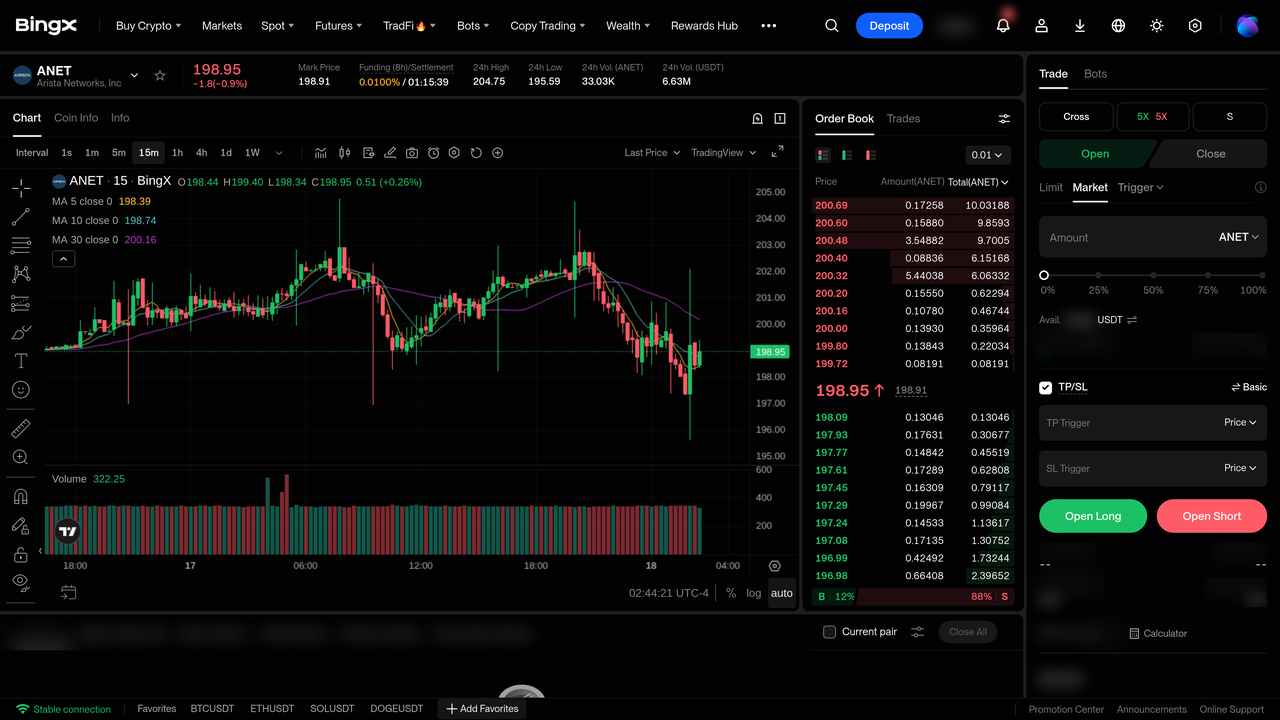
Step 1: Access BingX TradFi.Sign up and navigate to the specialized TradFi section on the BingX exchange dashboard. Complete any KYC requirements applicable in your region and enable two-factor authentication before funding a trading account.
Step 2: Select Arista Networks (ANET). Transfer or deposit USDT to the relevant account, then search for and select the ANET-USDT perpetual futures contract. Confirm the visible instrument before entering an order.
Step 3: Choose your direction. Select Open Long only if Q3 revenue, margin and shipment evidence confirm the AI-fabric conversion case. Select Open Short only if customer timing, a revenue-guide miss or margin pressure confirms the bear conditions described above. A directional position should be tied to those observable conditions rather than to a target alone.
Step 4: Select leverage and margin mode. Choose Isolated or Cross-Margin based on risk tolerance, and use conservative leverage and position sizing. ANET closed down 4.28% on August 18, showing why a completed-session move can matter even after a strong reported quarter.
Step 5: Execute strict risk protocols. Set Take-Profit and Stop-Loss (TP/SL) levels before or immediately after entering the trade. ANET can react quickly to earnings, guidance, hyperscaler spending expectations, platform ramps and changes in the AI-infrastructure valuation environment.
Top 5 Risks to Watch for Arista Networks Investors in 2026
Arista’s AI-networking growth and high-margin model remain strong, but investors should also watch five risks that could affect the second half of 2026.
- Inventory remains elevated at $2.54 billion. The inventory can support future deliveries, but it could become a working-capital risk if AI or cloud deployment schedules slow. The key signal is whether shipments convert inventory in line with Q3 guidance.
- Operating margins may come under pressure. Arista guided Q3 non-GAAP operating margin to 48% to 49%, below the 49.9% reported in Q2. A result near the lower end could matter more if revenue growth also begins to moderate.
- Product-heavy revenue increases exposure to deployment timing. Product revenue reached $2.61 billion in Q2, making hardware the clear growth engine. Delays in large AI or cloud projects can therefore affect reported revenue quickly.
- New 1.6-terabit platforms still need customer adoption. Arista’s latest AI networking systems expand the opportunity, but revenue depends on customer ramps, supply availability, and successful deployment at scale.
- Analyst targets remain widely dispersed. The seven retained targets range from $220 to $289, a $69 spread that reflects disagreement over how much AI growth and valuation upside remain. That uncertainty can amplify reactions to guidance, margins, and cloud spending.
Final Thoughts: Should You Invest in Arista Networks in 2026?
Arista enters the rest of 2026 with strong momentum after its first $3 billion revenue quarter, 37.7% year-over-year growth, and operating margins near 50%. The main question is whether AI networking demand, customer deployment schedules, and the new 1.6 Tbps product cycle can keep supporting that growth at a premium valuation.
The bull case depends on Q3 revenue reaching about $3.3 billion, non-GAAP operating margin holding near 48% to 49%, and successful adoption of Arista’s latest AI networking platforms. The bear case is that slower customer deployments, weaker inventory conversion, or margin pressure reveal a more cyclical growth path. The next major confirmation points are Q3 revenue, EPS, margins, and inventory trends.
Risk Reminder: ANET scenarios are conditional research estimates, not investment advice or guaranteed returns. Arista is exposed to AI and cloud spending cycles, product-ramp execution, inventory risk, margin pressure, and valuation changes. Investors should review current results and assumptions independently before taking risk.
Related Reading
- Top AI Networking Stocks 2026: AI Fabric, Switches, Copper, Fiber, and Optics Connectivity
- Top AI Optical Stocks to Buy in 2026: Photonics, Optics, Fiber, and Data Center Interconnects
- Top AI Data Center Stocks to Buy in 2026: Cloud, Servers, and AI Compute Infrastructure
- Top AI Server Stocks to Buy in 2026: Rack-Scale Systems, GPU Servers, and AI Servers Infrastructure
- Top AI Compute and GPU Stocks to Buy in 2026: The Shift to Inference and Custom Silicon
- Top AI Cloud Infrastructure Stocks to Buy in 2026 Amid Hyperscaler Capex and the Neocloud Boom
- Top 10 AI Infrastructure Stocks to Buy in 2026: Chip Manufacturing and Design Leaders
