



NVIDIA (NVDA) develops GPUs, CPUs, networking systems and software for cloud providers, enterprises, gamers and industrial customers. Its CUDA ecosystem supports accelerated computing, while Vera Rubin expands the opportunity across AI training, inference and complete data-center systems. Leadership continuity after Jensen Huang’s departure, overseas export approvals and customer cash generation now determine whether AI growth supports shareholder returns.
The latest quarter showed accelerating AI infrastructure sales while product transitions continued pressuring margins. NVIDIA Q3 FY2027 revenue reached $115.8 billion, up 103%, with Data Center sales increasing 110%. GAAP diluted EPS reached $2.70, while gross margin eased to 74.8% from 75.0% sequentially. The next test is whether Rubin deliveries support higher revenue without sacrificing profitability or extending customer-payment cycles.
The NVDA stock forecast for 2026 now centers on two competing views:
- The Rubin and leadership-continuity case: Strong customer deployments, credible succession and workable export approvals could preserve cash generation while reducing the valuation discount following Huang’s departure.
- The export and oversight pressure case: Licensing delays and anticipated post-midterm investigations could weaken overseas growth expectations, particularly if succession uncertainty damages customer confidence or compliance credibility.
This guide breaks down the NVDA stock forecast, 2026 price scenarios, key risks and analyst outlooks, drawing on NVIDIA’s November 17 release, CFO commentary, BIS rules, election reporting and November 17 market data, plus how to buy NVDA Stocks on BingX TradFi with USDT or USDC.
Top 5 Things for NVIDIA Investors to Know in November 2026
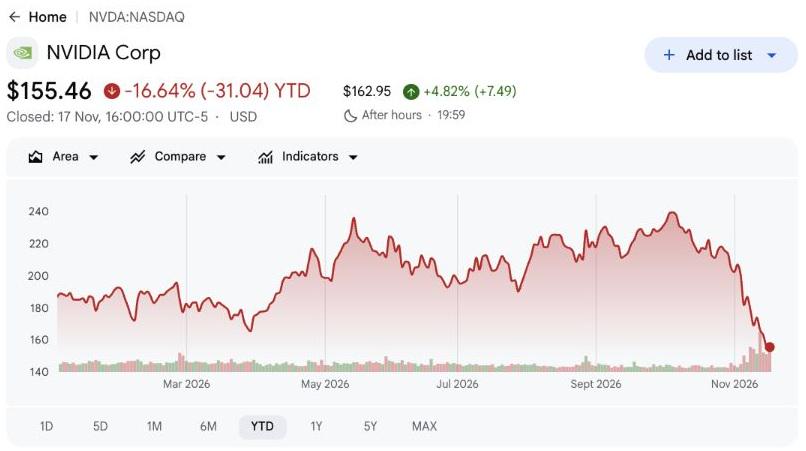
- NVDA closed at $155.46 on November 17, down 16.64% YTD: Shares remain below their opening-year level, making the $200 bull scenario dependent on more than strong earnings. Continued recovery requires Rubin growth to rebuild confidence after Huang’s departure while overseas licensing and succession risks remain unresolved.
- Q3 revenue rose to $115.8 billion from $57.0 billion a year earlier: Sales also increased from $96.2 billion in Q2, showing sequential expansion. Within that result, Data Center supplied most revenue, making customer infrastructure spending more important than a recovery across every end market.
- Data Center revenue reached $107.6 billion as Rubin shipments expanded: Q3 sales increased 21% sequentially, with racks running at CoreWeave, Google Cloud and Microsoft Azure. Customer acceptance, payment collection and production costs will determine how much of that scale translates into sustainable cash returns.
- New export controls extend licensing to five countries: The rule covers Indonesia, Malaysia, Singapore, Thailand and Brazil, with publication and effectiveness scheduled for November 19. Qualifying U.S.-headquartered end users may use a reporting-based exception, but licensing delays could still disrupt overseas deployments.
- Huang’s exit and the midterms raise governance risk: Colette Kress became interim CEO on November 12, while Democrats won both chambers of Congress. The January 2027 oversight shift and succession process could influence customer confidence, compliance costs and the valuation of future cash returns.
What Is NVIDIA (NVDA)?
NVIDIA is a semiconductor and computing-platform company headquartered in Santa Clara, California, serving cloud providers, enterprises, developers and consumers. Its integrated approach combines processors, interconnects, software and complete systems to accelerate demanding workloads rather than supplying a single interchangeable chip. CUDA, GeForce graphics, data-center infrastructure and edge-computing platforms support AI development, gaming, scientific computing and industrial applications. The company generates revenue from computing products, systems and related software services, with Data Center supplying approximately 93% of Q3 sales.
NVIDIA’s growth strategy focuses on scaling Vera Rubin systems, expanding Vera CPUs and increasing AI training and inference adoption. Its November 17 results identified Rubin racks running at CoreWeave, Google Cloud, Microsoft Azure and Oracle Cloud Infrastructure, demonstrating deployed customer systems. Following Huang’s November 12 resignation, interim CEO Colette Kress must sustain that roadmap while the board’s new National Security and Export Control Oversight Committee strengthens compliance oversight. With Q3 Data Center revenue reaching $107.6 billion, customer execution and credible regulatory controls will determine whether growth produces durable cash returns.
Read More: AMD vs. Nvidia Comparison 2026: Which AI Computing Stock Is the Better Buy?
NVIDIA (NVDA) Q3 FY2027 Earnings Overview: AI Infrastructure Growth Drives 115% Operating Profit Increase
NVIDIA reported Q3 FY2027 revenue of $115.8 billion, up 103% year over year and 20% sequentially, driven primarily by $107.6 billion in Data Center sales. GAAP operating income increased 115% to $77.5 billion, while gross margin declined 0.2 percentage points sequentially to 74.8% as the initial Rubin ramp affected product economics. With Q4 revenue guided to $130 billion, plus or minus 3%, and gross margin expected at 71%–72%, sustaining earnings growth will depend on infrastructure deliveries, cost management, and cash generation.
Read More: NVIDIA Q3 2027 Earnings Overview: Data Center Sales Surge 110% as CEO Transition Raises Uncertainty
|
Financial Metric |
Guidance / Consensus |
Reported / Actual |
Surprise |
|
Revenue |
$57.0B Q3 FY2026 |
$115.8B |
Expanded. Up 103% YoY. |
|
Data Center revenue |
$51.2B Q3 FY2026 |
$107.6B |
Expanded. Up 110% YoY. |
|
GAAP diluted EPS |
$1.30 Q3 FY2026 |
$2.70 |
Improved. Up 108% YoY. |
|
Non-GAAP diluted EPS |
$1.27 Q3 FY2026 |
$2.68 |
Improved. Up 111% YoY. |
|
GAAP gross margin |
75.0% Q2 FY2027 |
74.80% |
Lower. Down 0.2 percentage points. |
|
GAAP operating income |
$36.0B Q3 FY2026 |
$77.5B |
Improved. Up 115% YoY. |
|
Operating cash flow |
$23.8B Q3 FY2026 |
$48.3B |
Improved. About twice the prior-year amount. |
|
Q4 revenue guidance |
$115.8B Q3 actual |
$130B ±3% |
Outlook. Includes an additional reporting week. |
|
Q4 gross-margin guidance |
74.8% Q3 GAAP |
71%–72% |
Lower. Below the Q3 margin. |
- Q3 revenue surged 103% to $115.8 billion. Revenue also increased 20% sequentially, driven by accelerating AI infrastructure shipments. Sustained cloud demand and enterprise AI adoption remain important to maintaining growth momentum.
- Data Center revenue jumped 110% to $107.6 billion. Rubin infrastructure, standalone Vera CPUs, and continued Blackwell Ultra growth supported performance. Expanding AI deployments could sustain demand, although higher production costs may pressure margins.
- GAAP operating income rose 115% to $77.5 billion. Operating expenses increased 57% to $9.2 billion, while gross margin eased slightly sequentially. Revenue growth strengthened profitability, but maintaining margins will be important as Rubin production scales.
- Supply commitments increased to $390 billion from $279 billion. The increase primarily reflects multi-year memory procurement agreements supporting future computing platforms. Securing critical components strengthens production capacity, although returns depend on sustained demand and profitable deliveries.
- Q4 revenue guidance reached $130 billion, plus or minus 3%. The outlook includes an additional reporting week and excludes Data Center compute revenue from China. Gross margin guidance of 71%–72% also signals potential near-term profitability pressure during the Rubin ramp.
NVIDIA (NVDA) 2026 Investment Outlook: $200 Bull Case vs. $130 Bear Case
NVIDIA's 2026 outlook depends on Rubin demand, leadership stability, and U.S. export restrictions. Its $130 billion Q4 revenue guidance supports AI infrastructure growth, while three developments could influence NVDA's valuation through December 31:
- Leadership uncertainty: Jensen Huang's departure and the transition under interim CEO Colette Kress could affect investor confidence.
- Export restrictions: The November 16 BIS rule expands licensing requirements for advanced chips and certain overseas data centers, potentially delaying deliveries.
- Regulatory scrutiny: Possible congressional investigations following the 2026 midterms could add uncertainty, although the new Congress begins in January 2027.
The Bull Case: Rubin Growth and Leadership Stability Push NVDA Toward $200
Continued Rubin deployments and a stable leadership transition could support NVIDIA's earnings growth and valuation recovery. Q3 Data Center revenue reached $107.6 billion, while operating cash flow totaled $48.3 billion. Effective leadership under interim CEO Colette Kress, combined with sustained cloud infrastructure demand, could preserve revenue momentum without relying on renewed direct China sales.
The $200 bull case assumes licensed overseas deployments proceed, NVIDIA maintains its $130 billion Q4 revenue outlook, and leadership uncertainty gradually eases. Strong customer commitments, improving regulatory clarity, and sustained cash generation could support a higher valuation multiple.
The Base Case: U.S.-Led AI Demand Keeps NVDA Between $150 and $175
Sustained U.S. AI infrastructure spending could support earnings growth, although overseas licensing restrictions and leadership uncertainty may limit valuation upside. NVIDIA projects $130 billion in Q4 revenue, with gross margin expected at 71%–72%. The base case assumes customer commitments remain intact despite additional compliance requirements and near-term margin pressure.
The 150–175 base case reflects continued Rubin adoption, resilient U.S. demand, and manageable export restrictions. Greater clarity on leadership succession and overseas approvals could support the upper end, while higher compliance costs or slower deployments may limit further gains.
The Bear Case: Export Delays and Leadership Risks Pull NVDA Toward $130
Broader export restrictions, delayed infrastructure deployments, or prolonged leadership uncertainty could weaken investor confidence and compress NVIDIA's valuation. Multi-year supply commitments increased to $390 billion, while accounts receivable reached approximately $81 billion. Slower customer payments or disruptions to overseas deployments could increase financial pressure despite strong reported revenue growth.
The $130 bear case assumes licensing delays threaten NVIDIA's Q4 revenue outlook while leadership uncertainty persists. Weaker cash conversion, higher compliance costs, or prolonged regulatory scrutiny could reduce earnings expectations and push investors toward a lower valuation multiple.
NVDA Stock Price Forecasts for 2026 By Wall Street Analysts
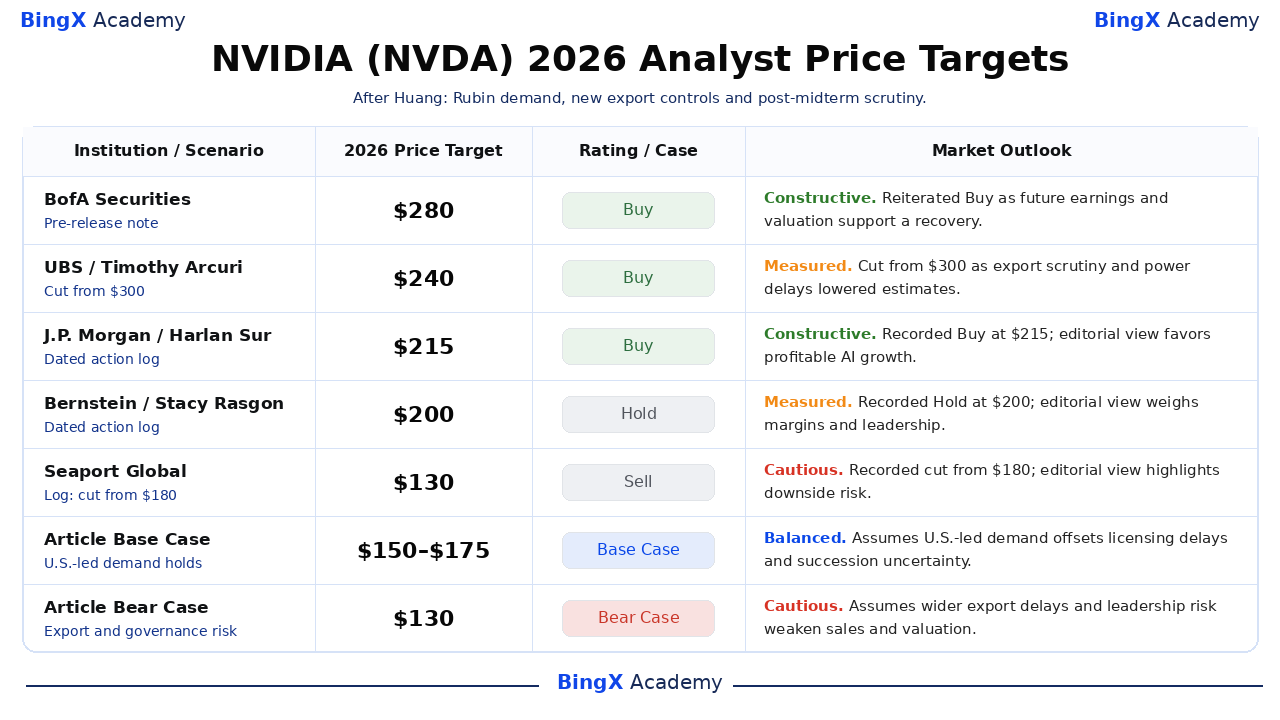
These named targets refer to Nasdaq-listed NVIDIA shares and generally cover roughly twelve months, extending beyond December 2026. The $130 to $280 spread reflects different views on growth, governance and valuation. Dated notes and action-log entries are not confirmed post-release revisions; the final two rows are separate article scenarios.
|
Institution / Scenario |
Price Target |
Rating / Case |
Market Outlook |
|
BofA Securities |
$280 |
Buy |
Constructive. Maintained November 16. Expects AI infrastructure growth and earnings recovery to support a higher valuation. |
|
UBS |
$240 |
Buy |
Measured. Cut from $300 on November 17. Export restrictions and infrastructure constraints weigh on growth expectations. |
|
J.P. Morgan |
$215 |
Buy |
Constructive. Maintained November 16. Continued AI demand supports growth, although policy risks remain. |
|
Bernstein |
$200 |
Hold |
Measured. Maintained November 17. Strong demand is balanced against leadership uncertainty and margin pressure. |
|
Seaport Global |
$130 |
Sell |
Cautious. Cut from $180, reported November 16–17. Export risks and valuation concerns support a cautious outlook. |
|
Article Base Case |
150–175 |
Base Case |
Balanced. Resilient U.S. AI demand offsets licensing delays and leadership uncertainty through December 2026. |
|
Article Bear Case |
$130 |
Bear Case |
Cautious. Export restrictions, weaker cash conversion, and leadership risks pressure NVDA's valuation. |
How to Buy NVIDIA (NVDA) Stock on BingX
Buy and hold NVIDIA shares through BingX Stocks Trading using USDT or USDC, subject to listing and account eligibility. NVIDIA offers exposure to AI computing, data-center infrastructure, graphics and accelerated-computing software. Eligible users can size holdings according to their investment goals without using leverage or paying perpetual funding fees.
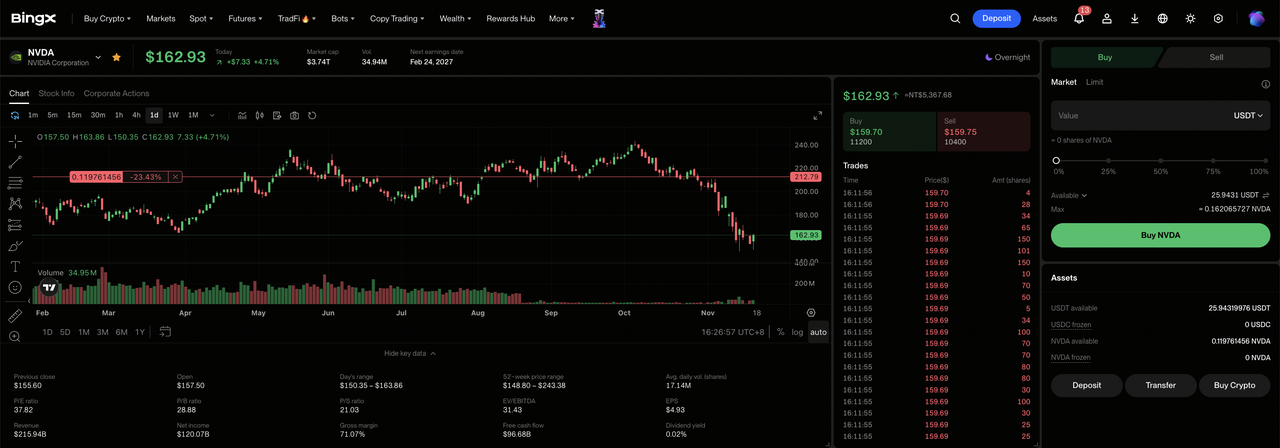
Step 1: Access BingX Stocks Trading. Sign up or log in to BingX, complete the required identity verification, and navigate to “TradFi > Stocks”. Accept the Stock Trading Risk Disclosure if accessing the product for the first time.
Step 2: Prepare USDT or USDC. Ensure your Spot Account has sufficient funds for the purchase. Transfer USDT or USDC from your Fund Account or Wealth Account if needed. Review the selected stock’s minimum order amount and fractional eligibility before choosing the investment size.
Step 3: Select NVIDIA (NVDA). Open the Stocks market, search for NVIDIA (NVDA), and confirm that the share is available to your account. Review the company identity, current share price, trading session and available order types.
Step 4: Buy NVIDIA Shares. Select “Buy”, enter an allowed investment amount or share quantity, and choose a supported market or limit order. Market orders use available prices during supported sessions, while limit orders require the specified price or better and sufficient liquidity to execute.
Step 5: Review and Manage Your Holdings. Open “Stocks > Positions” to monitor your NVDA shares and unrealized profit or loss. Use All Orders to review transactions or sell shares when needed. T+1 settlement generally affects when sale proceeds become withdrawable, rather than when purchased shares can be sold.
Top 5 Risks to Watch for NVIDIA Investors in 2026
NVIDIA's CUDA ecosystem, expanding Rubin platform, and strong operating cash flow support its earnings outlook. However, export restrictions, margin pressure, financial commitments, and leadership uncertainty could affect profitability, cash generation, and shareholder returns.
- Export restrictions could reduce revenue: The November 16 BIS rule expands licensing requirements across five countries and certain overseas remote-computing arrangements. Delayed approvals or restricted AI infrastructure deployments could weaken sales and cash generation.
- Lower gross margins could pressure profitability: Q4 gross margin guidance of 71%–72% is below Q3's 74.8%. Higher component costs and the Rubin ramp could weigh on earnings if revenue growth slows.
- Leadership uncertainty could disrupt growth: Jensen Huang's November 12 departure left Colette Kress as interim CEO while the board searches for a successor. A prolonged transition could affect customer confidence and future revenue visibility.
- Customer financing guarantees could limit cash returns: NVIDIA disclosed $118 billion in maximum gross guarantee exposure, with no payments made to date. Partner defaults or additional infrastructure funding could reduce cash available for shareholder returns.
- Post-midterm scrutiny could pressure valuation: Democrats will control both chambers of Congress beginning January 2027. Potential investigations, tighter export oversight, or higher compliance costs could weigh on investor confidence and NVDA's valuation.
Final Thoughts: Should You Invest in NVIDIA in 2026?
NVIDIA’s $115.8 billion in quarterly revenue and $48.3 billion in operating cash flow demonstrate substantial demand and cash generation across its computing platform. Rubin and Blackwell Ultra provide operating support, while established cloud relationships offer opportunities for further infrastructure sales. Sustaining that progress will depend on authorized market access, stable leadership and customer collections as supply commitments expand.
The $200 bull case assumes sustained Rubin demand, credible succession and workable overseas export approvals. The $150 to $175 base case reflects resilient orders with policy friction, while the $130 bear case accounts for wider restrictions and governance pressure. With NVDA closing at $155.46 on November 17, investors should watch whether business growth overcomes the discount attached to regulatory and leadership risk.
Risk Reminder: NVIDIA’s AI computing leadership does not eliminate investment risk. Export restrictions, succession setbacks, or financing losses could weaken earnings and shareholder returns. Investors should assess valuation, customer-payment performance, and their risk tolerance before buying NVDA shares.
Related Reading
- What Is BingX Stocks Trading? A Beginner's Guide to Trading U.S. Stocks and ETFs With Crypto
- Top 10 AI Infrastructure Stocks to Buy in 2026: Chip Manufacturing and Design Leaders
- Top AI Compute and GPU Stocks to Buy in 2026: The Shift to Inference and Custom Silicon
- Top AI Data Center Stocks to Buy in 2026: Cloud, Servers, and AI Compute Infrastructure
- AMD vs. Nvidia Comparison 2026: Which AI Computing Stock Is the Better Buy?
- AMD Price Prediction 2026: Can AI Growth Push AMD Toward $700?
