
Onsemi (ON) designs and manufactures power semiconductors, analog chips and image sensors for vehicles, industrial systems and energy infrastructure. Its silicon carbide and advanced power devices also address higher-density AI systems. More power content per application creates a larger opportunity, but factory utilization, long customer qualification and uneven automotive demand make the earnings recovery sensitive to shipment timing.
The latest quarter showed a power-led improvement rather than a broad recovery. Onsemi Q2 2026 revenue reached $1.6035 billion and non-GAAP EPS rose to $0.74, while Power Solutions revenue increased 19% year over year. Analog sales still declined. Q3 guidance calls for 40% to 42% non-GAAP gross margin, making factory utilization and the conversion of new power designs into shipments the next tests.
The ON stock forecast for 2026 now centers on two competing views:
- The AI power growth case: Larger power content, new customer platforms and recovering margins support higher earnings expectations.
- The uneven recovery case: Automotive and industrial softness, manufacturing costs and acquisition financing limit the valuation investors assign to future growth.
This guide breaks down the ON stock forecast, 2026 price scenarios, key risks and analyst outlooks, drawing on earnings, investor-day disclosures and October announcements, plus how to trade ON stock futures on BingX TradFi with USDT collateral.
Top 5 Things for onsemi Investors to Know in October 2026
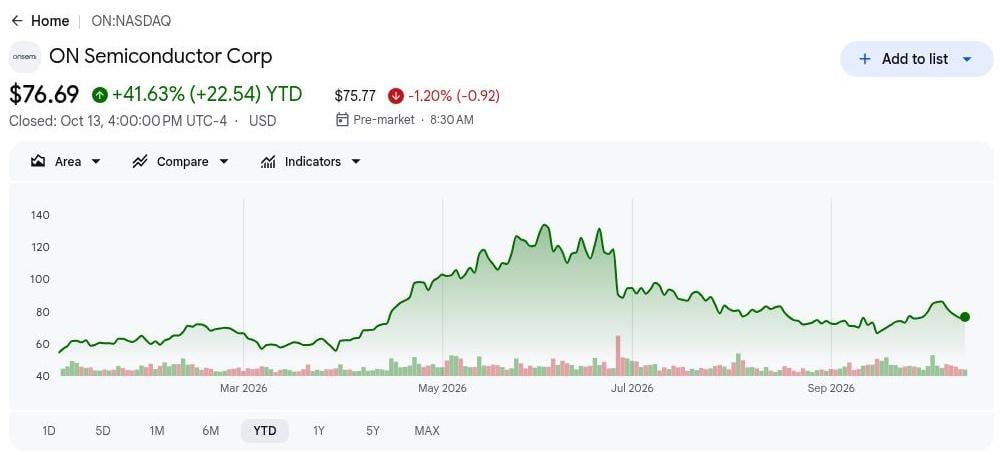
- A 41.63% YTD gain leaves ON dependent on earnings follow-through. The $76.69 October 13 close followed a retreat from summer levels visible in the chart. Sustained upside requires stronger profit expectations as AI power opportunities compete with concerns about the broader recovery.
- Q2 revenue rose 9% to $1.6035 billion. Non-GAAP EPS increased to $0.74 from $0.53 a year earlier. Both results exceeded management's guidance midpoints. Faster profit growth strengthens the recovery argument and raises the importance of delivering the next improvement in margins.
- Power Solutions revenue increased 19% year over year. The $829 million segment supplied the clearest reported growth engine. NVIDIA MGX participation adds AI infrastructure exposure beyond automotive electrification. Platform adoption must become sustained shipments before that opportunity can support a lasting valuation premium.
- Q3 gross-margin guidance moved to 40%–42%. Management projected 1.65billion–1.75 billion revenue and 0.81–0.93 non-GAAP EPS. Earnings depend on better product mix and manufacturing economics. Q3 results remained unreported at the October 14 cutoff, leaving these improvements prospective.
- Sungrow's 10 GWh delivery forecast adds a concrete energy-storage catalyst. On October 14, Sungrow adopted EliteSiC hybrid modules for PowerTitan 3.0, citing 0.4% better inverter efficiency. The European delivery estimate concerns Sungrow systems. The design win expands grid exposure without a disclosed onsemi dollar backlog.
What Is onsemi (ON)?
onsemi designs and manufactures semiconductors that manage power, control electrical systems, and enable intelligent sensing. Its three main businesses are Power Solutions, Analog and Mixed-Signal, and Intelligent Sensing, serving automotive electrification, industrial automation, energy storage, and data centers. Its silicon, silicon carbide (SiC), and gallium nitride (GaN) technologies improve power efficiency across these applications. Unlike fabless chip designers, onsemi operates its own manufacturing facilities, giving it greater control over production while making factory utilization and product mix important to profitability.
onsemi is expanding into higher-growth power applications through its Treo sensing and control platform, GaNEXUS devices, and Embedded Power Platform (EPP). Its participation in NVIDIA MGX supports emerging 800 VDC AI data center infrastructure, while Sungrow's adoption of EliteSiC modules for PowerTitan 3.0 strengthens its position in energy storage. Subaru is also evaluating EPP for future vehicles, and the planned Synaptics acquisition could expand onsemi's connected computing capabilities after closing. Together, these initiatives broaden its opportunities beyond automotive demand and position the company for growth across AI infrastructure, industrial power, and next-generation electrification.
Read More: Top AI Energy Stocks to Buy in 2026: Nuclear, Gas, Fuel Cells, and the AI Power Buildout
onsemi (ON) Q2 2026 Earnings Overview: 19% Power Solutions Growth Drives Margin Recovery
Q2 2026 revenue reached $1.6035 billion, above the $1.585 billion company-guidance midpoint, and non-GAAP EPS was $0.74 versus the $0.71 midpoint. Power Solutions revenue grew 19% to $829 million, while non-GAAP gross margin reached 39.3%. Q3 guidance of $1.65 billion to $1.75 billion revenue and 40% to 42% gross margin points to further recovery, though weaker analog demand keeps that improvement uneven.
Read More: Onsemi (ON) Q2 2026 Earnings Overview: AI Power Growth and Higher Q3 Guidance Lift Shares 0.47%
|
Financial Metric |
Guidance / Consensus |
Reported / Actual |
Surprise |
|
Q2 revenue |
1.535B–1.635B guidance |
$1.6035B |
Above. $18.5M over midpoint; up 9% YoY. |
|
Q2 non-GAAP diluted EPS |
0.65–0.77 guidance |
$0.74 |
Above. $0.03 over midpoint; up 40% YoY. |
|
Q2 GAAP net income |
$170.3M a year earlier |
$226.8M |
Improved. Up $56.5M, or 33%, year over year. |
|
Q2 non-GAAP gross margin |
38%–40% guidance |
39.30% |
Above. 30 basis points above midpoint. |
|
Power Solutions Group revenue |
$698.2M a year earlier |
$829.0M |
Grew. Up 19% year over year. |
|
Q3 revenue outlook |
Q2 actual $1.6035B |
1.650B–1.750B |
Higher. $1.70B midpoint implies 6% sequential growth. |
|
Q3 non-GAAP gross-margin outlook |
Q2 actual 39.3% |
40%–42% |
Higher. 41% midpoint is up 170 basis points. |
|
Q2 operating cash flow |
$184.3M a year earlier |
$459.7M |
Improved. Up about 150% year over year. |
- Revenue exceeded the midpoint by $18.5 million. Sales rose from $1.4687 billion a year earlier and $1.5133 billion in Q1. Sequential improvement supports margin recovery. The modest gain above guidance still requires shipment durability before investors can assume a broader acceleration.
- Adjusted EPS increased about 40% year over year. The $0.74 result compared with $0.53 in Q2 2025; GAAP EPS reached $0.56. Faster profit growth signals better economics. Restructuring and acquisition adjustments still influence the relationship between reported earnings and the valuation investors assign.
- The $829 million power segment carried the strongest growth. Power Solutions rose 19% year over year, against a 2% decline in Analog and Mixed-Signal revenue. This divergence supports the power thesis and limits claims of a complete cycle recovery. Broader participation would diversify future earnings upgrades.
- Free cash flow reached $425.4 million, or 26.5% of revenue. Operating cash flow of $459.7 million exceeded capex of $34.3 million. Cash conversion supports financing flexibility and capital returns. The low investment level requires attention when judging repeatability through a fuller manufacturing cycle.
- The Q3 EPS midpoint rose to $0.87. That compares with $0.74 in Q2, alongside a $1.70 billion revenue midpoint. Sales, mix and factory efficiency must improve together. Delivering revenue without the projected margin step would weaken the operating-leverage argument despite new AI customer announcements.
onsemi (ON) 2026 Investment Outlook: $100 Bull Case vs. $60 Bear Case
onsemi's 2026 outlook depends on whether stronger power demand lifts factory utilization and margins beyond a single segment. AI infrastructure and energy-storage designs could add growth outside automotive applications. Slower customer qualification, weak industrial orders or expensive acquisition financing would make the projected profit recovery harder to achieve.
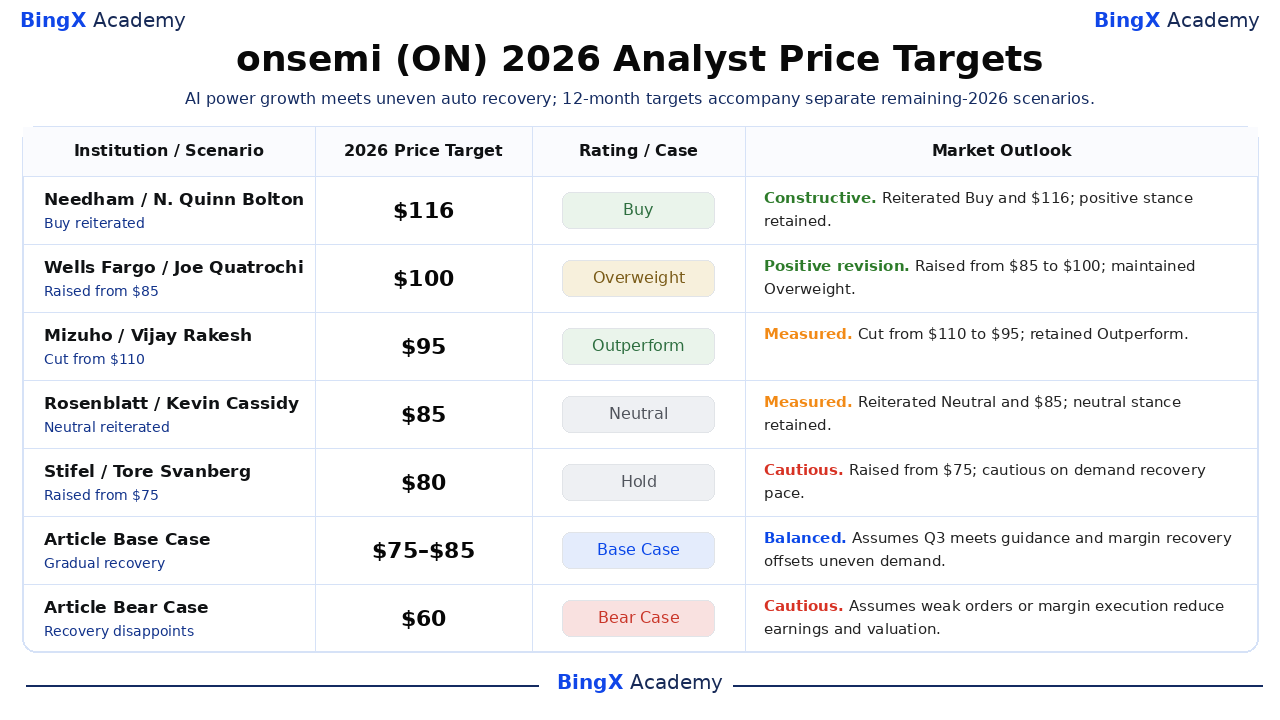
The Bull Case: AI Power Growth Pushes ON Toward $100
The Bull Case assumes power shipments continue rising, Q3 revenue approaches or exceeds $1.70 billion and non-GAAP gross margin reaches about 41%. Higher utilization spreads fixed manufacturing costs across more devices. Sungrow's deployment and NVIDIA ecosystem participation widen the opportunity beyond vehicles, while repeat customer orders would support stronger earnings estimates.
A move toward $100 would require margin delivery, stronger guidance and evidence that AI power designs become sustained shipments. The planned Synaptics deal is expected to close later, so this scenario does not rely on immediate acquisition earnings.
The Base Case: Gradual Recovery Keeps ON Between $75 and $85
The Base Case assumes Q3 meets guidance as power products offset weaker analog and sensing demand. EPP and GaNEXUS progress through customer qualification without a rapid revenue ramp. Better factory absorption supports profit, but the $75 to $85 range does not assume that every AI or automotive design is already in volume production.
ON could trade mainly between $75 and $85 if gross margin stays within 40% to 42% and industrial orders stabilize. A guidance upgrade would lift the range; a revenue or margin miss would undermine it.
The Bear Case: Weak Demand Pulls ON Toward $60
The Bear Case assumes weaker vehicle or industrial orders push revenue below the $1.65 billion Q3 guidance floor. Fewer shipments would leave fixed factory costs spread across a smaller base, while slower power-product adoption limits the offset. Analog's 2% Q2 decline already shows that the recovery is uneven.
A move toward $60 would become more likely if gross margin falls below 40%, energy-storage deployments slip or acquisition financing burdens cash flow. Stabilizing orders and improving guidance would weaken this downside case.
ON Stock Price Forecasts for 2026 By Wall Street Analysts
These dated analyst actions are 12-month reference objectives, rather than guaranteed year-end prices. Selected targets span 80–116. Where the ledger verifies only an action, no undisclosed rationale is attributed. The final two rows are separate editorial remaining-2026 scenarios, with assumptions explained above.
|
Institution / Scenario |
2026 Price Target |
Rating / Case |
Market Outlook |
|
Needham |
$116 |
Buy |
Constructive. October 2: N. Quinn Bolton reiterated Buy and $116; Buy stance maintained. |
|
Wells Fargo |
$100 |
Overweight |
Positive revision. October 2: Joe Quatrochi raised the target from $85 to $100 and retained Overweight; a positive target revision. |
|
Mizuho |
$95 |
Outperform |
Measured. September 17: Vijay Rakesh cut the target from $110 to $95 and retained Outperform; target cut despite Outperform. |
|
Rosenblatt |
$85 |
Neutral |
Measured. September 17: Kevin Cassidy reiterated Neutral and $85; Neutral stance retained. |
|
Stifel |
$80 |
Hold |
Cautious. October 5: Tore Svanberg raised the target from $75 to $80, retaining Hold because industrial and automotive recovery visibility remains limited. |
|
Article Base Case |
$75 to $85 |
Base Case |
Balanced. Assumes Q3 meets guidance and margin recovery offsets uneven demand. |
|
Article Bear Case |
$60 |
Bear Case |
Cautious. Assumes weak orders or margin execution reduce earnings and valuation. |
How to Trade onsemi (ON) Stock on BingX
Trade onsemi's AI power, margin recovery and connected-compute outlook using BingX TradFi and BingX AI tools. Because ON can react sharply to earnings guidance, customer announcements and Synaptics developments, traders should define both the catalyst and risk limits before entering a position.
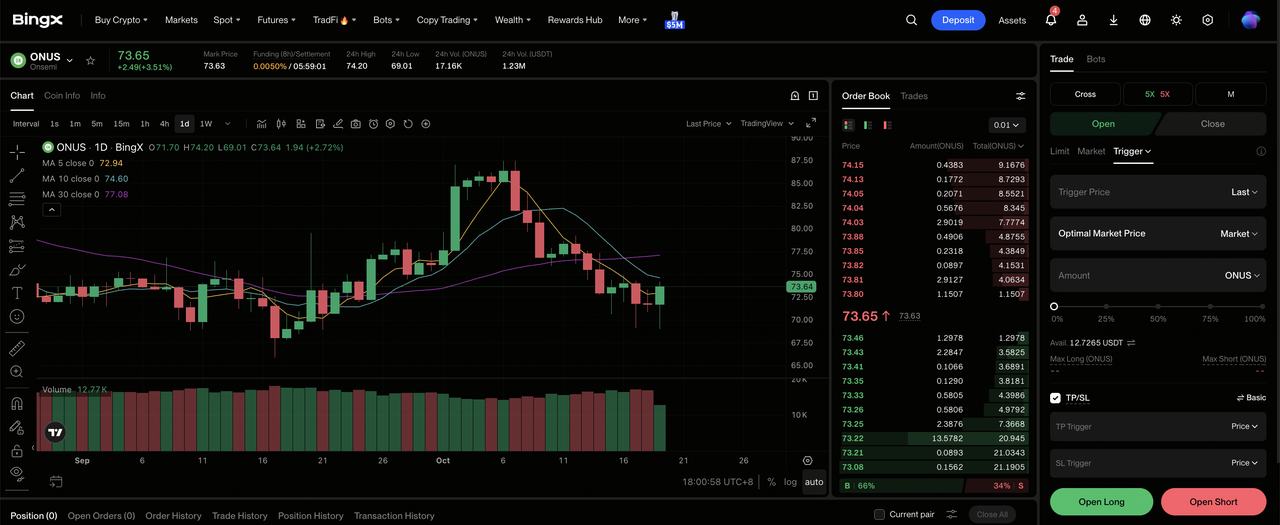
Step 1: Access BingX TradFi. Sign up and navigate to the specialized TradFi section on the BingX exchange dashboard.
Step 2: Select onsemi (ON). Search for and select the ONUS-USDT perpetual futures contract.
Step 3: Choose your direction. Select Open Long if you expect AI power shipments and recovering gross margins to lift earnings. Select Open Short if you expect weak automotive or industrial demand to undermine guidance.
Step 4: Select leverage and margin mode. Choose Isolated or Cross-Margin based on your risk tolerance. ON's 41.63% YTD gain and retreat from summer levels make conservative leverage and clear position sizing important.
Step 5: Execute strict risk protocols. Set Take-Profit and Stop-Loss (TP/SL) levels before or immediately after entering the trade. ON can react quickly to earnings, margin guidance, energy-storage customer updates and acquisition financing news.
Top 5 Risks to Watch for onsemi Investors in 2026
onsemi's opportunity in power and AI infrastructure still depends on customer programs reaching production at a scale that improves factory utilization, margins and cash generation.
- Uneven customer demand can slow the margin recovery. Analog and Mixed-Signal revenue fell 2% in Q2 as Power Solutions expanded. Weak automotive or industrial orders would reduce factory utilization, lowering earnings and the valuation assigned to a recovered profit base.
- Technology adoption can take longer than market expectations. Subaru's EPP engagement involves early evaluation. Qualification delays or customers choosing competing architectures could postpone revenue needed to recover development costs, producing a slower return on the capital committed to new platforms.
- AI infrastructure timing can weaken shipment visibility. NVIDIA MGX participation depends on customer deployment schedules. Delays in data-center construction or grid connections would push shipments outward, reducing earnings visibility and making a premium based on rapid growth harder to sustain.
- The Synaptics deal can absorb financing flexibility. The revised $5.7 billion cash acquisition requires cash and financing, with closing expected in mid-2027. Interest costs, integration spending or delayed synergies could reduce earnings benefits and cash available for repurchases.
- Long-term financial targets can be discounted prematurely. The 2030 model targets 53% adjusted gross margin and roughly $3.5 billion annual free cash flow. Mix or utilization shortfalls would lower expected earnings and compress the multiple before revenue declines.
Final Thoughts: Should You Invest in onsemi in 2026?
onsemi has a credible route from specialized power devices into larger AI and energy-infrastructure systems. Power Solutions growth, improving cash conversion and the Sungrow design win provide concrete support for that direction. Customer adoption, engineering evaluation and future financial ambitions have different paths into recognized revenue and future shareholder returns.
The $100 editorial bull case requires better earnings visibility and margin delivery; the $60 bear case assumes demand disappointments reduce both earnings and valuation. The 75–85 base range reflects uneven recovery. Conservative traders may wait for reported Q3 gross margin, updated customer-demand commentary and clearer acquisition financing before increasing exposure to the longer-term roadmap.
Risk Reminder: Trading and investing in equities like ON involves a high risk of capital loss. Automotive cyclicality, manufacturing costs, AI deployment timing and acquisition execution can change the outlook; leveraged perpetuals add liquidation risk. Conduct independent research before allocating capital.
Related Reading
- Top AI Energy Stocks to Buy in 2026: Nuclear, Gas, Fuel Cells, and the AI Power Buildout
- NVIDIA (NVDA) Price Prediction 2026: Can AI Infrastructure Growth Drive NVDA Toward $420?
- AMD Price Prediction 2026: Can AI Growth Push AMD Toward $700?
- HPE Price Prediction 2026: Can AI and Networking Growth Push HPE Toward $90?
- Bloom Energy (BE) Price Prediction 2026: Can AI Data-Center Power Push BE Toward $350?
- Oklo (OKLO) Price Prediction 2026: Can Nuclear Milestones Push OKLO Toward $100?
