



Shopify (SHOP) provides storefront, checkout and payments tools for merchants selling online, in stores and across borders. Subscription plans give it a recurring base, while merchant services rise with transaction volume. Deeper payment adoption, enterprise customers and AI shopping could expand revenue, but the business must preserve cash margins as processing costs, credit losses and infrastructure spending grow.
The latest quarter showed rapid commerce growth reaching cash flow. Shopify Q2 2026 revenue rose 34% to $3.583 billion, gross merchandise volume reached $115.567 billion and free cash flow increased to $654 million. Merchant solutions grew faster than subscriptions as payments penetration reached 68%. Q3 guidance calls for low-thirties revenue growth, leaving holiday demand and the cost of serving more transactions as the next tests of profitability.
The SHOP stock forecast for 2026 now centers on two competing views:
- The commerce expansion case: Broader payment adoption, enterprise merchants and AI distribution sustain growth and support stronger cash flow.
- The valuation pressure case: Infrastructure costs, weaker spending and an expensive earnings multiple limit how much operating progress reaches shareholders.
This guide breaks down the SHOP stock forecast, 2026 price scenarios, key risks and analyst outlooks, drawing on Shopify’s August 5 Q2 earnings release, Form 10-Q and financial supplement, with market data through October 13 and analyst actions through October 14, plus how to trade SHOP stock futures on BingX TradFi with USDT collateral.
Top 5 Things for Shopify Investors to Know in October 2026
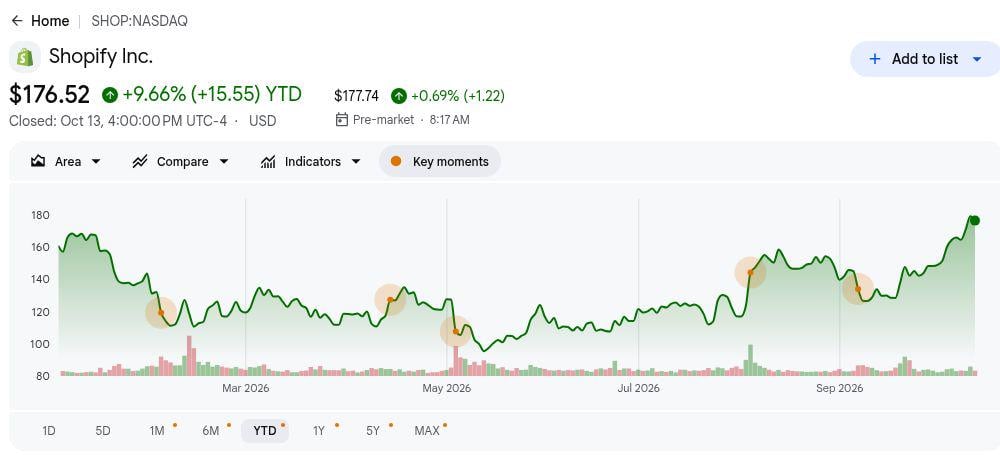
- SHOP closed at $176.52, up 9.66% year to date. The October 13 close sits between Cantor Fitzgerald's $158 and Stifel's $210 price targets, reflecting different growth and valuation expectations. The recovery increases pressure on upcoming earnings to confirm stronger commerce performance.
- Q2 revenue grew 34% to $3.583 billion. Growth accelerated from 31% a year earlier, with merchant solutions contributing $2.781 billion. Stronger merchant activity supports expansion, although rising payment-processing costs make operating profit conversion an important test.
- Shopify Payments penetration reached 68% of GMV. Payment volume increased to $78.1 billion from $56.6 billion, while penetration rose from 64%. Deeper adoption strengthens merchant monetization, but processing expenses and transaction losses remain important to sustainable profitability.
- Q3 operating expenses are expected at 33% to 34% of revenue. Management guided for low-thirties revenue growth and a high-teens-to-low-twenties free cash flow margin. Strong gross profit growth and expense discipline will determine whether sales momentum translates into stronger cash generation.
- The November 3 earnings report will test expectations of roughly 35% growth. Stifel's October 14 outlook exceeds management's low-thirties Q3 guidance, supported by enterprise, international, and payments expansion. Strong execution across these businesses could support a higher valuation, with agentic shopping providing additional longer-term potential.
What Is Shopify (SHOP)?

Shopify is a commerce operating system for entrepreneurs, established brands and enterprises. Merchants use it to build storefronts, manage inventory and orders, sell through physical and digital channels, and accept payments. Subscription fees provide recurring revenue, while merchant solutions add transaction-related revenue as sellers grow. The platform serves merchants in more than 175 countries, including SKIMS, Supreme, Aldo and Vuori. That model connects Shopify's growth to merchants' sales volume, though payment processing can make revenue rise faster than gross profit.
Shopify is adding routes to discovery and checkout beyond its merchants' own sites. Shop Pay speeds purchases, and Sidekick helps sellers manage work with AI. Shopify and Google co-developed the Universal Commerce Protocol so AI agents can discover products and complete transactions through a shared standard, with support from companies including Etsy, Target and Walmart. These tools could bring more orders into Shopify's payment and merchant services network; actual completed purchases, payment adoption and cash margins remain the measures of commercial progress.
Shopify (SHOP) Q2 2026 Earnings Overview: Commerce Growth Builds Operating Leverage
Shopify reported Q2 2026 revenue of $3.583 billion, up 34% year over year, while gross merchandise volume (GMV) increased approximately 32% to $115.567 billion. Merchant solutions revenue grew 37%, adjusted EPS of $0.42 exceeded the $0.40 estimate, and free cash flow reached $654 million. Q3 guidance points to low-thirties revenue growth and mid-to-high-twenties gross profit growth, making payments monetization, operating leverage, and cost discipline central to Shopify's earnings outlook.
|
Financial Metric |
Guidance / Consensus |
Reported / Actual |
Surprise |
|
Q2 revenue |
$2.680B a year earlier |
$3.583B |
Grew. Up 34% year over year. |
|
Q2 non-GAAP diluted EPS |
$0.40 consensus (IBD) |
$0.42 |
Beat. $0.02 above estimate. |
|
Q2 GAAP net income |
$906M a year earlier |
$1.502B |
Higher. Up $596M; includes investment gains. |
|
Merchant solutions revenue |
$2.024B a year earlier |
$2.781B |
Grew. Up 37% year over year. |
|
Gross merchandise volume |
$87.837B a year earlier |
$115.567B |
Grew. Up about 32% year over year. |
|
Payments penetration |
64% a year earlier |
68% |
Improved. Up 4 percentage points. |
|
Gross profit |
$1.302B a year earlier |
$1.708B |
Higher. Up 31% year over year. |
|
Free cash flow |
$422M a year earlier |
$654M |
Improved. Up 55% year over year. |
|
Q3 free-cash-flow margin outlook |
Q2 actual 18% |
High teens to low twenties |
Guided. Range spans the Q2 level. |
- Revenue growth of 34% outpaced operating expense growth of 21%. Operating expenses reached $1.220 billion, allowing more gross profit to flow into operating income. Stronger merchant activity supported operating leverage despite a lower gross-margin percentage, making incremental profitability a key measure of sustainable growth.
- Adjusted EPS of $0.42 beat estimates by $0.02. Adjusted earnings increased from $0.35 a year earlier, while GAAP EPS of $1.16 benefited from $1.249 billion in unrealized investment gains. Separating these non-operating gains from recurring commerce earnings provides a clearer view of underlying profitability.
- Payments penetration rose 4 percentage points to 68%. Shopify Payments GMV increased 38% to $78.1 billion, capturing more revenue from existing merchant activity. Higher payment volume strengthens monetization, although processing costs remain important in determining incremental profitability.
- Free cash flow jumped 55% to $654 million. Operating cash flow reached $658 million, while the free cash flow margin improved to 18% from 16%. Strong cash conversion gives Shopify greater capacity to fund expansion and provides additional support for its valuation beyond revenue growth.
- Transaction and loan losses increased to $141 million. Losses rose from $80 million a year earlier, while subscription infrastructure costs increased by $37 million, partly due to AI usage. These expenses offset operating leverage, making cost discipline and transaction profitability important tests for the next quarter.
Shopify (SHOP) 2026 Investment Outlook: $210 Bull Case vs. $130 Bear Case
Shopify's 2026 outlook turns on whether stronger merchant sales and payment adoption keep producing cash as the business scales. Enterprise, international and AI-assisted commerce offer more routes to transactions. Slower consumer spending, rising transaction losses and a demanding valuation could offset that progress if gross profit and cash flow fail to keep pace with revenue.
The Bull Case: Strong Commerce Growth Pushes SHOP Toward $210
The Bull Case assumes merchant sales continue growing above 30%, payments penetration stays at or above 68%, and operating profit rises with transaction volume. Enterprise, cross-border and B2B customers add demand. Sidekick and AI shopping create upside if they produce more completed purchases, while the subscription layer continues supporting the economics of merchant services.
A move toward $210 would require strong November 3 results, constructive holiday guidance and free cash flow margins in the high teens or better. Faster gross-profit growth and contained transaction losses would show that added volume is improving shareholder economics.
The Base Case: Operating Progress Keeps SHOP Between $160 and $185
The Base Case assumes Q3 delivers low-thirties revenue growth and payments adoption continues without an immediate AI-commerce windfall. Monthly recurring revenue of $221 million supports the subscription base. Merchant solutions expand with sales volume, though processing costs and a lower-margin service mix keep gross-profit growth below the headline revenue rate.
SHOP could trade mainly between $160 and $185 if cash margins meet guidance and expenses stay disciplined. Faster cash generation would strengthen the upside case; rising loan losses or a sales miss would weaken the range.
The Bear Case: Slower Spending Pulls SHOP Toward $130
The Bear Case assumes weaker merchant sales slow both transaction and subscription growth while Shopify keeps funding product and payment infrastructure. Transaction and loan losses reached $141 million in Q2, up from $80 million, and could climb further if merchant conditions deteriorate. Lower volume would make these costs harder to absorb.
A move toward $130 would become more likely if revenue growth falls below guidance, cash margins slip below the high teens or credit losses rise. At the $176.52 reference close, weaker growth could also compress the premium multiple applied to future earnings.
SHOP Stock Price Forecasts for 2026 By Wall Street Analysts
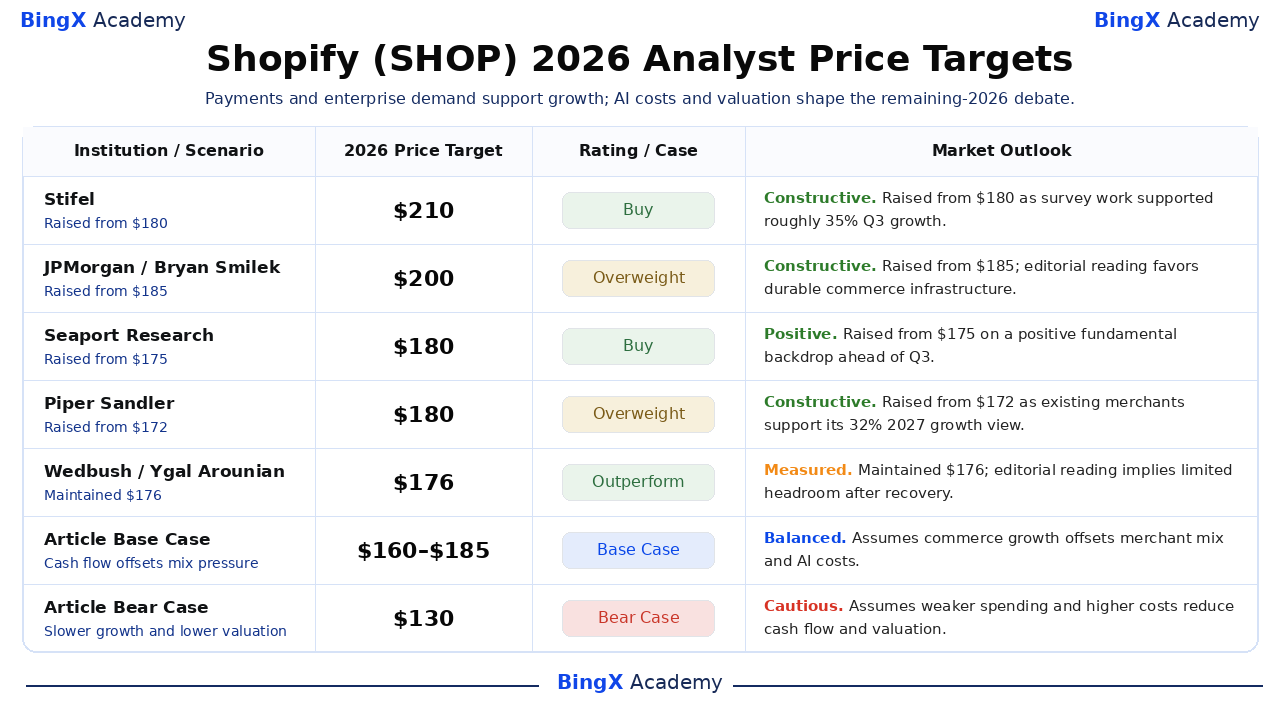
These are dated third-party targets for the U.S. SHOP listing, generally framed over approximately 12 months rather than December 2026. Their spread reflects different operating and valuation assumptions. The article’s remaining-2026 Base and Bear cases are editorial scenarios. Where a source verifies only an action, the interpretation below is explicitly identified as editorial.
|
Institution / Scenario |
2026 Price Target |
Rating / Case |
Market Outlook |
|
Stifel |
$210 |
Buy |
Constructive. October 14: Raised from $180 as survey work supported roughly 35% Q3 growth. |
|
JPMorgan |
$200 |
Overweight |
Constructive. October 6: Raised from $185; editorial interpretation favors durable commerce infrastructure. |
|
Seaport Research |
$180 |
Buy |
Positive. October 8: Raised from $175 on a positive fundamental backdrop ahead of Q3. |
|
Piper Sandler |
$180 |
Overweight |
Constructive. September 8: Raised from $172 as existing merchants supported its 32% 2027 growth view. |
|
Wedbush |
$176 |
Outperform |
Measured. September 23: Maintained $176; editorial interpretation implies limited headroom after recovery. |
|
Cantor Fitzgerald |
$158 |
Neutral |
Cautious. October 12: Raised from $145; AI costs and merchant mix temper strong growth. |
|
Article Base Case |
160–185 |
Base Case |
Balanced. Assumes commerce growth offsets merchant mix and AI costs. |
|
Article Bear Case |
$130 |
Bear Case |
Cautious. Assumes weaker spending and higher costs reduce cash flow and valuation. |
How to Trade Shopify (SHOP) Stock on BingX
Trade Shopify’s payments adoption, merchant growth and AI commerce outlook using BingX TradFi and BingX AI tools. Because SHOP can react sharply to revenue guidance, consumer spending and margin trends, traders should define both the catalyst and risk limits before entering a position.
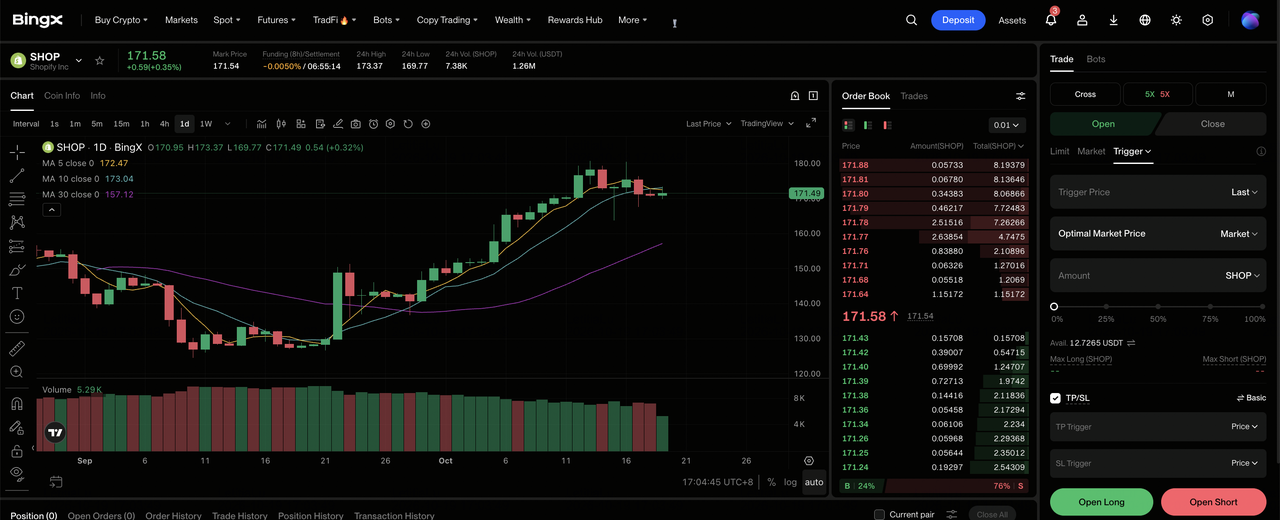
Step 1: Access BingX TradFi. Sign up and navigate to the specialized TradFi section on the BingX exchange dashboard.
Step 2: Select Shopify (SHOP). Search for and select the SHOP-USDT perpetual futures contract.
Step 3: Choose your direction. Select Open Long if you expect sustained low-thirties revenue growth, deeper payment adoption and strong cash conversion. Select Open Short if you expect weaker merchant spending, higher loan losses or disappointing margin guidance.
Step 4: Select leverage and margin mode. Choose Isolated or Cross-Margin based on your risk tolerance. SHOP’s 9.66% YTD gain follows a volatile recovery, making conservative leverage and clear position sizing important around the November 3 report.
Step 5: Execute strict risk protocols. Set Take-Profit and Stop-Loss (TP/SL) levels before or immediately after entering the trade. SHOP can react quickly to holiday demand, revenue guidance, payment adoption, AI infrastructure costs and analyst revisions.
Top 5 Risks to Watch for Shopify Investors in 2026
Shopify's growing merchant activity, payments adoption, and AI capabilities support its long-term expansion. However, consumer demand, transaction costs, infrastructure spending, and valuation remain important factors determining how much of that growth translates into profitability and shareholder returns.
- Weaker merchant spending could slow revenue growth. Merchant solutions generated $2.781 billion in Q2 revenue. Softer consumer demand or tariffs affecting merchants could reduce GMV and payments volume, weakening incremental profits and cash flow.
- AI infrastructure costs could outpace returns. Subscription infrastructure expenses increased by $37 million, partly due to AI usage. If Sidekick and agentic commerce tools generate higher computing costs without sufficient merchant adoption or order growth, gross margins and earnings could face pressure.
- Higher payments penetration could pressure margins. Shopify Payments reached 68% penetration as gross margin declined to 47.7% from 48.6%. Processing expenses may absorb part of the additional revenue, making gross profit growth and cash conversion important measures of sustainable monetization.
- Merchant credit losses could reduce operating leverage. Transaction and loan losses rose to $141 million from $80 million a year earlier. Weaker merchant repayment or transaction quality could increase provisions, especially if sales growth slows, reducing the profitability of Shopify's expanding financial services.
- Premium valuation increases sensitivity to earnings misses. SHOP traded at roughly 105 times mechanically annualized adjusted EPS, reflecting high growth expectations. Slower revenue expansion, weaker margins, or disappointing Q3 guidance could trigger valuation compression even if the underlying business continues growing.
Final Thoughts: Should You Invest in Shopify in 2026?
Shopify's strong Q2 performance reinforces its growth potential, with revenue rising 34%, payments penetration reaching 68%, and free cash flow increasing 55%. Enterprise adoption, international expansion, and deeper payment integration provide established growth opportunities, while Sidekick and agentic commerce tools could further improve merchant efficiency and transaction volume. The key is whether these initiatives can sustain revenue growth and strengthen profitability as Shopify scales.
The $210 bull case depends on sustained commerce growth, stronger merchant monetization, and disciplined operating expenses, while the $130 bear case reflects weaker consumer spending and valuation pressure. Investors can track the November 3 earnings report, payment adoption, free cash flow margins, and holiday demand to assess whether Shopify's growth can continue to support its premium valuation.
Risk Reminder: Investing in SHOP involves the risk of capital loss. Consumer spending trends, payment-processing costs, merchant credit losses, AI investment, and valuation changes can affect earnings and share-price performance. Investors should assess these risks and conduct independent research before investing.
Related Reading
- Walmart (WMT) Price Prediction 2026: Can E-Commerce and Advertising Push WMT Toward $155?
- Amazon (AMZN) Price Prediction 2026: Can AWS and AI Growth Push AMZN Past $400?
- Meta (META) Price Prediction 2026: Can AI Monetization Push META Toward $1,000?
- Costco (COST) Price Prediction 2026: Can Membership Growth Push COST Toward $1,200?
- Alibaba (BABA) Price Prediction 2026: Can 45% Cloud Growth Push BABA Toward USD $230?
