
In mid-May 2026, Aluminum (XAL) stands at the center of a geopolitical firestorm. After a vertical rally triggered by the U.S.-Israeli strikes on Iran in late February, the industrial metal is currently trading near $3,655 per tonne, a 19% surge year-to-date. While the market began the year in a modest surplus, the Black Swan closure of the Strait of Hormuz and direct hits on Gulf smelters have removed approximately 3% of global supply overnight. Investors are now weighing a projected 2-million-tonne deficit against the risk of demand destruction as automakers like Ford grapple with $2 billion in additional commodity headwinds.
As the global energy transition intensifies, aluminum’s role in solar framing, EV chassis, and power grids has transformed it into a strategic critical mineral. With LME inventories sitting at a precarious 1.5 days of global production, the market is in a state of extreme backwardation. This guide breaks down the Aluminum price prediction for 2026 using data from the World Bank, Goldman Sachs, Mercuria, and Wood Mackenzie.
You will also discover how to trade Aluminum futures with USDT through BingX TradFi.
Top 5 Things for Aluminum Traders to Know in 2026
As Aluminum navigates a high-stakes environment of war-driven supply halts and green energy mandates, traders must monitor these five market-moving factors.
- The Gulf Supply Shock: The Middle East produces 9% of global primary aluminum. With key smelters like Al Taweelah in the UAE and Alba in Bahrain facing force majeure, the market is losing roughly 7 million metric tons of annual capacity.
- Inventory Depletion: Visible LME inventories have plummeted to around 350,000 tonnes. Analysts warn that the buffer is effectively gone, leaving the market highly sensitive to any further shipping disruptions.
- The Acid Chain Constraint: China has restricted exports of sulphuric acid to protect domestic fertilizer production. This has created a bottleneck in bauxite-to-alumina refining, raising the global cost floor for aluminum production.
- Energy as a Price Floor: Often called solid electricity, aluminum prices are tracking the surge in natural gas and coal costs. High energy prices in Europe prevent idled smelters from restarting, even at current record metal prices.
- Backwardation Intensity: The cash-to-three-month spread has widened significantly, signaling that buyers are willing to pay a massive premium for immediate physical delivery over future contracts.
What Is Aluminum (XAL)?
Aluminum is a lightweight, corrosion-resistant metal essential for modern infrastructure. In 2026, its value is driven by its necessity in the Twin Transitions: Digitalization in Data Centers and Decarbonization in Renewables. Unlike precious metals, aluminum is a high-volume industrial commodity where supply chains are highly sensitive to energy prices and maritime security.
As of May 2026, the market is defined by inelastic supply. China’s 45-million-tonne capacity cap means the world's largest producer cannot easily ramp up to fill the gap left by the Middle East. Trading aluminum in 2026 utilizes tickers benchmarked by the LME Aluminum 99.7% cash price. Investors can also gain exposure via major mining equities like Alcoa (AA), Rio Tinto (RIO), and CBA.
On the BingX TradFi platform, traders can speculate on these movements through Aluminum perpetual contract with Tether (USDT), allowing for leveraged exposure to LME price swings.
Aluminum's Performance in 2025: Steady Between $2,300 and $2,600
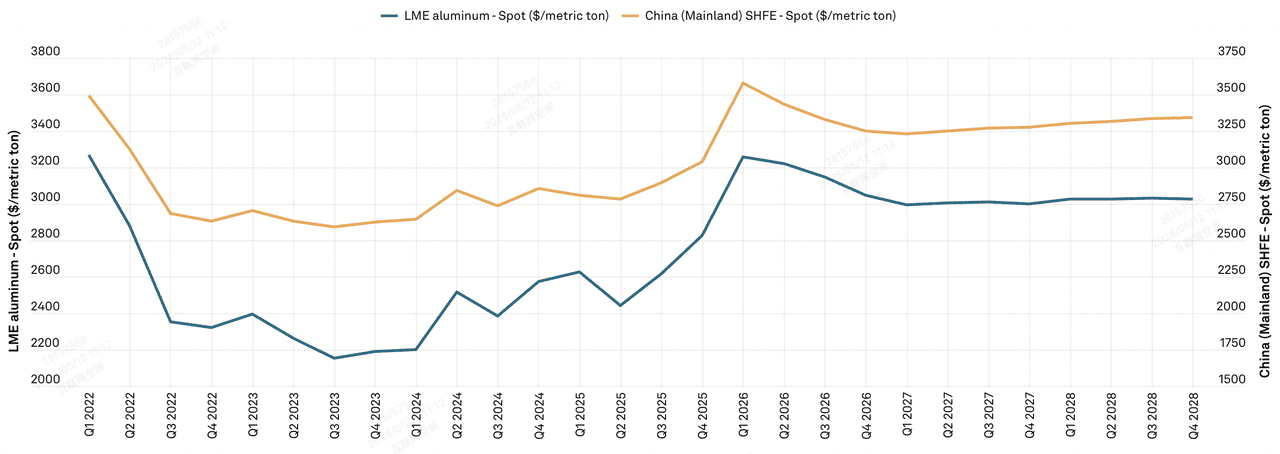
Aluminum prices over the previous quarters | Source: S&P Global
In 2025, Aluminum was a steady performer, trading in a range between $2,200 and $2,600. The year was characterized by a healthy surplus and a focus on Green Aluminum with low-carbon smelting. However, the narrative shifted abruptly in Q1 2026. The U.S. Geological Survey (USGS) and European Union officially prioritized aluminum as a strategic asset, setting the stage for the massive risk-premium repricing seen in April and May.
Aluminum’s 2026 Strategy: How to Navigate Commodity Volatility
- The $3,200 Floor: Technical analysts identify $3,000–$3,200 as the new structural support. As long as AL holds this level, the Black Swan bull trend remains the dominant trade.
- Physical Premiums: Don't just watch the LME. U.S. Midwest and European duty-paid premiums are at record highs of $1.14/lb, signaling that the actual cost for manufacturers is much higher than the exchange price.
- China’s Export Highs: In April 2026, Chinese aluminum exports hit a new high of 598,000 mt, up 15.4% YoY. This surge is the primary release valve preventing prices from immediate moon-shotting to $5,000.
Aluminum 2026 Investment Outlook: $4,000 Peak vs. $2,800 Mean Reversion
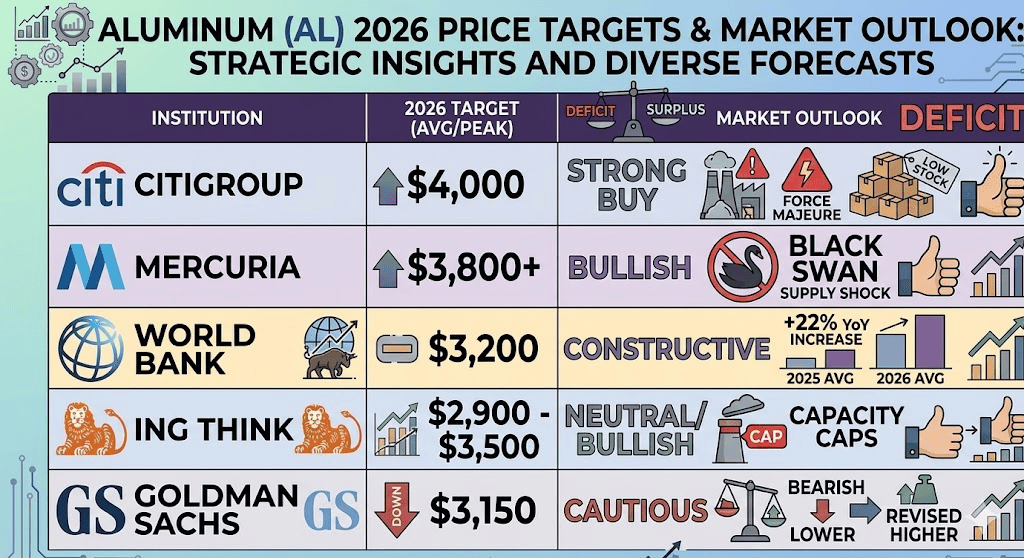
Aluminum price forecasts for 2026 by leading Wall Street analysts
Investors navigating the 2026 aluminum market must weigh a historic supply-side Black Swan against the rising threat of a global industrial slowdown.
The Bull Case: Aluminum's $4,000 Supply Black Hole
The bullish narrative, championed by Citi and Mercuria, hinges on a structural black hole in global supply caused by the persistent blockade of the Strait of Hormuz. With roughly 9% of global primary production trapped or halted in the Gulf, the global market deficit is projected to widen to a record 3 million tonnes by year-end. This scenario is exacerbated by the solidification of potlines at damaged smelters like Al Taweelah, which ensures that even an immediate ceasefire would not restore supply for 6–12 months.
Practically, this creates a panic-buying environment where the LME cash price serves only as a floor. Traders should monitor the backwardation spread; as long as the cash-to-three-month premium remains above $80/t, the momentum supports a push toward the $3,800–$4,000 zone. In this environment, long positions in non-Russian, Western-aligned producers like Alcoa or Rio Tinto offer the highest alpha as physical availability premiums in the U.S. and Europe hit triple-digit highs.
The Base Case: $3,200 – $3,500 Consolidation for Aluminum Prices
The base case envisions a High-for-Longer plateau where the market digests the initial war shock but faces a ceiling due to industrial thrifting. While supply remains historically tight, analysts at the World Bank and ING note that sustained prices above $3,500 have already begun to activate price elasticity. Major manufacturers are pivoting to secondary or recycled aluminum, which currently trades at a 15–20% discount to primary ingots, effectively acting as a pressure-relief valve that prevents a vertical moon-shot to $5,000.
For investors, this results in a high-volatility range defined by $3,200 support and $3,600 resistance. The focus shifts to China’s export data; as long as Chinese semi-fabricated exports remain near the 600,000 mt/month level, they will likely cap price spikes. Strategic positioning in this scenario involves range-trading the LME volatility while focusing on Real-World Assets (RWAs) and mining equities that benefit from expanded margins without requiring a runaway commodity rally.
The Bear Case: The $2,800 Demand Destruction Trap
The bearish scenario, warned by BMO and Goldman Sachs, is triggered by demand destruction where the cure for high prices becomes the high prices themselves. As aluminum costs double the previous estimates for automakers, reaching a $2 billion headwind for firms like Ford, a forced reduction in vehicle production rates could lead to a sudden demand cliff. This is compounded by high energy prices fracturing consumer discretionary spending, potentially shifting the global market from a deficit of 3 million tonnes back toward a surplus by Q4 2026.
Technically, the bear case is confirmed by a decisive daily close below the $3,150 line in the sand. A breach of this level would likely trigger a liquidation of speculative length as the geopolitical premium evaporates. If shipping via the Suez Canal and Hormuz resumes, the market would rapidly retest the $2,800 support zone, the marginal cost of production for high-cost European smelters, effectively erasing the war-driven gains of Q1 and Q2.
Aluminum Price Forecasts for 2026 by Leading Analysts
|
Institution |
2026 Target (Avg/Peak) |
Market Outlook |
|
Citi |
$4,000 |
Strong Buy: Cites Gulf force majeure and low stocks. |
|
Mercuria |
$3,800+ |
Bullish: Describes a Black Swan supply shock. |
|
World Bank |
$3,200 |
Constructive: Expects 22% YoY increase in averages. |
|
ING Think |
$2,900 - $3,500 |
Neutral/Bullish: Cites China capacity caps. |
|
Goldman Sachs |
$3,150 |
Cautious: Originally bearish, now revised higher. |
How to Trade Aluminum (XAL) Futures on BingX TradFi
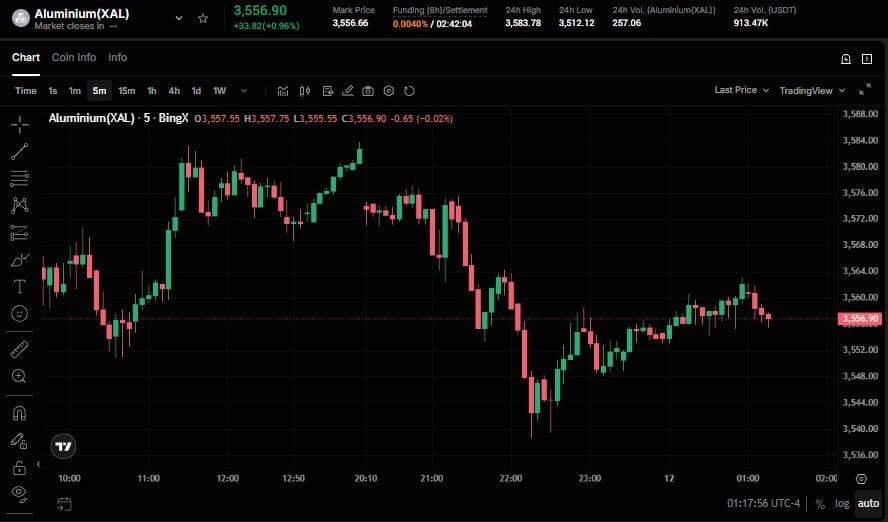
Aluminum-USDT perpetuals on BingX futures market
Capitalize on aluminum’s historic volatility using BingX TradFi and the predictive power of BingX AI. Whether you are hedging against rising industrial costs or speculating on the supply deficit, BingX provides the integrated tools and AI-driven market sentiment analysis needed for precision trading.
- Access BingX TradFi: Navigate to the Commodities section.
- Select Aluminum (XAL): Choose the Aluminum(XAL)-USDT perpetual contract.
- Choose Your Direction: Select Open Long if you anticipate the Hormuz blockade will tighten supply, or Open Short to trade the demand destruction case.
- Manage Risk: Use BingX TP/SL (take-profit/stop-loss) tools to protect your capital against sudden geopolitical de-escalation.
Top 5 Risks to Watch for Aluminum Traders in 2026
While the fundamental backdrop for aluminum remains historically tight, traders must navigate a complex landscape of macroeconomic and technical headwinds that could derail the current bullish trend.
- Hormuz Re-opening: A sudden diplomatic resolution would immediately wipe out the $400–$500 risk premium.
- Chinese Export Flux: If China restricts aluminum exports to protect domestic supply, global prices will explode.
- Substitution: High prices may force a permanent shift to plastic or glass in the packaging sector.
- Energy Price Collapse: If crude oil and natural gas prices fall, the cost floor for aluminum smelters drops significantly.
- Recycled Supply: A surge in urban mining or recycling could provide an unexpected supply cushion in H2 2026.
Final Thoughts: Is Aluminum a Buy at $3,600 in 2026?
As of mid-May 2026, aluminum has transitioned from a cyclical industrial commodity into a strategic security asset with a price floor dictated by geopolitical risk. At the $3,600 level, the market is pricing in a semi-permanent loss of Middle Eastern smelting capacity and a sustained blockade of the Strait of Hormuz. For tactical traders, the $3,500 support zone represents a critical line in the sand; as long as the daily close remains above this threshold, the structural deficit narrative remains the high-conviction play. However, the market is currently in a state of extreme backwardation, meaning the cost of entering long positions is high, and any sign of diplomatic de-escalation could lead to rapid gap-down moves.
Practical participation in this environment requires a disciplined, data-driven approach rather than chasing momentum. Investors should focus on the physical premium trends in the U.S. and Europe, as these often lead LME price action by several days. Utilizing BingX AI to monitor real-time satellite shipping data and LME warehouse drawdown rates is essential for distinguishing between genuine supply shocks and speculative noise. For those seeking long-term exposure, wait for consolidations near the $3,200 base-case support, while shorter-term traders should use the current volatility to scalp the range between $3,450 and $3,800 using strict risk-management protocols.
Risk Reminder: Trading industrial metals involves significant capital risk due to high price volatility and geopolitical sensitivity. Aluminum's direct link to energy prices can lead to rapid gap moves during weekend news cycles. Always implement strict stop-loss orders.
Related Reading
- Platinum (PL) Price Prediction 2026: $2,500 Industrial Breakout or Speculative Retrace?
- Nickel (XNI) Price Prediction 2026: $25,000 Supply Shock or Surplus Ceiling?
- Zinc (XZN) Price Prediction 2026: $3,500 Supply Breakout or $2,950 Demand Trap?
- Is Copper (XCU) a Good Investment in 2026?
- Lead (XPB) Price Forecast 2026: $2,000 Rangebound Stability or Supply Chain Breakout?
