

Since launching in January 2024, US spot Bitcoin ETFs have attracted over $110 billion in cumulative net inflows, with total assets under management (AUM) surging past $150 billion during the 2025 bull run. For Brazilian investors, this momentum has unlocked a variety of options far beyond the US market: today, you can access regulated Bitcoin exposure directly on the B3 exchange, denominated in BRL, without needing to open an account with a foreign broker.
The challenge is that available alternatives have multiplied, and the nuances between them matter immensely. Management fees, legal structures, daily liquidity, and tax treatment can significantly impact your real returns over a three, five, or ten-year horizon.
Quick answer: A Bitcoin ETF is an exchange-traded fund that tracks the price of BTC, allowing investors to gain exposure without handling self-custody. For Brazilians in 2026, the primary options are: BITH11 (lowest fee among pure BTC ETFs on B3), HASH11 (highest liquidity), QBTC11 (QR Capital's pioneer vehicle), and IBIT39 (BlackRock's iShares BDR, boasting the lowest overall fee). Your ultimate choice depends on your risk profile, investment horizon, and capital size.
What is a Bitcoin ETF and How Does It Work in Brazil?
An ETF (Exchange-Traded Fund) operates like a basket of assets that you buy and sell through your brokerage account just like a stock. For Bitcoin ETFs, the fund holds spot BTC (or shares of other funds that hold it) and issues shares that track the price fluctuations of the underlying cryptocurrency.
The most straightforward analogy for anyone already trading on the B3: it's like buying BOVA11 to get exposure to the Ibovespa index, but in this case, the underlying asset is the price of Bitcoin.
Brazil was a global pioneer in crypto ETFs, launching its first regulated products even ahead of the United States. All Bitcoin ETFs listed on the B3 are regulated by the CVM (Brazilian Securities and Exchange Commission), meaning custody and management follow the exact same stringent rules applied to any investment fund registered in the country.
Spot ETF vs. Futures ETF: It's crucial to understand the structural difference before allocating capital. A spot ETF buys physical Bitcoin directly, so each share represents a fractional claim on actual BTC. A futures-based ETF tracks the price through derivative contracts without ever holding the physical asset. The ETFs available on B3 are predominantly spot vehicles (or track indexes backed by spot BTC), which eliminates the roll costs typically associated with futures structures.
How to Calculate the Real Cost of a Bitcoin ETF
The management fee is the most visible metric, but it isn't the only cost dragging down your portfolio performance. The formula for the total effective cost is:
Total Cost = Management Fee (% p.a.) + Tracking Error + Brokerage Fees + B3 Exchange Fees
Practical Example:
Imagine an initial allocation of R$ 10,000 in BITH11 (0.70% p.a. fee) versus the same amount in HASH11 (1.30% p.a. fee), assuming a hypothetical gross appreciation of 20% per year over 5 years:
| Metrics | BITH11 (0.70% p.a.) | HASH11 (1.30% p.a.) |
|---|---|---|
| Initial Investment | R$ 10,000 | R$ 10,000 |
| Value After 5 Years (20% p.a. gross) | R$ 24,575 | R$ 23,846 |
Cumulative Difference: R$ 729 less in returns
While the variance seems minor in the short term, over a 10-year horizon with larger capital contributions, the compounded drag can exceed R$ 3,000 for every R$ 10,000 invested.
The Top Bitcoin ETFs Available for Brazilians in 2026
BITH11 - Hashdex Nasdaq Bitcoin Reference Price
BITH11 is a pure-play ETF managed by Hashdex that tracks the Nasdaq Bitcoin Reference Price. It offers 100% exposure to Bitcoin with a competitive management fee of 0.70% per year, making it the most cost-effective, pure BTC vehicle listed on the B3 for investors looking for exclusive exposure to the asset.
Hashdex differentiates this product through its commitment to carbon neutrality, offsetting the carbon emissions generated by Bitcoin mining, which labels it the "green ETF" of the sector. For investors indifferent to ESG metrics, the core selling point remains its combination of low fees and institutional backing by one of Brazil's most established crypto asset managers.
Best suited for: Investors seeking pure-play BTC exposure with low overhead and a medium-to-long-term holding strategy.
HASH11 - Hashdex Nasdaq Crypto Index
HASH11 is the most heavily traded crypto ETF in Brazil. It replicates the Nasdaq Crypto Index (NCI), a diversified digital asset basket that features quarterly rebalancing, market-cap weighting, and strict liquidity and custody criteria.
The underlying asset allocation of HASH11 extends beyond Bitcoin: it consists of roughly 70% BTC, 20% Ethereum, and a 10% mix of alternative Layer-1s like Solana and Cardano. Its management fee sits at 1.30% per year, reflecting the active indexing and broad-market exposure.
For investors looking to capture the broader crypto market beta in a single ticker, HASH11 offers the deepest liquidity available on the B3. During volatile trading days, high volume ensures tighter bid-ask spreads and seamless execution.
Best suited for: Investors seeking broad diversified exposure to top-tier crypto assets in a single vehicle, or high-volume traders requiring deep liquidity.
QBTC11 - QR CME CF Bitcoin Reference Rate
Launched in 2021 by QR Capital, QBTC11 tracks the CME CF Bitcoin Reference Rate—the exact same benchmark used by the CME Group for pricing institutional BTC derivatives. The fund features a 0.75% annual management fee and is a 100% pure-play Bitcoin vehicle.
QBTC11’s historical performance closely mirrors that of BITH11, showing an almost identical correlation in recent market cycles. For the vast majority of allocators, the operational difference between BITH11 and QBTC11 is marginal: both maintain a near 100% correlation with spot BTC and offer physically-backed exposure. The true differentiation lies in their respective underlying reference rates and the asset managers backing each vehicle.
Best suited for: Investors who prefer BTC exposure benchmarked to the institutional derivatives market (CME).
IBIT39 - iShares Bitcoin Trust BDR (BlackRock)
IBIT39 aims to track the performance of the spot Bitcoin price and carries a headline management fee of 0.25% per year—the lowest face-value rate among all options available to Brazilian investors. It is not an ETF listed directly on the B3, but rather a BDR (Brazilian Depositary Receipt), which is a locally issued security representing fractional shares of the original underlying ETF traded in the US.
This means that by purchasing IBIT39, you gain indirect exposure to BlackRock's iShares Bitcoin Trust—the largest Bitcoin ETF globally, which captures a substantial share of weekly institutional capital inflows into BTC investment vehicles.
However, there is an extra layer of drag that does not appear in the headline fee: the BDR structure embeds an additional custody expense of roughly 0.30% per year. This pushes the total effective cost closer to 0.55% p.a.—still highly competitive, but not as radically different from BITH11 as the headline numbers suggest.
Another key variable to monitor: while IBIT39 trades in BRL on the B3, its underlying asset is denominated in US dollars. Consequently, BRL/USD FX volatility will impact your net returns, serving as either a tailwind or a headwind depending on currency movements.
Best suited for: Sophisticated investors who want BlackRock’s institutional operational framework and understand how to manage embedded FX exposure.
Comparative Table: Bitcoin ETFs for Brazilians in 2026
| Ticker | Issuer | Structure | Fee (p.a.) | Exposure | FX Risk? |
|---|---|---|---|---|---|
| BITH11 | Hashdex | B3 ETF (Spot) | 0.70% | 100% BTC | No |
| QBTC11 | QR Capital | B3 ETF (Spot) | 0.75% | 100% BTC | No |
| HASH11 | Hashdex | B3 ETF (Crypto Index) | 1.30% | BTC + ETH + Alts | No |
| IBIT39 | BlackRock (BDR) | US ETF Cross-Border BDR | ~0.55% effective | 100% BTC | Yes (USD) |
Reference data: June 2026. Please check official fund factsheets from each manager for updated information.
B3 Bitcoin ETFs vs. Direct Purchase: Practical Trade-Offs
The debate between exchange-traded vehicles and holding physical crypto is well-established, but it warrants close attention because both paths carry completely different tax and operational implications.
Taxation: The Most Significant Variable
Capital gains derived from Bitcoin ETFs on the B3 are taxed as equities/variable income, applying a flat 15% tax rate on net gains for standard swing trades, with no tax-exempt threshold.
Conversely, for physical spot crypto assets held with domestic custody or local exchanges, investors can benefit from a tax exemption on monthly total sales up to R$ 35,000. Above this threshold, capital gains are taxed on a progressive scale starting at 15%.
The bottom line: Investors allocating smaller amounts who intend to keep monthly liquidations below the R$ 35,000 cap can optimize their net returns by buying spot BTC directly on a crypto exchange. On the flip side, larger allocators or those seeking to streamline accounting and avoid monthly tax tracking will likely find the B3 ETF wrapper more operationally convenient, despite lacking the exemption.
Other Practical Differences
- ETFs only trade during B3 market hours (10:00 AM to 5:00 PM BRT). Conversely, direct Bitcoin purchases operate 24/7/365 on the BingX spot market.
- ETFs charge an ongoing annual management fee. With direct purchases, you only incur a one-time exchange transaction fee at execution, with zero recurring holding costs.
- ETFs eliminate the operational overhead of digital wallet management, private key security, and self-custody risks. For crypto onboarding, this simplicity offers clear institutional-grade value. Traders wanting full autonomy over their assets can instead opt for compatible self-custody wallets.
For market participants looking to step beyond passive index exposure and actively trade Bitcoin—whether via the 24/7 spot market, algorithmic copy trading, or perpetual futures with customizable leverage—BingX provides institutional-grade global liquidity, advanced order routing (including stop-loss and take-profit mechanics with isolated or cross-margin modes), and a fully localized interface. Trading the BTC/USDT pair on BingX accommodates everything from micro-lot retail strategies to large block institutional flows with tight spreads and real-time execution.
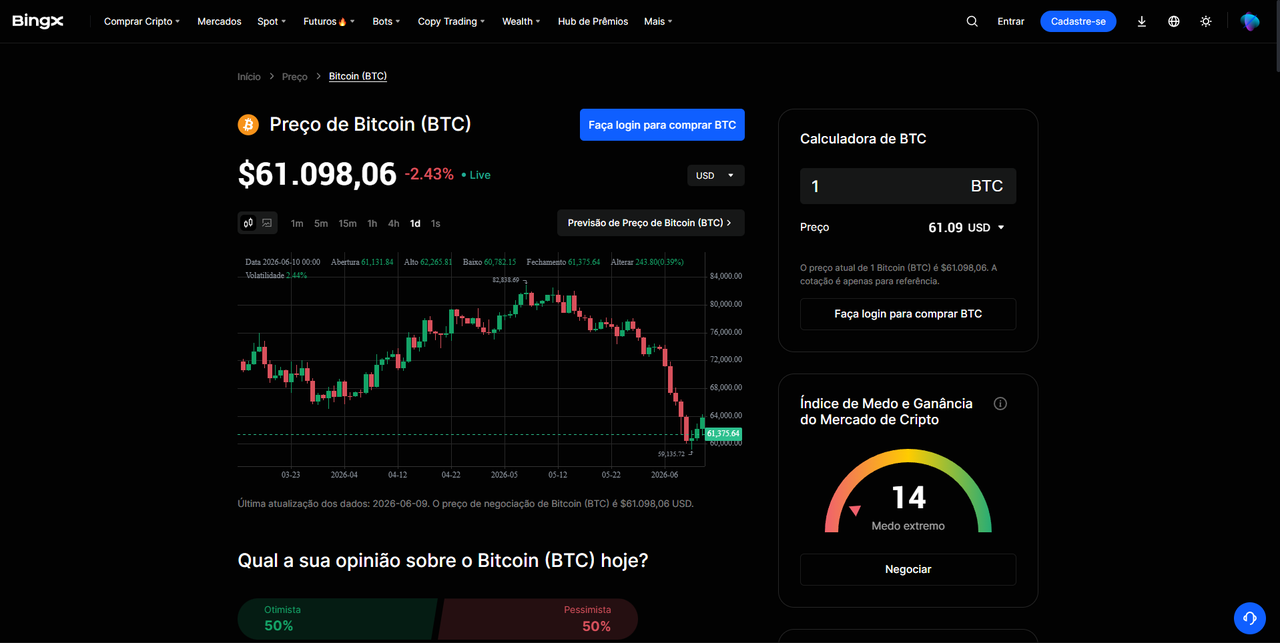
Bitcoin (BTC) Price Index on BingX
Core Risks Every Bitcoin ETF Investor Must Monitor
Volatility: Bitcoin is historically a high-beta asset. For instance, BITH11 has clocked an annualized volatility of 52.74% since inception—over three times the historical volatility of the Ibovespa index. The ETF wrapper does not cushion these drawdowns; it mirrors them perfectly. Deploying a robust risk management strategy is non-negotiable regardless of the chosen vehicle.
Tracking Error: All ETFs face performance drift relative to their underlying benchmark index. In the digital asset space, tracking error can widen significantly compared to traditional equities, particularly during periods of extreme intra-day volatility and market fragmentation.
Liquidity Risk: During systemic market stress, the bid-ask spread for lower-volume ETFs can widen aggressively, increasing slippage. HASH11 typically mitigates this due to its superior daily trading volume on B3. For those operating in the 24/7 spot market, the order book depth on BingX provides highly predictable execution metrics at any hour.
FX/Currency Risk (IBIT39): As a cross-border BDR, IBIT39 integrates BRL/USD exchange rate fluctuations into its net asset value (NAV). A strengthening Real can act as a drag on performance even if spot BTC ticks upward, while a depreciating BRL will amplify gains. Hedging or maintaining a portion of portfolio liquidity in dollar-pegged stablecoins can help balance this FX exposure.
Regulatory Shifts: The compliance framework for digital asset investment vehicles is still maturing in Brazil. Potential adjustments to CVM directives or local tax codes could alter the structural advantages of these funds. Conversely, global platforms operating as regulated VASPs and publishing transparent, real-time Proof of Reserves (PoR) offer a highly resilient environment adapted to evolving cross-border compliance standards.
FAQ: Frequently Asked Questions About Bitcoin ETFs in Brazil
1. What is BITH11 and how does it execute its mandate?
BITH11 is a B3-listed ETF issued by Hashdex that tracks the Nasdaq Bitcoin Reference Price to mirror spot BTC value. Purchasing shares provides regulated, passive exposure to Bitcoin without requiring self-custody or private key management. It carries an annual management fee of 0.70%.
2. Do Bitcoin ETFs distribute dividends or yields?
No. Digital asset ETFs do not generate dividend distributions because Bitcoin does not yield cash flows. Total returns are driven exclusively by capital appreciation reflected in the fund's NAV, tracking the spot market price of BTC.
3. What are the key structural differences between BITH11 and QBTC11?
Both products provide 100% pure spot exposure to Bitcoin but utilize different institutional pricing benchmarks. BITH11 tracks the Nasdaq Bitcoin Reference Price, whereas QBTC11 relies on the CME CF Bitcoin Reference Rate. In terms of performance, they are almost perfectly correlated. The primary distinction comes down to the asset manager and the management fee (0.70% p.a. for BITH11 versus 0.75% p.a. for QBTC11).
4. What is IBIT39 and why does it feature a lower management fee?
IBIT39 is a Brazilian Depositary Receipt (BDR) that maps directly to BlackRock's US-listed iShares Bitcoin Trust—the largest spot Bitcoin vehicle globally. While the underlying US fund has a low baseline fee of 0.25% p.a., the cross-border BDR structure embeds secondary custody overhead that pushes the total effective drag to roughly 0.55% p.a. Furthermore, IBIT39 embeds continuous BRL/USD currency risk.
5. Do Bitcoin ETFs qualify for the R$ 35,000 capital gains tax exemption?
No. Variable income assets and ETFs traded on the B3 do not qualify for monthly tax-free thresholds. All profitable liquidations trigger a flat 15% capital gains tax via monthly DARF settlement. The R$ 35,000 exemption limit applies strictly to spot crypto assets traded directly via crypto exchanges, or up to R$ 20,000 for spot domestic equities.
6. Is it better to allocate to a Bitcoin ETF or buy spot BTC directly?
The optimal path depends on your deployment volume, tax strategy, and required control. Direct exchange trading yields a monthly R$ 35,000 tax exemption, zero management fees, and 24/7 liquidity access. ETFs trade off those perks for extreme accounting simplicity, seamless integration with traditional brokerage accounts, and a CVM-regulated environment. For retail allocators looking for zero-overhead onboarding, the ETF wrapper provides the most frictionless bridge.
7. Which Bitcoin ETF offers the deepest liquidity pools on the B3?
HASH11 commands the highest average daily trading volume (ADTV) in Brazil’s crypto ETF landscape. For high-net-worth allocators or algorithmic traders executing large transactions, HASH11’s deep market liquidity significantly lowers execution slippage and entry/exit spreads.
8. How do I report a Bitcoin ETF on my Brazilian Income Tax Return (Imposto de Renda)?
ETF shares held as of December 31st must be reported under the "Bens e Direitos" section using their exact acquisition cost basis. Any profitable liquidation requires the investor to calculate the 15% tax liability manually and pay the corresponding DARF by the final business day of the following month.
Key Takeaways
- Brazil has positioned itself as a pioneer in regulated crypto products, offering CVM-compliant Bitcoin ETFs since 2021.
- Primary options for local investors in 2026 consist of BITH11, QBTC11, HASH11 (native B3 ETFs), and IBIT39 (a cross-border BlackRock BDR).
- BITH11 features the lowest fee among pure-play B3 BTC ETFs (0.70% p.a.); while IBIT39 advertises a 0.25% baseline rate, its true effective cost settles near 0.55% p.a. due to structural BDR custody expenses.
- B3-listed Bitcoin ETFs carry no tax exemptions. A flat 15% capital gains tax applies to all profitable liquidations regardless of trading size.
- Direct crypto trading on global platforms offers up to R$ 35,000 in monthly tax-exempt liquidations alongside 24/7 execution, but requires self-directed custody and manual tax reporting when exceeding limits.
- Management fees, tracking error metrics, and embedded currency volatility (specifically for IBIT39) remain the three critical variables determining long-term net performance.
- For market participants looking beyond passive index products, platforms like BingX allow users to trade spot BTC with deep global liquidity, execute perpetual futures with isolated/cross-margin modes, and deploy sophisticated automated toolsets.
Related Reads
- What Are the Top Spot Bitcoin ETFs to Watch in 2026?
- Bitcoin Spot vs. Futures: Why Prices Diverge and How to Trade the Basis
- Cross Margin vs. Isolated Margin on BingX Futures: The Ultimate 2026 Beginner's Guide
- How to Get Started with Spot Copy Trading on BingX
- How to Buy Bitcoin and Crypto with Credit or Debit Cards on BingX
