



BlackRock (BLK) is a global investment manager connecting institutional and individual investors with public markets, private assets and portfolio technology. Its iShares ETF franchise supplies a large fee engine, while private credit, infrastructure and Aladdin broaden the opportunity. Market performance, client inflows and the economics of this expanded platform determine whether growth in managed assets produces sustainable shareholder earnings.
The latest quarter showed broad client inflows and stronger adjusted profitability alongside meaningful accounting differences. BlackRock Q3 2026 revenue rose 19% to $7.752 billion and adjusted EPS increased 38% to $15.93. Adjusted operating margin reached 47.8%, versus 30% on a GAAP basis. The next test is sustaining organic fee growth as markets and performance fees fluctuate.
The BLK stock forecast for 2026 now centers on two competing views:
- The diversified fee growth case: ETF inflows, private-market fundraising and Aladdin subscriptions could deepen recurring earnings, allowing BlackRock to expand profitability beyond market appreciation alone.
- The market and integration pressure case: Lower asset values, weaker fundraising or acquisition costs could restrain fees and margins, leaving the shares vulnerable as earnings expectations rise.
This guide breaks down the BLK stock forecast, 2026 price scenarios, key risks and analyst outlooks, drawing on BlackRock’s October 14 earnings release, partnership disclosures and market data through October 21, plus how to buy BLK stock on BingX TradFi with USDT or USDC.
Top 5 Things for BlackRock Investors to Know in October 2026
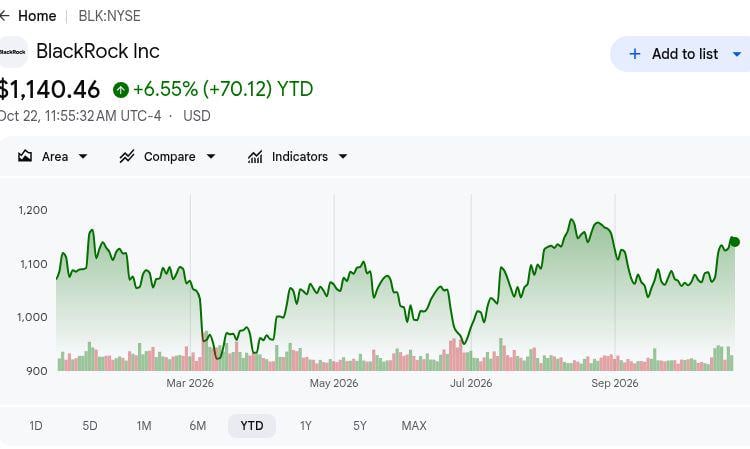
- BLK closed at $1,149.60 on October 21, up 7.41% YTD: Shares have gained this year, making the $1,400 bull scenario dependent on sustained earnings growth. Further upside will require stronger organic fee generation rather than relying solely on rising financial markets.
- Q3 revenue increased 19% to $7.752 billion. Base fees and securities lending contributed $6.036 billion, supported by higher assets under management and client activity. Continued inflows and recurring management fees will be important as performance-related revenue fluctuates.
- Assets under management reached $15.49 trillion: Quarterly net inflows totaled $205 billion, including approximately $135 billion into ETFs, reflecting strong investor demand. Sustained inflows, client retention, and favorable product mix could support recurring fee growth and profitability.
- Private markets and AI infrastructure create new growth opportunities: BlackRock raised $68 billion in private capital over twelve months, while its AI Infrastructure Partnership completed its first investment. Additional fundraising and successful deployments could expand long-term management fees and investment returns.
- Q3 share repurchases reached $550 million: Adjusted operating income totaled $3.330 billion, supporting shareholder distributions alongside platform expansion. Strong profitability provides financial flexibility, while disciplined acquisition spending and capital allocation remain important to long-term shareholder returns.
What Is BlackRock (BLK)?

BlackRock (BLK) is a global investment-management and financial-technology company serving pension funds, insurers, governments, financial intermediaries, and individual investors. Its asset-management business earns fees from managing client capital across public and private markets. Its iShares ETF lineup includes the iShares Bitcoin Trust ETF (IBIT), which tracks Bitcoin, and the iShares Semiconductor ETF (SOXX), which provides exposure to leading chip companies. BlackRock also offers active investment strategies, infrastructure, and private credit, while its Aladdin platform provides portfolio management and risk analytics. Revenue depends on assets under management, client inflows, product mix, performance fees, and technology subscriptions.
BlackRock's growth strategy focuses on expanding ETFs, private markets, and integrated investment technology. In August 2026, NVIDIA announced AI infrastructure financing initiatives involving BlackRock and five other financial institutions, targeting over $500 billion in combined third-party capital, subject to final agreements. BlackRock also raised $68 billion in private capital over twelve months, while its AI Infrastructure Partnership made its first investment during Q3. These initiatives aim to expand recurring management fees, strengthen institutional relationships, and support long-term earnings growth.
BlackRock (BLK) Q3 2026 Earnings Overview: ETF Inflows Lift Earnings as Costs Rise
BlackRock reported Q3 2026 revenue of $7.752 billion, up 19% year over year, supported by organic fee growth, favorable markets and higher performance fees. Adjusted diluted EPS increased 38% to $15.93, while GAAP diluted EPS rose 25% to $10.57 and total operating expenses increased to $5.424 billion, highlighting the importance of distinguishing underlying profitability from acquisition-related accounting. With $205 billion in net inflows and $15.49 trillion in managed assets, future growth depends on retaining clients, deploying private capital and preserving margins.
Read More: BlackRock (BLK) Q3 2026 Earnings Overview: Record $15.5T AUM and 11% Fee Growth Fuel a 0.72% Rally
|
Financial Metric |
Guidance / Consensus |
Reported / Actual |
Surprise |
|
Revenue |
$6.509B Q3 2025 |
$7.752B |
Improved. Up 19% YoY. |
|
Assets under management |
$13.464T Q3 2025 |
$15.488T |
Expanded. Up 15% YoY. |
|
Total net inflows |
$204.6B Q3 2025 |
$205.5B |
Sustained. Broad client demand. |
|
Base fees and securities lending |
$5.046B Q3 2025 |
$6.036B |
Improved. Up $990M YoY. |
|
Technology services revenue |
$515M Q3 2025 |
$588M |
Expanded. Up 14% YoY. |
|
GAAP diluted EPS |
$8.43 Q3 2025 |
$10.57 |
Improved. Up 25% YoY. |
|
Adjusted diluted EPS |
$11.55 Q3 2025 |
$15.93 |
Improved. Up 38% YoY. |
|
Adjusted operating margin |
44.6% Q3 2025 |
47.80% |
Improved. Up 3.2 points. |
- Q3 revenue increased 19% to $7.752 billion. Base fees and securities lending grew by $990 million, while markets and performance fees supported results. Sustained client inflows and broader fee growth will be important to maintaining earnings momentum.
- ETFs attracted approximately $135 billion in quarterly inflows. Fixed-income ETFs contributed $61 billion, demonstrating demand beyond equity-market exposure across a diverse product range. Continued client demand and ETF adoption could support earnings, although market conditions and product mix influence profitability.
- Adjusted EPS climbed 38% to $15.93 despite accounting pressure. GAAP EPS reached $10.57, while contingent-consideration expense totaled $564 million during the quarter. Stronger fee revenue supported profitability, but expense discipline will be important as acquisition accounting and investment income fluctuate.
- Private markets raised $68 billion over twelve months. The AI Infrastructure Partnership made its first deployment, expanding activity beyond listed investment products. The investments support diversified fee generation, with returns depending on capital deployment and sustained investment performance.
- Technology services revenue rose 14% to $588 million. Aladdin and multi-product solutions supported demand, with technology annual contract value growth reaching 12%. Retaining subscriptions, expanding client relationships, and completing deployments will be important to future recurring revenue growth.
BlackRock (BLK) 2026 Investment Outlook: $1,400 Bull Case vs. $950 Bear Case
BlackRock’s 2026 outlook depends on whether client inflows can sustain fee growth after a strong quarter for markets and investment income. Q3 adjusted operating margin reached 47.8%, while private fundraising and technology subscriptions broadened the platform. The following editorial scenarios test how asset values, capital deployment and operating discipline could shape shareholder returns through year-end.
The Bull Case: Strong ETF Inflows and Private Markets Push BLK Toward $1,400
Stronger client inflows could expand recurring fee income while private-market deployment adds higher-value investment mandates to the platform. Q3 net inflows reached $205 billion, with annualized organic base fee growth of 11%. Retaining those assets and extending Aladdin relationships would strengthen earnings without requiring a repeat of favorable nonoperating income.
The $1,400 scenario would gain support if broad inflows continue and organic fee growth remains strong through Q4. Durable operating leverage and productive private-capital deployment would provide stronger valuation support than market appreciation or accounting adjustments alone.
The Base Case: Steady Fee Growth Keeps BLK Between $1,100 and $1,250
Recurring management fees could sustain earnings as client demand remains positive but market and performance-fee benefits become less pronounced. Q3 base fees and securities lending revenue reached $6.036 billion, up $990 million year over year. Ongoing ETF adoption and technology contracts would support the business, while acquisition integration and compensation costs absorb some incremental revenue.
A $1,100 to $1,250 range would fit continued net inflows and stable profitability without another acceleration in market returns. Better private-market deployment could support the upper end, while a less favorable fee mix could limit the valuation investors assign to earnings.
The Bear Case: Weaker Markets and Fundraising Pull BLK Toward $950
Falling asset values could reduce management fees while weaker fundraising slows the expansion of higher-value private-market revenue. BlackRock ended Q3 with $15.49 trillion under management, leaving substantial earnings sensitivity to investment-market conditions. If client redemptions rise as acquisition and technology spending remain elevated, lower revenue could translate into disproportionate pressure on operating earnings.
The $950 scenario would become more likely if net inflows reverse and organic fee growth weakens alongside declining markets. Lower margins or disappointing private-asset performance would then reduce confidence in recurring earnings, leaving less support for the current valuation multiple.
BLK Stock Price Forecasts for 2026 By Wall Street Analysts
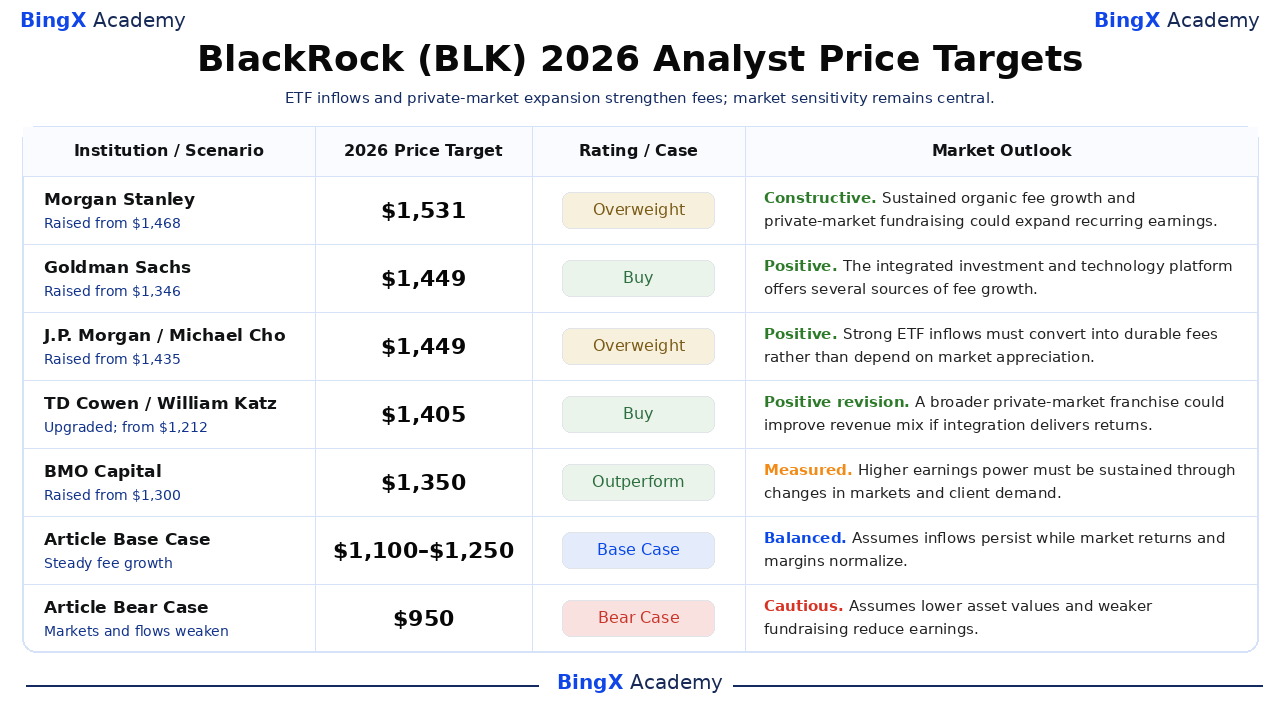
These named, dated targets refer to BlackRock’s NYSE-listed shares and generally cover approximately 12 months, extending beyond calendar 2026. The selected $1,350 to $1,531 range reflects differing expectations for fee growth and earnings durability. The final two rows are separate editorial year-end scenarios; accompanying business interpretations are this article’s analysis.
|
Institution / Scenario |
2026 Price Target |
Rating / Case |
Market Outlook |
|
Morgan Stanley |
$1,531 |
Overweight |
Constructive. October 16, 2026: Raised from $1,468 to $1,531; Overweight rating. Editorial view: Sustained organic fee growth and private-market fundraising could expand recurring earnings. |
|
Goldman Sachs |
$1,449 |
Buy |
Positive. October 15, 2026: Raised from $1,346 to $1,449; Buy rating. Editorial view: The integrated investment and technology platform offers several sources of fee growth. |
|
J.P. Morgan |
$1,449 |
Overweight |
Positive. October 15, 2026: Raised from $1,435 to $1,449; Overweight rating. Editorial view: Strong ETF inflows must convert into durable fees rather than depend on market appreciation. |
|
TD Cowen |
$1,405 |
Buy |
Positive revision. October 20, 2026: Upgraded to Buy and raised from $1,212 to $1,405; Editorial view: A broader private-market franchise could improve revenue mix if integration delivers returns. |
|
BMO Capital |
$1,350 |
Outperform |
Measured. October 19, 2026: Raised from $1,300 to $1,350; Outperform rating. Editorial view: Higher earnings power must be sustained through changes in markets and client demand. |
|
Article Base Case |
1,100–1,250 |
Base Case |
Balanced. Assumes steady inflows and fee growth as markets and margins normalize through December 2026. |
|
Article Bear Case |
$950 |
Bear Case |
Cautious. Assumes lower asset values and weaker fundraising reduce earnings through December 2026. |
How to Buy BlackRock (BLK) Stock on BingX
Buy and hold BlackRock shares through BingX Stocks Trading using USDT or USDC, subject to listing and account eligibility. BlackRock offers exposure to global asset management, ETFs, private markets and portfolio technology. Eligible users can size holdings according to their investment goals without using leverage or paying perpetual funding fees.
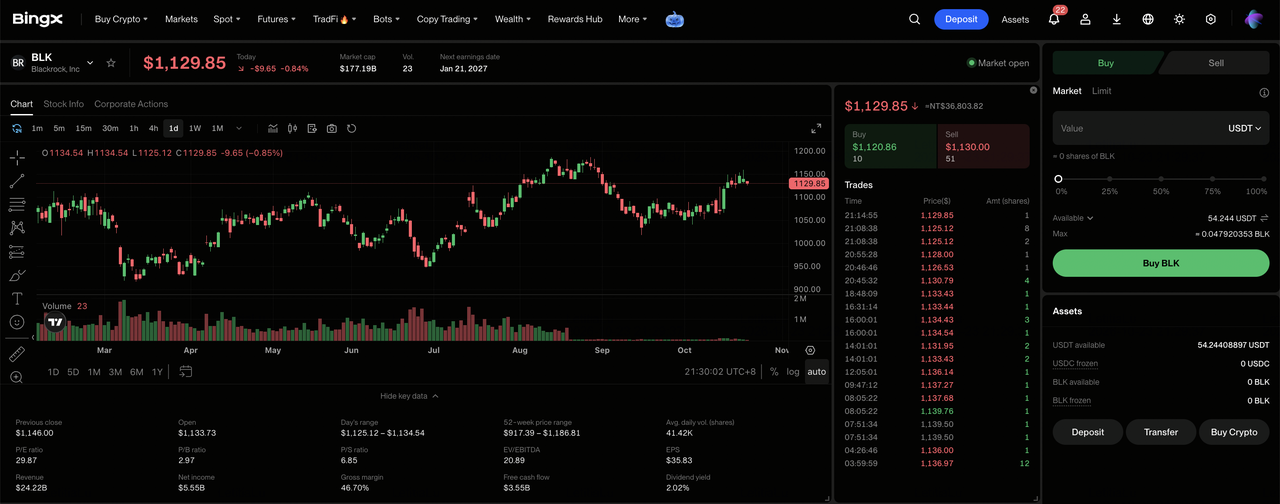
Step 1: Access BingX Stocks Trading. Sign up or log in to BingX, complete the required identity verification, and navigate to “TradFi > Stocks”. Accept the Stock Trading Risk Disclosure if accessing the product for the first time.
Step 2: Prepare USDT or USDC. Ensure your Spot Account has sufficient funds for the purchase. Transfer USDT or USDC from your Fund Account or Wealth Account if needed. Review the selected stock’s minimum order amount and fractional eligibility before choosing the investment size.
Step 3: Select BlackRock (BLK). Open the Stocks market, search for BlackRock (BLK), and confirm that the share is available to your account. Review the company identity, current share price, trading session and available order types.
Step 4: Buy BlackRock Shares. Select “Buy”, enter an allowed investment amount or share quantity, and choose a supported market or limit order. Market orders use available prices during supported sessions, while limit orders require the specified price or better and sufficient liquidity to execute.
Step 5: Review and Manage Your Holdings. Open “Stocks > Positions” to monitor your BLK shares and unrealized profit or loss. Use All Orders to review transactions or sell shares when needed. T+1 settlement generally affects when sale proceeds become withdrawable, rather than when purchased shares can be sold.
Top 5 Risks to Watch for BlackRock Investors in 2026
BlackRock’s global client base, expanding private-market franchise, and diversified investment platform support its earnings outlook. However, market volatility, operating costs, fundraising delays, and integration demands could pressure profitability and shareholder returns.
- Weaker asset values could pressure management fees: Q3 assets under management reached $15.49 trillion, supporting a large recurring fee base. Lower market valuations or client balances could reduce revenue and operating earnings.
- Rising operating costs could constrain margins: Q3 GAAP operating expenses reached $5.424 billion, including acquisition-related accounting costs. Higher compensation and infrastructure costs could weaken profitability if management fees and technology revenue grow more slowly.
- Private-market deployment delays could limit fee growth: BlackRock raised $68 billion in private markets over twelve months, creating investment obligations. Delayed investments, fund closings, or institutional mandates could reduce future revenue visibility.
- Acquisition integration could weaken shareholder returns: Q3 contingent-consideration expense reached $564 million, illustrating acquisition-related earnings sensitivity. Integration problems or additional investment needs could limit incremental operating profit and reduce shareholder value.
- Weaker investment performance could pressure valuation: Q3 adjusted operating margin reached 47.8%, supported by expanding fee income. Slower inflows, weaker private-asset returns, or rising costs could reduce earnings and trigger share-price declines.
Final Thoughts: Should You Invest in BlackRock in 2026?
BlackRock’s $15.49 trillion in managed assets and $205 billion in quarterly net inflows highlight its ability to attract capital across investment categories. The iShares franchise, private markets and Aladdin provide fee growth beyond a single asset class, while share repurchases support per-share returns. Sustaining that growth will depend on retaining assets, deploying capital productively and controlling expenses.
The $1,400 bull case assumes strong client inflows, continued fee expansion and successful private-market deployment. The $1,100 to $1,250 base case reflects steady operations, while the $950 bear case accounts for weaker markets and fundraising. With BLK closing at $1,149.60 on October 21, investors should watch whether organic growth translates into sustainable earnings per share.
Risk Reminder: BlackRock’s diversified investment platform does not eliminate investment risk. Falling asset values, weaker fundraising, or acquisition integration problems could reduce earnings and shareholder returns. Investors should assess valuation, financial performance, and their risk tolerance before buying BLK shares.
Related Reading
- Top Financial Services and Fintech Stocks to Buy in 2026 Amid Agentic AI, Stablecoin Rails Shift
- NVIDIA (NVDA) Price Prediction 2026: Can AI Infrastructure Growth Drive NVDA Toward $420?
- Goldman Sachs (GS) Price Prediction 2026: Can Record Equities Revenue Lift GS Toward $1,150?
- JPMorgan Chase (JPM) Price Prediction 2026: Can Rising Interest Income Drive JPM Toward $425?
- Wells Fargo (WFC) Price Prediction 2026: Can Rising Interest Income Push WFC Toward $105?
- Morgan Stanley (MS) Price Prediction 2026: Can Wealth Management Growth Drive MS Toward $230?
