
In April 2026, the Direxion Daily Semiconductor Bull 3X Shares (SOXL) has cemented itself as the ultimate greed vs. fear barometer for the AI era. After skyrocketing over 944% in the last 12 months, the ETF reached a historic peak of $130 before a sharp 3.84% correction on April 27 sent ripples through the retail trading community. While the Agentic Web and autonomous on-chain workflows drive insatiable demand for silicon, a legendary contrarian has entered the fray: Michael Burry.
The Big Short investor recently revealed a massive put position on the underlying SOXX index, claiming the sector is in a technical bubble that must return to earth. As SOXL’s RSI (relative strength index) hits an eye-watering 94, traders are caught between a generational tech supercycle and a classic blow-off top.
This guide breaks down the SOXL price prediction for 2026 using technical data, single-stock catalysts like Intel and NVIDIA, and how to trade SOXL futures with Tether (USDT) on BingX TradFi.
Top 5 Things for SOXL ETF Investors to Know in 2026
As the semiconductor sector faces extreme 300% daily leverage swings, investors must monitor these five factors:
- The Burry Omen: Michael Burry’s purchase of January 2027 $330 Puts on the iShares Semiconductor ETF (SOXX) signals a high-conviction bet that the current AI infrastructure mania is nearing a cyclical peak.
- The RSI 94 Warning: SOXL recently entered extremely overbought territory with an RSI of 94. Historically, such levels precede sharp, multi-day corrections of 15%–30% in leveraged products.
- Intel’s Terafab Catalyst: The joint venture between Elon Musk's Tesla and Intel on the Terafab project is positioning Intel as a legitimate foundry rival to TSMC, potentially shifting the internal weightings of the ICE Semiconductor Index.
- Agentic AI Demand: The shift from LLMs to Agentic AI autonomous agents is requiring a 4x increase in inference-at-the-edge hardware, creating a structural floor for chip demand through late 2026.
- Volatility Decay: Investors are reminded that SOXL is a daily trading tool. Holding through 2026 involves significant beta slippage risk, where the fund can lose value even if the index remains flat.
What Is the Direxion Daily Semiconductor Bull 3X (SOXL) Leveraged ETF?
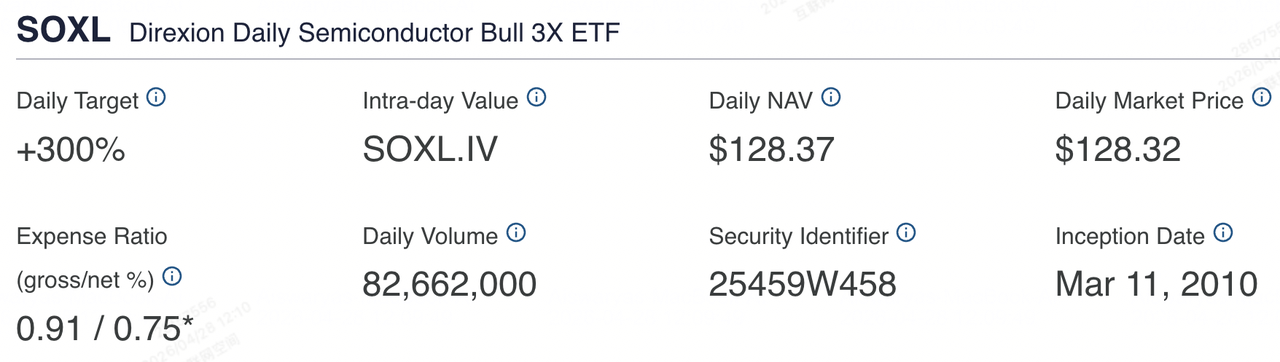
Direxion Daily Semiconductor Bull 3X Shares (SOXL) market price and NAV as of April 2026 | Source: Direxion
The Direxion Daily Semiconductor Bull 3X Shares (SOXL) is a leveraged ETF designed to deliver 300% of the daily performance of the ICE Semiconductor Index. This index tracks 30 of the largest U.S.-listed semiconductor firms, including NVIDIA (NVDA), Broadcom (AVGO), and AMD.
Managed by Direxion, SOXL utilizes complex financial derivatives and swaps to amplify returns. With a net expense ratio of 0.75%, it is one of the most liquid instruments for betting on the AI revolution. However, because it rebalances daily, it is notoriously volatile and primarily intended for short-term tactical plays.
A Review of the Semiconductor Sector Performance in 2025
The Great AI Build-out of 2025 saw semiconductors decouple from the broader Nasdaq. While the S&P 500 rose a respectable 29%, the semiconductor sector rallied over 150%. This was driven by the tokenization of Real-World Assets (RWAs) and the integration of blockchain into data centers, where specialized hardware like Scrypt ASICs and AI-optimized GPUs became the new global currency. This momentum carried SOXL from a low of $10.75 to its 2026 highs near $130.
SOXL 2026 Investment Outlook: $200 Bull Run vs. $65 Bear Case
Navigate the 3X volatility of the Agentic Web by weighing these three probability-weighted scenarios for SOXL through the remainder of 2026.
The Bull Case: SOXL's $200 SuperCycle Moonshot
The bullish narrative centers on a structural shift where semiconductors evolve from cyclical commodities to Agentic Infrastructure essentials. The primary catalyst is the Intel-Tesla Terafab synergy; if Intel’s 14A process achieves high-volume manufacturing (HVM) for xAI’s Colossus clusters, it validates a massive expansion in the ICE Semiconductor Index's underlying valuation. This prepayment mania, where hyperscalers secure 5-year HBM4 and Blackwell-series chip capacity with upfront cash, creates a supply floor that prevents price depreciation despite high interest rates.
Practically, this scenario requires the ICE Semiconductor Index to sustain a monthly growth rate of just 5%–7%. Due to the mechanics of daily compounding in a low-volatility uptrend, SOXL can mathematically outpace its 3x mandate. If NVIDIA and Broadcom continue to beat whisper numbers on 40% CapEx growth from the Magnificent Seven, SOXL is positioned to breach the psychological $200 barrier by late Q4, fueled by a permanent re-rating of AI infrastructure multiples.
The Base Case: The $115 – $145 Range-Bound Grind for SOXL ETF
The base case anticipates a Time Correction rather than a Price Crash. Following the historic 17-day win streak in April 2026, the market enters a distribution phase to digest the 944% trailing twelve-month (TTM) gains. Technical support is anchored at the $112.77 volume shelf, where institutional dip-buying typically offsets Michael Burry-inspired retail fear. In this environment, the RSI cools from its extreme 94 level toward a neutral 50, allowing moving averages to catch up with the vertical price action.
For traders, this scenario demands a focus on range-trading and mean reversion. As the market pivots toward Inference at Scale, volatility likely clusters around Federal Reserve PCE prints and quarterly earnings from key holdings like Micron and AMD. SOXL will likely oscillate between a $115 floor and $145 ceiling, making it an ideal period for selling covered calls or utilizing short-term swing strategies rather than buy-and-hold positions that suffer from daily leverage decay (beta slippage).
The Bear Case: SOXL ETF's Michael Burry’s $65 "Return to Earth" Valuation
The bear case is predicated on CapEx Fatigue and the burst of the technical AI bubble. If Oracle’s reported order cancellations signal a broader inventory glut at Super Micro or NVIDIA, the Peak Earnings Trap is sprung. Michael Burry’s high-conviction short position targets the widening divergence between falling consumer spot prices and artificial contract price hikes. A decisive break below the 50-day moving average around $82 would trigger systematic trend-following liquidations, turning the 3x leverage against the bulls.
This waterfall effect is exacerbated by software breakthroughs like Google’s TurboQuant, which could slash physical memory requirements by 6x, effectively ending the hardware shortage narrative overnight. From a technical standpoint, a failure to hold the $110 psychological level exposes a massive air pocket in the charts, potentially dragging SOXL back to the $65–$75 zone. This would represent a classic 50% retracement of the 2026 rally, punishing late-cycle investors who ignored the overbought RSI signals.
SOXL Analyst Forecasts and Price Targets for 2026
|
Institution |
2026 Price Target (SOXL) |
Market Outlook |
|
StockInvest.us |
$166.89 |
Buy: Expects 30% rise in the next 3 months. |
|
Michael Burry |
<$80.00 (Implied) |
Sell: Claims the boom is technical and unsustainable. |
|
TradingKey |
$112.00 |
Hold: Cites volatility and peak earnings trap. |
How to Trade SOXL ETF Futures on BingX TradFi
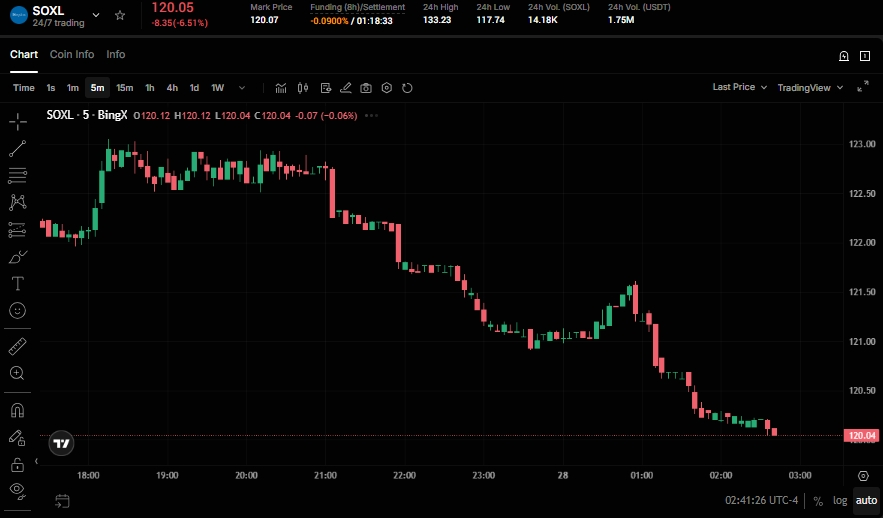
SOXL/USDT perpetual contract on the BingX futures market
Maximize your precision in the semiconductor market by leveraging BingX AI tools to identify optimal entry points during the 2026 cycle.
- Access TradFi: Log in to BingX, go to TradFi, and select Stocks.
- Locate SOXL: Search for the SOXL/USDT perpetual contract.
- Analyze Sentiment: Use the extremely bullish retail sentiment indicator but cross-reference with the RSI levels.
- Execute: Select Open Long if you believe in the Terafab breakthrough, or Open Short to follow Burry’s contrarian lead.
- Set Stops: Set tight stop-loss orders for short-term trades.
Top 5 Risks to Watch for SOXL Investors in 2026
While the upside potential of the Agentic Web is vast, the inherent 300% leverage of SOXL subjects traders to a unique set of structural and macroeconomic tripwires that could derail the 2026 rally.
- The Peak Earnings Trap: As seen with Micron (MU), low P/E ratios in semis can be deceptive; if earnings are at a cyclical peak, a low valuation actually signals an imminent contraction rather than a bargain.
- Leverage Decay or Beta Slippage: Because SOXL rebalances daily to maintain 3X exposure, a choppy sideways market can erode your principal even if the underlying index remains flat over a long period.
- Geopolitical Supply Chain Flares: With a heavy concentration of manufacturing in the Pacific, any escalation in regional trade restrictions or regional instability remains the primary Black Swan for the index's top 30 holdings.
- CapEx Fatigue Among Hyperscalers: If major cloud providers like Microsoft or Amazon signal a pause in AI infrastructure spending, the massive capacity currently under construction could transform into a catastrophic supply glut.
- Systemic Burry Sentiment: Michael Burry’s high-profile short position creates a psychological resistance level; if his 'Return to Earth' thesis gains mainstream traction, it could trigger a cascade of automated sell programs and retail liquidations.
Final Thoughts: Is SOXL Semiconductor Leveraged ETF a Good Buy in 2026?
The investment thesis for SOXL in 2026 is a study in extreme divergence between secular growth and technical exhaustion. While the fundamental tailwinds of the Agentic Web and Intel’s foundry expansion provide a robust long-term narrative, the immediate technical setup, characterized by a record-high RSI and Michael Burry’s high-conviction short, suggests that the easy money phase of this rally has peaked. For tactical participants, the strategy shifts from aggressive accumulation to capital preservation, prioritizing entry points near the $100–$112 support zone where historical volume clusters may provide a safer floor against volatility.
Practical execution in this high-beta environment requires a move away from 'buy-and-forget' mentalities toward disciplined risk management. Investors should monitor the 50-day moving average as a critical line in the sand; a failure to hold this level would validate the bear case and necessitate a defensive posture. Ultimately, SOXL remains a powerful tool for capturing the AI supercycle, but its efficacy in 2026 depends entirely on a trader's ability to navigate the inevitable 'return to earth' corrections without succumbing to the compounding effects of leverage decay.
Risk Reminder: SOXL is a leveraged financial product that provides 300% daily exposure to its underlying index. It is designed for short-term trading; due to daily rebalancing and volatility decay, it is not suitable for long-term 'buy and hold' portfolios. A 33.3% decline in the benchmark index in a single day would result in a total loss of principal. Always utilize stop-losses and ensure leveraged positions constitute only a small fraction of your overall portfolio.
Related Reading
- TSMC (TSM) Price Prediction 2026: AI Monopoly or Geopolitical Trap at $480?
- Arm Holdings (ARM) Stock Outlook 2026: AI Licensing and the $200+ Price Target
- Nvidia (NVDA) Stock Price Outlook for 2026: Can Blackwell and Vera Rubin Take NVDA Back to $300?
- Intel (INTC) Stock Forecast 2026: Foundry Breakthrough to $89 or Value Trap?
- Roundhill Memory ETF (DRAM) Forecast 2026: $1.5B AI Supercycle or 'RAMmageddon' Trap?
