
When General Electric completed its transformation into a pure-play aerospace company with the spinoff of GE Vernova in April 2024, it emerged as a focused engine manufacturer with an installed base of approximately 80,000 engines, a $190 billion order backlog, and a management team that had spent years rebuilding margins and supply chain capacity. The repositioning was well received by the market, with GE stock rising about 64% over the past year and reaching an all-time high of $348.48 in February 2026.
Macro conditions introduced some friction in early 2026. Escalating US-Iran tensions pushed crude oil prices above $100 per barrel, triggering a broader risk-off rotation across industrial equities. GE shares pulled back to around $315 by mid-March, weighed by rising fuel costs affecting airline customers, renewed tariff uncertainty, and ongoing supply chain risks tied to rare-earth materials. At the same time, the company reported record full-year 2025 results in January, issued above-consensus 2026 guidance, expanded its AI partnership with Palantir Technologies for defense readiness in March, and secured major engine contracts with leading airlines. Whether these drivers can support a move toward the $350 to $400 range remains the key question for investors in 2026. This guide examines the outlook using the latest data from Bernstein, Morgan Stanley, UBS, JP Morgan, Deutsche Bank, and Wolfe Research.
Note: GE Aerospace's fiscal year runs on a calendar-year basis. Full-year 2025 results were reported on January 22, 2026. The next earnings report covers Q1 2026 and is scheduled for April 21, 2026.
Key Highlights: Top 5 Things GE Aerospace Investors Should Know in 2026
GE Aerospace’s 2026 outlook reflects strong momentum in commercial aviation and defense, set against a more cautious macro environment. Here are five key metrics shaping the investment case.
- 2025 revenue reached $42.3B, up 21% YoY: GE Aerospace delivered record adjusted revenue of $42.3 billion in 2025, with operating profit rising 25% to $9.1 billion and free cash flow increasing 24% to $7.7 billion. Commercial Engines and Services saw 26% services revenue growth, while LEAP engine deliveries exceeded 1,800 units, setting a program record.
- Q4 orders jumped 74% to $27B; backlog at ~$190B: Fourth-quarter orders surged to $27 billion, driven by strong demand across commercial and defense segments. The backlog reached approximately $190 billion, up nearly $20 billion year over year, providing close to five years of revenue visibility.
- 2026 guidance implies double-digit growth: Management guided 2026 adjusted EPS to $7.10–$7.40, with a midpoint of $7.25 above prior consensus of $7.12. Operating profit is expected at $9.85–$10.25 billion, with free cash flow of $8.0–$8.4 billion, pointing to continued double-digit growth.
- Expanded Palantir AI partnership for defense readiness: In March 2026, GE Aerospace expanded its partnership with Palantir to deploy AI solutions across US Air Force programs and internal operations. The collaboration focuses on supply chain automation, predictive maintenance, and improving mission readiness.
- Strong Buy consensus with targets around $350–$360: Most analysts maintain Buy or Outperform ratings, with an average 12-month price target between $350 and $360 across roughly 20 firms. Bernstein holds a Street-high target of $405, while Morgan Stanley initiated with an Overweight rating and a $425 target.
What Is GE Aerospace (GE)?
General Electric Company, now operating as GE Aerospace (NYSE: GE), is a leading manufacturer of commercial and military aircraft engines, turboprop systems, and aviation services. Headquartered in Evendale, Ohio, GE traces its origins to 1892 and today operates as a focused aerospace company following the breakup of its former conglomerate structure.
Investors buying General Electric stock today are investing in GE Aerospace exclusively. The company is separated into three independent public entities:
- GE HealthCare (Nasdaq: GEHC): spun off in January 2023, focused on medical technology
- GE Vernova (NYSE: GEV): spun off in April 2024, focused on energy and grid solutions
- GE Aerospace (NYSE: GE): the remaining aviation-focused business
GE Aerospace is now the sole business represented by the GE ticker.
GE Aerospace operates through two core segments. Commercial Engines and Services designs, manufactures, and services jet engines for commercial and business aviation, including the CFM56 and LEAP families through its CFM International joint venture with Safran. Defense and Propulsion Technologies develops engines and systems for government customers, including the F110 and F135 fighter jet engines.
The company supports an installed base of approximately 80,000 engines globally, including around 50,000 commercial and 30,000 military units, and employs roughly 57,000 people.
GE Aerospace’s Strategic Evolution (1892 to 2026): From Conglomerate to Pure-Play Aviation Leader
GE’s aviation business was built over decades of military and commercial engine programs, establishing leading positions in both narrowbody and widebody propulsion. The broader conglomerate’s expansion into financial services added complexity that weighed on valuation. A decade of restructuring, including the exit from GE Capital, the separation of GE HealthCare, and the spinoff of GE Vernova, ultimately resulted in a focused aerospace company with clear advantages in propulsion and services.
The current model is centered on recurring services revenue. With approximately 80,000 engines in operation worldwide, GE Aerospace generates aftermarket income over each aircraft’s lifecycle, typically spanning 20 to 30 years. CEO Larry Culp’s FLIGHT DECK lean operating system has improved supply chain efficiency and expanded production capacity, driving consistent gains in throughput and turnaround times.
GE Aerospace's Key Growth Phases
- Conglomerate Era and Aviation Leadership (pre-2020): GE built its aviation unit into one of the most profitable segments within a diversified industrial group. The CFM56 became the dominant narrowbody engine globally, supported by a strong aftermarket business through long-term service agreements.
- Restructuring and Pandemic Recovery (2020–2023): The COVID-19 shock reduced flight activity and engine service demand. GE used this period to cut costs, improve LEAP production, and advance its separation from the broader conglomerate. As travel recovered, aftermarket revenue rebounded strongly through 2023.
- Pure-Play Growth Phase (2024–Present): Following the GE Vernova spinoff, GE Aerospace began operating as a standalone company. Revenue, EPS, and free cash flow have grown at double-digit rates, supported by record engine deliveries, rising aftermarket demand, and a ~$190 billion backlog. The company is investing over $1 billion in MRO capacity to meet demand through the decade.
GE Aerospace 2025 Performance Overview: Record Revenue, Backlog Growth, and Strong 2026 Guidance
GE Aerospace delivered its strongest results as a standalone company in 2025, reporting record revenue, operating profit, and free cash flow, alongside 2026 guidance that exceeded expectations at the midpoint.
1. Revenue grew 21% to $42.3B, with strong margin expansion
Adjusted revenue reached $42.3 billion, up 21% year over year, driven by growth across both segments. Commercial services revenue rose 26% on higher shop visits and improved material availability, while LEAP deliveries exceeded 1,800 units, up 28%. Defense revenue grew 11%, with engine deliveries up 30%. Operating profit increased 25% to $9.1 billion, and free cash flow rose 24% to $7.7 billion, with cash conversion above 110%.
2. Q4 orders surged 74%; backlog reached ~$190B
Q4 revenue rose 20% to $11.9 billion, beating consensus of ~$11.2 billion, while EPS of $1.57 exceeded expectations of $1.43. Orders surged 74% to $27 billion, with commercial services up 35% and defense up 61%. Backlog reached approximately $190 billion. Shares fell ~7% post-earnings as investors focused on guidance normalization and margin mix from higher equipment shipments.
3. 2026 guidance signals continued double-digit growth
Management guided to low double-digit revenue growth and EPS of $7.10–$7.40, implying ~15% growth at the midpoint. Operating profit is expected at $9.85–$10.25 billion, with free cash flow of $8.0–$8.4 billion and conversion above 100%. The company plans to invest over $1 billion in MRO capacity and returned $7.4 billion to shareholders in 2025, while raising its dividend 31% to $0.47.
4. Major contracts reinforce long-term demand visibility
Recent wins include United Airlines selecting 300 GEnx engines for Boeing 787 aircraft, Qatar Airways awarding over 400 GE9X and GEnx engines, and defense contracts including $5 billion for F110 engines and $1.4 billion for US Marine Corps helicopters. These agreements support backlog visibility through the decade.
The GE Aerospace Investment Thesis for 2026: 4 Pillars of GE Stock Valuation
The investment case for GE Aerospace in 2026 rests on sustained aviation demand, high-margin recurring services revenue, defense spending growth, and continued operational improvements. These four drivers underpin the long-term outlook.
1. The aviation aftermarket supercycle drives high-margin recurring revenue
Aircraft engines require regular maintenance and overhaul, generating recurring, high-margin service revenue. With Boeing and Airbus production constraints extending aircraft lifecycles, shop visits and spare parts demand have exceeded prior expectations. GE Aerospace expects mid-teens growth in commercial services revenue in 2026 and continues to expand MRO capacity to support this demand.
2. LEAP engine dominance creates a long-term revenue pipeline
The CFM LEAP engine powers the Boeing 737 MAX and Airbus A320neo, the two leading narrowbody platforms. With order books extending into the early 2030s, LEAP deliveries are set to grow, with GE targeting over 2,000 units in 2026. Each engine generates 20 to 30 years of aftermarket revenue, and the program is expected to turn profitable at the engine level as production scales.
3. Defense growth provides a second revenue engine
Rising global defense budgets and US program wins drove defense revenue up 11% in 2025, with Q4 orders surging 61%. GE’s expanded partnership with Palantir in March 2026 adds AI-driven capabilities across mission readiness and supply chain operations. Management guides defense revenue to grow mid-to-high single digits in 2026.
4. FLIGHT DECK supports continued margin expansion
GE’s FLIGHT DECK operating system has improved efficiency across production and supply chain operations. In 2025, supplier material input rose over 40% year over year, while shop visit turnaround times improved more than 10% in Q4. Despite near-term mix pressure, management expects stable margins in 2026, with potential expansion beyond the 2025 level of 21.4% as productivity gains continue.
GE Aerospace (GE) Price Forecasts for 2026: Bull vs. Bear Outlook
Wall Street maintains a broadly constructive view on GE Aerospace in 2026, with a Strong Buy consensus and an average 12-month price target of $350 to $360. Estimates range from roughly $279 to $425, reflecting different assumptions around aftermarket growth, GE9X program losses, and macro conditions affecting airline demand.
Institutional Price Targets for GE Aerospace (GE) in 2026
|
Institution |
Price Target |
Rating / Outlook |
|
Morgan Stanley |
$425 |
Overweight. Initiated February 2026. Cites strong aerospace and defense positioning, aftermarket supercycle tailwinds, and the Palantir AI partnership as long-term re-rating drivers. |
|
Bernstein (Douglas Harned) |
$405 (raised from $374) |
Outperform. Target raised March 3, 2026. Sees widebody services growth and sustained shop visit demand as key catalysts following review of 2025 results and 2026 guidance. |
|
Deutsche Bank |
$387 (raised from $375) |
Buy. Target raised January 23, 2026. Points to the depth of the commercial order book and LEAP program margin improvement as primary re-rating drivers. |
|
UBS |
$374 |
Buy. Initiated January 23, 2026. Highlights GE's leading position in narrowbody propulsion and the high recurring revenue quality of the aftermarket services model. |
|
Wolfe Research |
$360 (raised from $340) |
Outperform. Target raised January 12, 2026. Views commercial aviation super-cycle and defense budget growth as mutually reinforcing tailwinds through 2027. |
|
JP Morgan |
$335 |
Overweight. Target raised January 26, 2026. Constructive but acknowledges near-term margin mix headwinds from higher OEM shipments and GE9X program losses. |
|
Wall Street Consensus |
~$350 to $360 |
Strong Buy. Approximately 16 Buy and 2 Hold ratings. Consensus implies roughly 10% to 15% upside from mid-March 2026 levels near $315. |
The Bull Case: Aftermarket Strength and Defense Momentum Support $375 to $425
The bull case is driven by continued strength in the aviation aftermarket, with engine shop visit volumes expected to rise as aging fleets require more frequent servicing. Additional LEAP test cell capacity in 2026 should improve throughput, while the expanded Palantir partnership adds operational efficiency on the defense side. If earnings land near the top of the $7.10 to $7.40 guidance range and GE9X losses stabilize, the stock could move toward $375 to $425. Morgan Stanley’s $425 target reflects confidence in GE’s positioning across both commercial and defense aerospace markets.
The Bear Case: Valuation and Macro Risks Keep GE Near $275 to $300
The bear case centers on valuation and macro pressure. GE trades at roughly 44x forward earnings, above the sector average of ~34x and peers such as RTX near 30x, leaving limited room for disappointment. Even in-line results can trigger downside, as seen in the ~7% post-earnings decline in January 2026. At the same time, GE9X losses are expected to increase as shipments scale, while oil prices above $100 per barrel and tariff-related costs weigh on airline spending. If these headwinds persist, the stock could remain in the $275 to $300 range until later earnings provide clearer direction.
What Could Move GE Aerospace (GE) Stock in 2026: 2 Key Catalysts
Two developments are likely to shape GE Aerospace’s near-term direction: the Q1 2026 earnings release and the trajectory of commercial aviation demand under elevated oil prices.
1. Q1 Earnings Must Confirm Aftermarket Strength to Support Upside
GE Aerospace will report Q1 2026 results on April 21. Investors will focus on whether commercial services growth remains on track with mid-teens full-year guidance, particularly through LEAP shop visit volumes and spare parts revenue. Updates on the GE9X loss trajectory and continued progress from FLIGHT DECK supply chain improvements will also be key.
CEO Larry Culp noted at the Q4 earnings call that early-year trends did not signal weakness in the commercial aftermarket. A strong Q1 print could help narrow the gap between the current share price and the $350 to $360 consensus target range.
2. Oil Prices Will Determine Whether Aviation Demand Holds Up
Oil prices above $100 per barrel create margin pressure for airlines, which could slow aircraft orders or delay maintenance spending, weighing on GE’s services revenue. However, the structural demand for fleet expansion, particularly in emerging markets, remains intact.
Analysts at Wolfe Research and Deutsche Bank note that even moderate capex softening is unlikely to materially impact 2026 earnings given the scale of GE’s backlog. A move in oil prices back below $90 would likely act as a positive catalyst, easing pressure on airline economics and supporting sentiment across the aerospace sector.
How to Trade GE Aerospace (GE) on BingX
BingX offers traders exposure to GE Aerospace's stock price through USDT-settled perpetual futures on BingX TradFi, allowing users to take long or short positions on GE without opening a traditional brokerage account. Availability varies by region and regulatory requirements.
Long or Short GE Aerospace (GE) Stock Perpetuals with USDT on BingX Futures
You can trade GE Aerospace stock perpetual futures on BingX TradFi using USDT to gain leveraged exposure or take both long and short positions. These USDT-settled contracts track the GE stock price and have no expiry date.
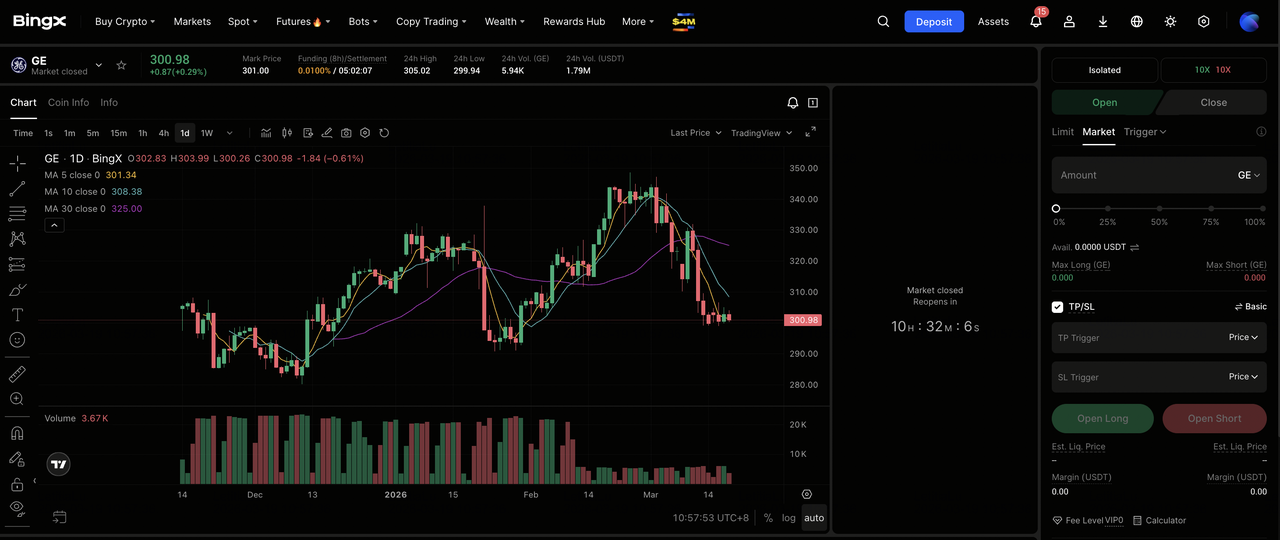
- Create and secure your BingX account: Register on BingX, complete identity verification (KYC) if required, and enable two-factor authentication (2FA) to protect your account.
- Deposit USDT or supported assets: Transfer USDT or other supported stablecoins into your BingX wallet. Select the correct blockchain network and review any minimum deposit requirements or fees before proceeding.
- Find the GE/USDT perpetual contract: Navigate to the BingX Futures section, select Stock Futures, and search for the GE/USDT perpetual contract. Review the current price, funding rate, and open interest. GE Aerospace follows the NYSE schedule, with regular hours from 9:30 AM to 4:00 PM Eastern Time, Monday to Friday. Liquidity may be lower during pre-market and after-hours sessions.
- Select your Margin Mode and leverage: Choose between Isolated or Cross margin mode and set your leverage. GE has historically moved 5% to 10% in sessions following earnings releases. Leverage in the 2x to 3x range is a commonly cited approach for managing risk around event-driven catalysts such as the Q1 2026 earnings report on April 21.
- Choose your direction and place your order: Select Open Long if you expect Q1 2026 results to confirm aftermarket momentum and defense growth, or Open Short if you expect oil price pressure on airline customers, GE9X headwinds, or weaker-than-expected shop visit volumes to weigh on guidance. Use BingX AI to review key technical levels and market sentiment before confirming.
- Set Take-Profit and Stop-Loss levels: Use Take-Profit and Stop-Loss orders before major catalyst events. GE can move significantly in reaction to earnings results and aerospace sector newsflow, and pre-set exit levels help manage risk in fast-moving conditions.
5 Key Risks GE Aerospace Investors Should Watch in 2026
Despite GE Aerospace’s strong market position and execution, several risks could affect revenue visibility and stock performance in 2026.
- GE9X Losses Will Weigh on Earnings as Deliveries Scale: The GE9X engine, designed for the Boeing 777X, continues to generate program losses. CFO Rahul Ghai indicated that losses could roughly double from the couple-hundred-million dollar impact in 2025 as shipments increase. With the 777X entry into service delayed to early 2027, the loss cycle is extended, creating a continued drag on near-term profitability.
- Elevated Oil Prices Could Pressure Airline Spending: Oil prices above $100 per barrel raise operating costs for airlines, GE’s core customers. Sustained high fuel costs could delay aircraft orders, reduce maintenance activity, or slow fleet expansion, directly affecting engine deliveries and aftermarket revenue.
- China-Linked Rare-Earth Supply Creates Production Risk: GE Aerospace relies on rare-earth materials, particularly from China, for certain engine components. Trade tensions and export restrictions introduce supply chain risk, especially for defense programs. While the company is building inventory buffers and diversifying sourcing, disruptions could still impact production timelines and costs.
- Premium Valuation Leaves Little Room for Execution Misses: GE trades at roughly 44x forward earnings, above the sector average of around 34x. At this level, even in-line results may not be sufficient to support the stock, as seen in the ~7% post-earnings decline in January 2026. Any guidance cut or cost pressure would likely trigger a sharper reaction.
- Tariffs and Policy Shifts Could Increase Cost Pressure: Rising tariff risks and shifting trade policies could increase input costs and complicate sourcing. GE’s $1 billion US manufacturing investment reflects efforts to localize production, but higher costs could weigh on margins while the company continues to invest in MRO and capacity expansion.
Conclusion: Should You Invest in GE Aerospace (GE) Stock in 2026?
GE Aerospace enters 2026 with strong revenue visibility, supported by a $190 billion backlog, record LEAP deliveries, and mid-teens commercial services growth guidance. Full-year 2025 results confirmed double-digit growth across revenue, operating profit, and free cash flow, while 2026 guidance exceeded consensus at the midpoint. The recent pullback from $348.48 to around $315 appears driven more by macro sentiment than fundamentals, with most analysts maintaining targets in the $350 to $360 range and higher-end estimates reaching $405 to $425.
The near-term trajectory will depend on execution and macro stability: whether Q1 earnings confirm continued strength in the commercial aftermarket, how GE9X losses and the Boeing 777X timeline evolve, and whether oil prices stabilize to ease pressure on airline customers. If these factors hold, the current level may represent a constructive entry point; if not, valuation sensitivity leaves limited room for disappointment.
Risk Reminder: This article is for informational purposes only and does not constitute investment advice. GE Aerospace (GE) carries risks including GE9X program losses, oil price-driven airline customer pressure, rare-earth supply chain exposure, tariff-related input cost risk, and valuation sensitivity at approximately 44x forward earnings. Investors should conduct independent research before making any investment decisions.
Related Reading
- How to Trade Crude Oil Futures Using Crypto: A Complete Beginner’s Guide (2026)
- Crude Oil Price Forecast 2026: $140 War Premium or $60 Surplus Baseline?
- Nvidia (NVDA) Stock Price Outlook for 2026: Can Blackwell and Vera Rubin Take NVDA Back to $300?
- Palantir (PLTR) Stock Outlook for 2026: Can the AI-Driven Enterprise Supercycle Take PLTR Stock to $235+?
- Oracle (ORCL) Stock Price Outlook for 2026: Can AI Cloud Infrastructure Take ORCL Back to Its Highs?