

Ethereum Perpetual Futures is the second most used derivative product among Taiwanese cryptocurrency investors, following Bitcoin Perpetual Futures. Compared to spot trading, perpetual futures allow investors to gain leveraged exposure to ETH price volatility without holding actual ETH, while supporting bidirectional trading. For Taiwanese investors familiar with the Ethereum ecosystem, these tools can provide value in multiple scenarios: shorting for profit during deep ETH corrections, adjusting crypto position exposure in coordination with Taiwan stock rotation cycles, or establishing hedging positions for ETH assets in staking.
As theEthereum Proof of Stake mechanism matures, theLayer 2 scaling ecosystem continues to expand, and spot ETFs bring institutional funding channels, ETH futures trading volume has steadily climbed in recent years. However, the high leverage risks inherent to futures also cause many novices to suffer significant losses early on, not due to incorrect market judgment, but from lacking understanding of ETH's volatility characteristics, applying leverage and stop-loss standards suitable for BTC directly to ETH, resulting in loss of principal in the first wave of violent fluctuations.
This article focuses on ETH perpetual futures, systematically breaking down core mechanisms, operational processes, and strategy selection. The first section explains basic concepts like leverage and margin, isolated vs. cross margin, funding rates, and forced liquidation; the second section provides a complete five-step operational tutorial using BingX as an example; the third section summarizes four trading strategies designed for ETH characteristics, concluding with five risk management principles to help Taiwanese investors establish a stable and executable futures trading framework.
Risk Warning: This content is for reference only and does not constitute investment advice. Cryptocurrency futures trading carries high risk, and investors should assess their risk tolerance before investing.
Key Takeaways
- ETH perpetual futures are derivative products without expiration dates: They anchor to spot prices through funding rates. BingX perpetual futures have maker fees of 0.02% and taker fees of 0.05%, with funding rates settled every 8 hours (8 AM, 4 PM, 12 AM Taiwan time). Long-term holders can check estimated rate directions before opening positions.
- ETH's historical volatility is typically higher than BTC: The probability of triggering forced liquidation under the same leverage is also higher. Beginners should start with 2x leverage, while experienced traders should keep it within 3-5x, with wider stop-loss margins than BTC to avoid forced liquidation from ETH's characteristic violent fluctuations.
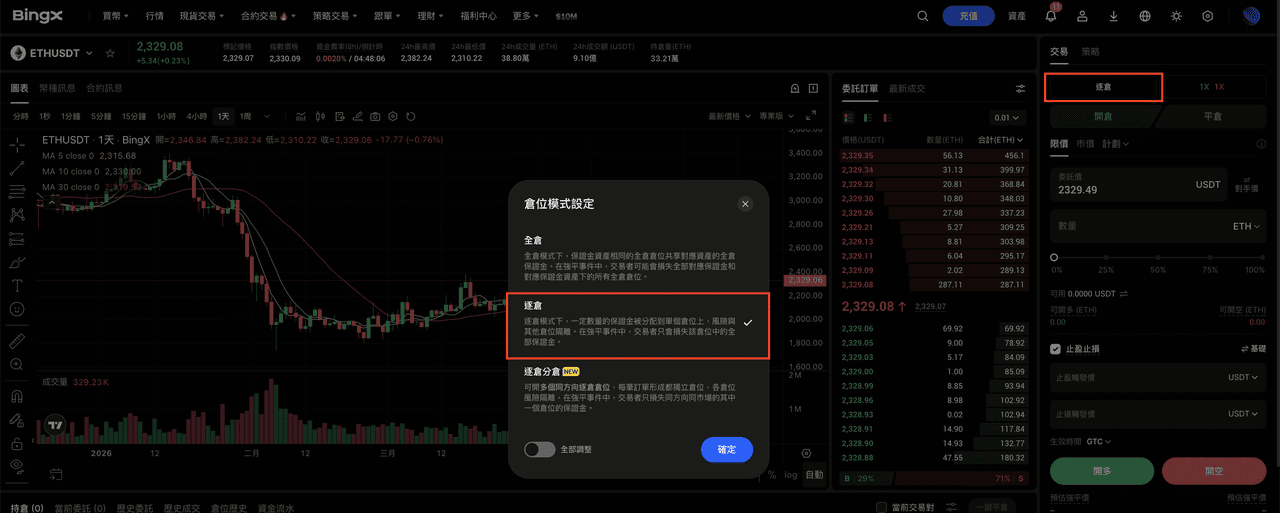
- Isolated margin mode calculates risk for each trade independently: It's the preferred choice for beginners to reduce liquidation impact; Cross margin uses the entire futures account as shared margin, offering high flexibility but concentrated risk, suitable for advanced users proficient in managing multiple positions.
- Four representative strategies for ETH perpetual futures: Including trend following, ETH/BTC relative strength, hedging (including staking integration), and funding rate arbitrage, each corresponding to different market conditions, technical analysis capabilities, and capital management requirements.
- The key to long-term profitability in futures trading lies in risk management: Not the strategy itself. Stop-loss discipline, position control, funding cost assessment, and emotional management are indispensable fundamentals.
What Are Ethereum Perpetual Futures? How They Differ from Spot and Standard Futures
Ethereum Perpetual Futures are derivative contracts based on ETH without expiration dates. Investors can open positions by posting margin without actually owning ETH, and can choose to go long or short. Perpetual futures prices are linked to spot prices through a funding rate mechanism: when contract prices deviate from spot, long and short positions pay fees to each other, pulling the price difference back. This is the origin of "perpetual" - investors can hold positions indefinitely, unlike traditional futures that require contract rollovers before expiration.
Compared to ETH spot trading, perpetual futures' biggest advantages are capital efficiency and bidirectional trading. Spot ETH purchases require full payment and only profit from upward movements; perpetual futures can open leveraged positions with partial margin, participating in markets whether bullish or bearish. However, this advantage is a double-edged sword: when prices move unfavorably to a certain extent, positions face forced liquidation, potentially losing all margin instantly. For investors bullish on the Ethereum ecosystem long-term who want low-cost ETH exposure, spot holding remains a more stable choice; perpetual futures are better suited for short-term swing trading or hedging purposes.
Compared to standard futures, perpetual futures eliminate rollover needs from expiration dates, but funding rates settled every 8 hours create ongoing costs that can significantly erode returns in long-term positions. Taiwanese investors should comprehensively judge from three aspects: holding time, capital scale, and leverage needs, rather than focusing on single metrics.
Ethereum Spot vs. Perpetual Futures vs. Standard Futures: Key Differences
|
Comparison Item |
Ethereum Spot |
Ethereum Perpetual Futures |
Ethereum Standard Futures |
|
ETH Ownership |
Actually holds ETH |
No actual ETH, only contract trading |
No actual ETH, only contract trading |
|
Expiration Date |
None |
No expiration date |
Usually has fixed term or expiration settlement |
|
Short Selling Support |
Usually no direct short selling support |
Supports both long and short |
Supports both long and short |
|
Leverage Usage |
Usually no leverage |
Can use leverage |
Can use leverage |
|
Main Costs |
Spot trading fees, withdrawal fees |
Trading fees, funding rates |
Trading fees, expiration settlement fees |
|
Suitable Uses |
Long-term holding, spot investment, staking |
Short-term trading, long/short operations, hedging |
Time-specific strategies, event-driven operations |
|
Main Risks |
Price decline, custody risk |
Leverage amplified losses, forced liquidation, funding rate costs |
Leverage risk, expiration settlement risk |
How Do ETH Perpetual Futures Work? Leverage, Funding Rates, and Liquidation Explained
Ethereum perpetual futures have become the second-highest trading volume derivative in the cryptocurrency market by combining leverage, bidirectional trading, and 24/7 market characteristics. Compared to spot trading, perpetual futures emphasize capital efficiency and risk management, but also increase volatility and liquidation risks. Understanding core mechanisms like leverage, margin, funding rates, and forced liquidation is the first step in building ETH futures trading strategies.
1. Leverage and Margin
Leverage represents the multiple between actual invested capital and controlled position size. For example, using 4x leverage to open a 1,000 USDT equivalent ETH position requires only 250 USDT margin. Higher leverage allows larger positions with the same capital, but margin depletes faster when prices move adversely. BingX offers high leverage for ETH perpetual futures, but practically it's not recommended to use near-maximum multiples, as ETH's daily volatility often ranges from 5% to 10%, far exceeding traditional financial products, making 10x+ leverage prone to liquidation in such volatility.
Margin consists of "initial margin" and "maintenance margin." The former is required when opening positions; the latter is the minimum capital needed to maintain positions without liquidation. When account equity falls below maintenance margin, forced liquidation triggers immediately. Practically, margin per trade shouldn't exceed 20% of total futures account balance to avoid single position losses consuming most capital. For ETH, given typically higher volatility than BTC, this ratio can be more conservative, such as within 15%.
2. Isolated vs. Cross Margin
Isolated Margin Mode: Reserves separate margin for each trade. Even if liquidated, losses are limited to that specific margin, with other account funds unaffected. For beginners, this mode allows pre-calculating maximum losses per trade, making risk control most intuitive. The trade-off is limited available margin, making early exits more likely during extreme short-term volatility due to insufficient margin.
Cross Margin Mode: Uses entire futures account balance as shared margin for all positions. When one position moves unfavorably short-term, other account funds can buffer, reducing immediate liquidation risk; the downside is that significant adverse market moves without timely stop-losses could zero the entire futures account. Cross margin suits advanced users proficient in managing multiple positions. For most Taiwanese investors, isolated margin remains the more stable choice, especially for volatile assets like ETH.
3. Funding Rate
Funding Rate is unique to perpetual futures, designed to keep contract prices close to ETH spot prices. To achieve balance, funding rates are periodically paid between long and short positions:
- When market is bullish: When contract price exceeds spot price, longs pay funding rates to shorts.
- When market is bearish: When contract price falls below spot price, shorts pay longs.
BingX's ETH funding rate settles every 8 hours at 8 AM, 4 PM, and 12 AM Taiwan time, only charged to current position holders. For short-term traders, funding rates have minimal impact, but for long-term holders, they represent significant costs. For example, if long funding rates consistently maintain 0.03% to 0.05% per 8 hours, annualized costs could reach 30%+, potentially consuming most potential returns. During strong ETH uptrends with overheated bullish sentiment, long funding rates often become particularly high. Check current and recent rate trends before opening positions, avoiding long-term holds in unfavorable environments. If directional positions must be held long-term, prioritize spot over futures. Funding rates also serve as income sources for professional arbitrageurs, with related strategies explained in later sections.
4. Liquidation Mechanics
Forced liquidation is the mechanism futures traders must be most vigilant about. When position floating losses consume most margin and account equity falls below maintenance margin levels, the system automatically liquidates at market price to prevent losses affecting exchange capital. Liquidated positions usually become zero or retain minimal residual value, potentially incurring additional slippage from insufficient instant liquidity. Liquidation distance inversely correlates with leverage multiples:
- 5x leverage: Triggers liquidation at approximately 18% to 20% adverse price movement
- 10x leverage: Triggers at 9% to 10%
- 20x leverage: May liquidate in 4% to 5% volatility
ETH's volatility exceeds BTC slightly, creating higher actual liquidation risk under identical leverage multiples. Historically, ETH has experienced multiple single-day 8% to 12% instant volatility events, easily causing high-leverage investors to lose principal in such markets. Pre-setting stop-losses is the basic tool for avoiding liquidation, with stop prices allowing wider margins than BTC operations, detailed in subsequent sections.
ETH Perpetual Futures Trading Strategies: 4 Popular ETH Futures Strategies
ETH perpetual futures support multiple trading strategies, with different strategies corresponding to different market conditions, technical analysis capabilities, and capital management requirements. Below are four strategy types designed for ETH characteristics, particularly considering ETH's relationship with BTC, staking integration, and other Ethereum ecosystem-specific elements. Practically, most investors choose one to two primary strategies, avoiding frequent switching between different strategies that could compromise discipline.
1. Trend Following
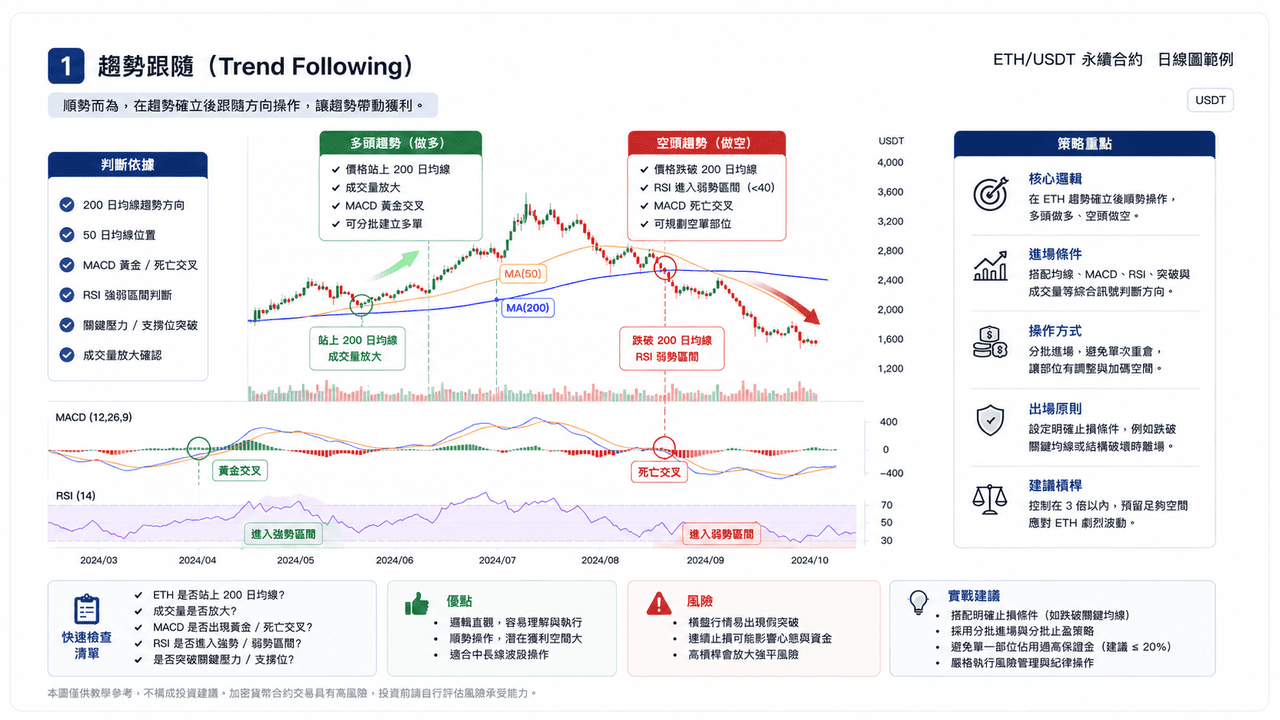
Trend following is the most basic and widely used futures trading strategy, with core logic of entering positions after ETH confirms direction: going long in uptrends, short in downtrends. Judgment criteria typically include 200-daymoving averages, 50-day moving averages,MACD golden or death crosses, breakouts above key resistance levels, and other technical signals. When ETH moves above the 200-day moving average with expanding volume, consider gradually building long positions; when ETH falls below the 200-day moving average with RSI (Relative Strength Index) entering weak zones, plan short positions.
This strategy's advantages are intuitive logic and low execution barriers; disadvantages include false breakouts in sideways markets, triggering consecutive stop-losses. Recommend combining with clear stop-loss conditions (e.g., immediately exit when breaking key moving averages) and gradual entry mechanisms to avoid single large positions. Keep leverage within 3x, allowing sufficient space for ETH's characteristic violent fluctuations.
ETH Trend Following Signals: Quick Checklist
|
Observation Item |
Bullish Signal |
Bearish Signal |
Risk Reminder |
|
Trend Direction |
Market enters uptrend |
Market enters downtrend |
False breakouts common in ranging markets |
|
200-Day MA |
ETH above 200-day MA |
ETH below 200-day MA |
Signals weak during repeated MA crossovers |
|
MACD |
Golden cross |
Death cross |
Noise common during consolidation |
|
RSI |
Enters strong zone |
Enters weak zone |
Extreme zones don't guarantee continuation |
|
Volume |
Price rises with expanding volume |
Price falls with expanding volume |
Low-volume breakouts less reliable |
|
Support/Resistance |
Breaks key resistance |
Breaks key support |
Quick stop-loss needed after false breakouts |
2. ETH/BTC Relative Strength (ETH/BTC Ratio)
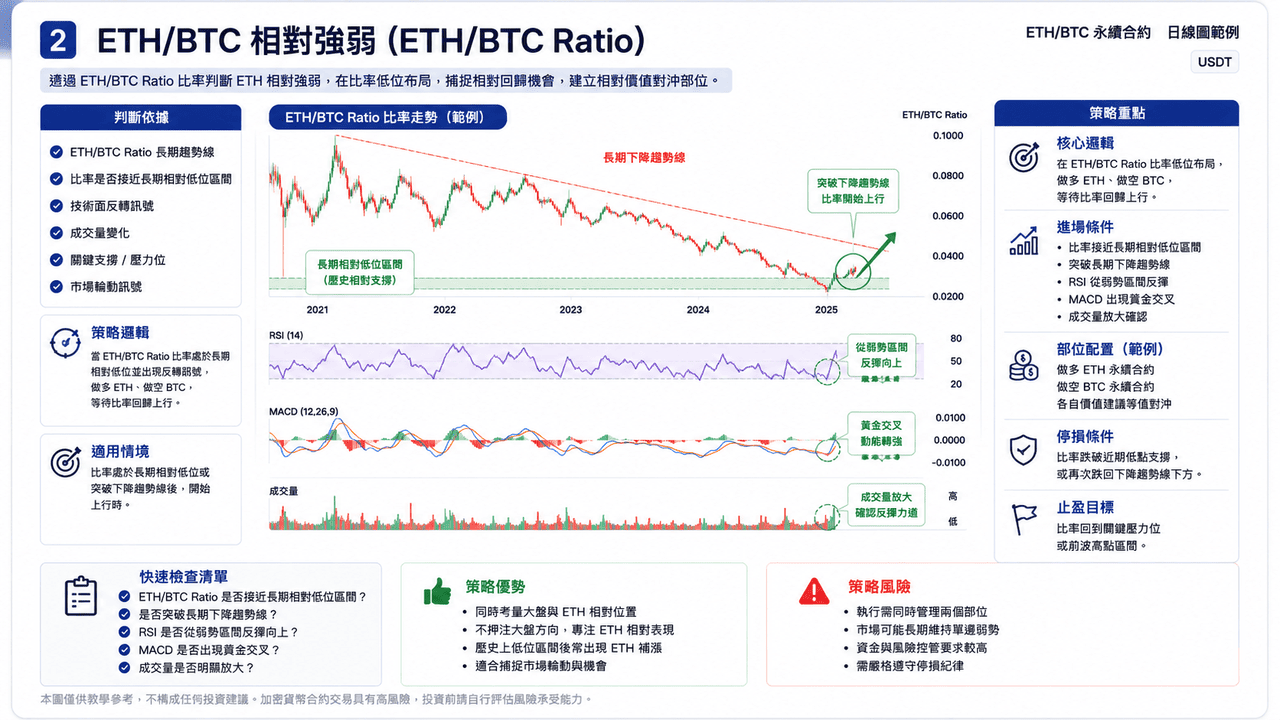
The ETH/BTC ratio reflects Ethereum's strength relative toBitcoin, serving as an important indicator for ETH investors to observe market rotation. By watching ETH/BTC ratio changes, one can more clearly judge whether market capital currently favors ETH or BTC.
Common judgment logic includes:
- ETH/BTC ratio in long-term decline, entering historical relative low zones: Indicates ETH's relatively weak performance among major crypto assets. Historically, when such zones show technical stabilization and reversal signals, they often accompany ETH catch-up rallies relative to BTC.
- ETH/BTC ratio breaks long-term descending trendlines: Usually indicates improving ETH relative strength, with market capital potentially gradually flowing from BTC to ETH.
- ETH/BTC ratio breaks key support or returns to descending trends: Usually indicates market capital refavoring BTC, with ETH relative performance potentially weakening again.
Practically, consider building ETH long positions when ETH/BTC ratio approaches long-term lows while showing MACD golden crosses, RSI recovery, volume expansion, and other reversal signals, simultaneously pairing with BTC shorts for relative value hedge positions.
This strategy's advantage is observing not just ETH's absolute price but also ETH's relative position to BTC and capital flows; the disadvantage is managing two positions simultaneously, requiring higher capital allocation and trading discipline. For Taiwanese investors familiar with crypto market rotation patterns, ETH/BTC relative strength strategies can capture ETH/BTC ratio mean reversion opportunities without directly betting on overall market direction. Since relative value trading still carries volatility risk, leverage is typically recommended within 2-3x.
ETH/BTC Relative Strength: Quick Checklist
|
Observation Item |
ETH Relatively Strong Signal (Long ETH Bias) |
ETH Relatively Weak Signal (Short ETH Bias) |
Risk Reminder |
|
ETH/BTC Ratio Position |
Ratio stabilizing and recovering from long-term lows |
Ratio weakening from long-term highs |
Relative strength can persist months or longer |
|
Long-term Trendline |
Breaks long-term descending trendline |
Falls back below descending trendline |
False breakouts can mislead direction |
|
MACD |
Golden cross |
Death cross |
Noise common during consolidation |
|
RSI |
Bouncing from weak zone |
Declining from strong zone |
Signals may fail during RSI divergence |
|
Volume |
Rising with expanding volume |
Falling with expanding volume |
Low-volume rebounds less sustainable |
|
Capital Rotation |
Capital beginning to flow toward ETH |
Capital flowing back to BTC |
ETH may decline with overall market weakness |
|
Position Allocation |
Long ETH, short BTC |
Short ETH, long BTC |
Requires managing two positions simultaneously |
3. Hedging (Including Staking Integration)
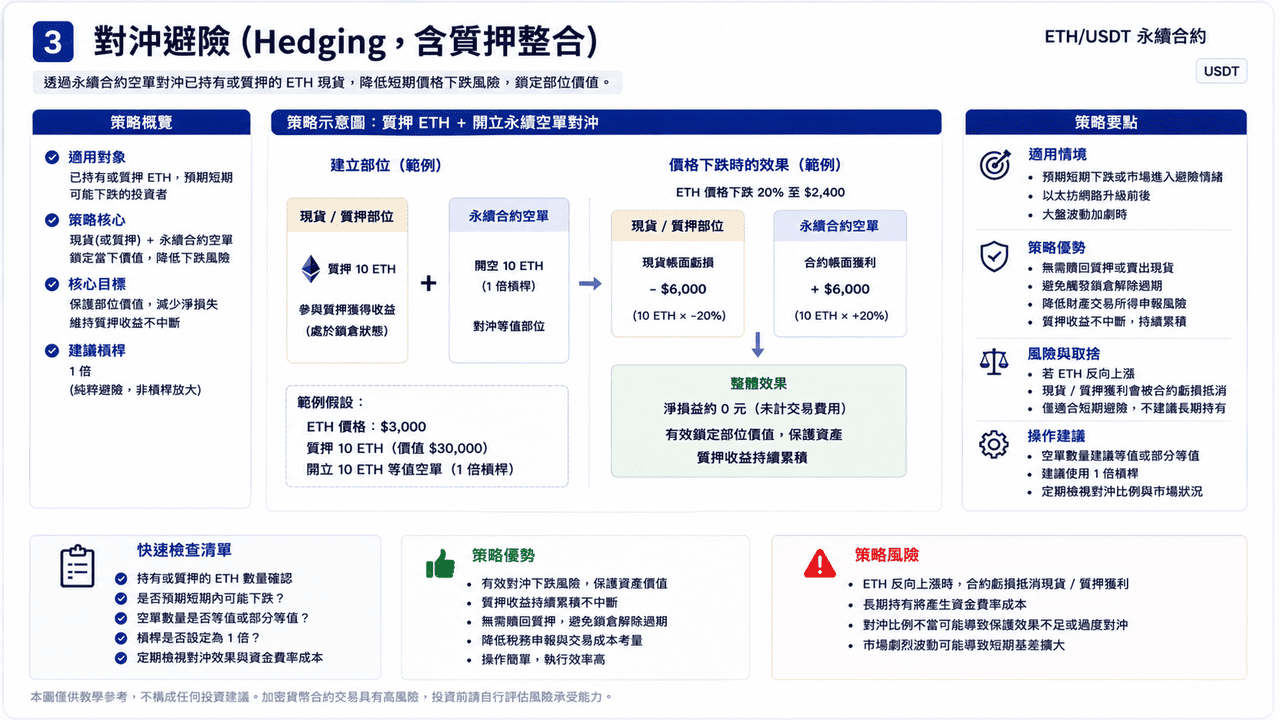
Hedging suits investors already holding ETH spot orstaking positions who want to protect holding values during expected short-term declines. The strategy logic involves opening equivalent or partial equivalent short positions in perpetual futures markets. When ETH declines, spot losses are offset by futures gains, keeping overall position net P&L relatively stable. For staked ETH, this strategy is particularly useful since staking positions are usually locked and cannot be sold immediately for hedging, making perpetual futures shorts the only viable hedging tool. For example, with 10 ETH staked and expecting potential 15% to 20% short-term corrections, open 10 ETH equivalent shorts to lock current value.
For Taiwanese investors, this strategy is particularly useful before/after Ethereum network upgrades and when overall crypto markets enter risk-off sentiment, avoiding tax considerations from unstaking redemption or spot sales that could trigger lock-up release periods or property transaction income reporting. The hedging trade-off is that if ETH moves up instead, spot or staking reward gains are offset by futures losses. Use 1x leverage for pure hedging purposes rather than leveraged amplification.
Extended reading:Ethereum Liquid Staking (2026): How to Stake ETH on Lido? Why Does It Dominate the Market?
Hedging Use Cases: Quick Checklist
|
Item |
Description |
|
Strategy Purpose |
Reduce spot or staking position risk during ETH short-term declines |
|
Core Logic |
Hold ETH spot or staking positions while establishing ETH perpetual futures shorts |
|
Applicable Scenarios |
Expected market corrections, before major events, rising market risk-off sentiment |
|
Common Practice |
Hold 10 ETH spot or staking, simultaneously establish 10 ETH equivalent short |
|
Main Advantages |
No need to unstake or sell spot while reducing short-term decline risk |
|
Main Disadvantages |
If ETH continues rising, spot or staking rewards partially offset by shorts |
|
Leverage Recommendation |
Recommend 1x leverage for hedging focus |
|
Considerations |
Monitor funding rates, futures fees, and hedge ratios with regular rebalancing |
4. Funding Rate Arbitrage
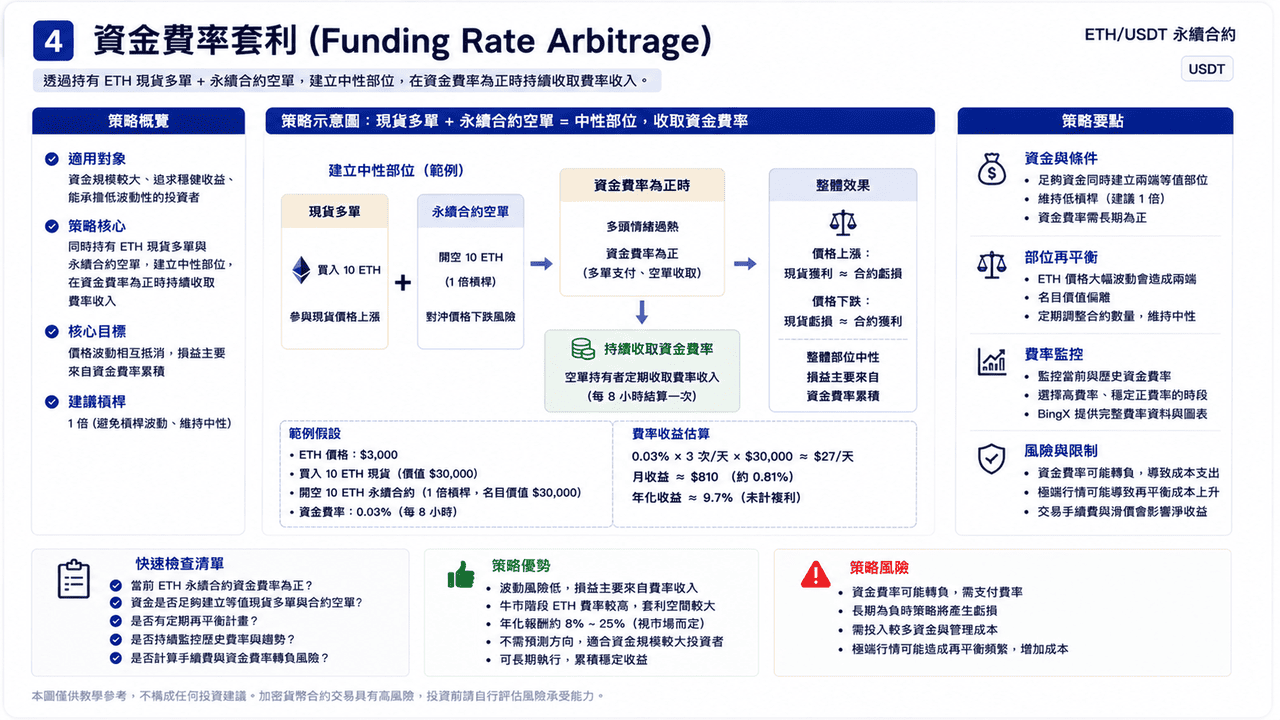
Funding rate arbitrage is an advanced strategy with core logic of simultaneously holding ETH spot longs and perpetual futures shorts, establishing neutral positions to continuously collect funding rate income during overheated bullish sentiment when funding rates are positive. Since spot longs and futures shorts offset price volatility, overall position P&L mainly comes from funding rate accumulation.
Practical requirements include: sufficient capital for equivalent positions on both sides, strict position rebalancing (significant ETH price volatility causes nominal value deviations between sides), and comprehensive funding rate historical monitoring. BingX's futures pages provide current and historical funding rate data as basic tools for executing such strategies. ETH funding rates during bull markets often exceed BTC, creating relatively larger arbitrage opportunities with potential annualized returns of 8% to 25%, far below trend following's potential returns but significantly more moderate volatility, suitable for larger capital seeking stable crypto market participation.
Extended reading:How to Conduct Ethereum Arbitrage in Taiwan? DeFi Strategy Comparison and BingX Tutorial (2026)
Funding Rate Arbitrage Use Cases: Quick Checklist
|
Item |
Description |
|
Strategy Purpose |
Collect funding rate income through neutral positions when rates are positive |
|
Core Logic |
Simultaneously hold ETH spot longs and ETH perpetual futures shorts |
|
Applicable Scenarios |
Overheated bullish sentiment, prolonged positive perpetual futures funding rates |
|
P&L Source |
Spot longs and futures shorts offset price volatility, main income from funding rate accumulation |
|
Operating Conditions |
Requires sufficient capital for equivalent positions on both sides |
|
Risk Control Focus |
Regular position rebalancing to avoid nominal value deviations from significant ETH price volatility |
|
Tool Requirements |
Track current and historical funding rate data; BingX futures pages serve as basic reference tools |
|
Return Characteristics |
Annualized returns typically 8% to 25%, lower potential than trend following but relatively moderate volatility |
|
Target Audience |
Larger capital seeking lower-volatility crypto market participation |
How to Trade ETH Perpetual Futures on BingX
BingX provides ETH/USDT perpetual futures with Traditional Chinese interface, integrating TradingView charts,BingX AI market analysis, andcopy trading functions, making it the most direct futures trading tool for Taiwanese investors. Order processes are nearly identical on desktop and mobile apps. Below is a complete five-step tutorial.
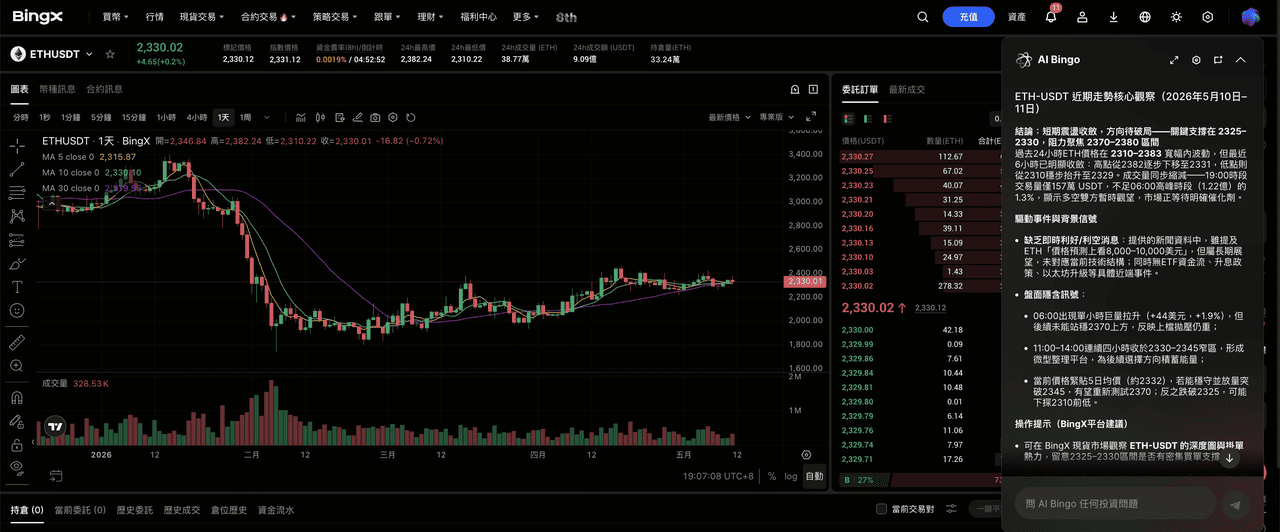
1. Transfer USDT margin to perpetual futures account: After logging into BingX, go to "Assets" → "Fund Transfer" to move USDT from spot account to perpetual futures account. Recommend margin per trade not exceeding 20% of total futures account balance to avoid single trade affecting overall capital safety. If Taiwanese users lack sufficient USDT, first buy USDT with TWD on MAX or BitoPro, then withdraw via TRC-20 to BingX (fees under $1 USD), or directlybuy USDT with TWD through credit cards or third-party payments on BingX's "Buy Crypto" page.
2. Enter ETH/USDT perpetual futures page: From top menu, go to "Futures Trading" → "USDT-M Futures", search and select ETH-USDT. The page displays real-time quotes, order books, recent trades, and current funding rates. Before ordering, confirm funding rate levels and next settlement time (8 AM, 4 PM, 12 AM Taiwan time), evaluating short-term holding fee costs to avoid extended positions in unfavorable rate environments.
3. Use BingX AI and TradingView charts to determine direction: BingX futures pages integrate TradingView charts, allowing switching between 1-minute to monthly timeframes while applying moving averages,RSI,MACD,Bollinger Bands, and other technical indicators to analyzesupport and resistance levels. Simultaneously activate BingX AI for structured market analysis summaries as auxiliary basis for long/short decisions. For investors familiar with Ethereum ecosystem, also monitor Layer 2 capital flows, spot ETF net inflows, staking ratio changes, and other fundamental signals.
4. Choose isolated mode, set leverage and place orders: Recommend selecting Isolated mode to limit single trade risk to specific margin. For leverage, beginners should use 2x, experienced traders keep within 3-5x, avoiding 10x+ multiples. After choosing long or short, input order size, prioritizing limit orders over market orders to reduce trading costs and slippage impact. Confirm all parameters before submitting orders.
5. Immediately set stop-loss and take-profit: After opening positions, immediately setStop Loss and Take Profit, the most basicrisk management tools that shouldn't be skipped. Considering ETH's higher volatility than BTC, 4-hour operations can set stop-loss ranges at 4% to 7%; daily operations at 7% to 12%. Take-profit commonly set at 1.5 to 2x+ stop-loss ranges, adjusting per individual risk-reward preferences. Monitor in "Positions" page afterward, adjusting based on market changes or manually closing positions.
5 Risk Management Strategies for ETH Perpetual Futures
Whether futures trading achieves long-term profitability depends far more on risk management than strategy selection itself. Many loss cases stem not from strategy errors but from undisciplined risk management causing single trades to consume most capital. The following five principles are basic rules every ETH perpetual futures investor should strictly follow, regardless of strategy choice.
- Strictly control leverage multiples, especially noting ETH's high volatility characteristics: Beginners should start with 2x, experienced traders keep within 3-5x. ETH's daily volatility often ranges 5% to 10%, making 10x+ leverage extremely prone to liquidation in such markets. Leverage is a tool, not a gamble - lower multiples allow greater market volatility tolerance and longer survival.
- Set stop-losses immediately for each trade, allowing wider margins than BTC: Positions without stop-losses expose principal completely to market volatility. Considering ETH's higher volatility than BTC, stop-loss ranges should allow more space: 4-7% for 4-hour charts, 7-12% for daily charts. Never randomly cancel or lower stop-loss prices after setting - this is the primary cause of futures trader bankruptcies.
- Single trade margin shouldn't exceed 15% to 20% of total futures account balance: For ETH, given higher volatility, this ratio can be more conservative at 15%. Even with high confidence in specific trades, reserve at least 80% of funds for unexpected events. BTC and ETH often experience correlated declines in violent markets - maintaining sufficient cash positions allows continued trading after losses.
- Evaluate funding rate costs before long-term positions: ETH funding rates during bull markets often exceed BTC. Levels of 0.05%+ every 8 hours sustained for a month could reach 50%+ annualized costs, consuming most potential returns. Check current and recent rate trends before opening positions, setting position time limits. For necessary long-term directional positions, prioritize spot over futures.
- Avoid revenge trading, establish daily loss limits: Attempting quick recovery with higher leverage and larger positions after consecutive losses is the most common path to bankruptcy in futures markets. Practically recommend setting daily maximum loss amounts - stop all futures operations for the day when reached, reassessing markets after emotions cool. Discipline is key to long-term futures survival, more important than technical analysis.
Conclusion: Should You Trade ETH Perpetual Futures in 2026?
ETH perpetual futures offer more flexible trading methods than spot, allowing investors to amplify bull market participation, profit from bear market shorts, hedge during ranging markets, and generate relatively stable income through funding rate arbitrage. For Taiwanese investors familiar with the Ethereum ecosystem who can strictly execute stop-loss discipline, perpetual futures can supplement market scenarios that pure spot holding or staking cannot address, serving as important risk management and trading tools in cryptocurrency investment portfolios. As Ethereum's Proof of Stake mechanism matures, Layer 2 scaling ecosystems expand, and spot ETF institutional funding channels gradually stabilize, ETH's futures trading environment continues developing.
However, leverage's dual nature means futures trading failure costs far exceed spot trading. Most newcomers to futures often lose most capital in the first few months due to high leverage, lack of stop-losses, or emotional trading, with ETH's typically higher volatility than BTC making this risk more pronounced. For Taiwanese investors wanting to start ETH perpetual futures in 2026, a reasonable entry approach involves starting with small capital, low leverage (within 2x), single strategies (like trend following) to accumulate practical experience, combined with strict stop-loss and position management, regularly reviewing trading records and emotional states.
BingX provides Traditional Chinese interface, BingX AI auxiliary analysis, and copy trading functions, enabling investors unfamiliar with futures operations to gradually build trading capabilities. Perpetual futures aren't shortcuts to quick wealth but trading tools requiring long-term discipline and risk management skill accumulation. Whether achieving long-term stable profits often depends on risk control rather than single market judgment accuracy.
Related Reading
- How to Invest in Bitcoin in Taiwan? Complete Bitcoin Investment Strategy Guide (2026)
- How to Buy Ethereum in Taiwan? 2026 Ethereum Exchange Recommendations and Complete Purchase Tutorial
- How to Conduct Ethereum Arbitrage in Taiwan? DeFi Strategy Comparison and BingX Tutorial (2026)
- Which Taiwan Exchange Is Best for Large-Volume Ethereum Trading? Complete Platform Fee and Liquidity Comparison (2026)
- Complete Taiwan Cryptocurrency Futures Trading Platform Comparison (2026): Fee, Liquidity, and Security Comparison
- Do You Need to Pay Taxes on Ethereum in Taiwan? Taiwan ETH Tax Regulations and Property Declaration Tutorial (2026)
