

Monero (XMR) is the most representative privacy coin in the cryptocurrency market and one of the mainstream digital assets that has consistently ranked in the top 30 by market capitalization. Since its launch in 2014, XMR has experienced multiple bull and bear cycles, with price volatility far exceeding traditional assets. It has seen deep retracements of over 60% multiple times, yet its long-term annualized returns have remained in the high double-digit range. XMR provides complete on-chain privacy through ring signatures, stealth addresses, and confidential transactions, maintaining a dominant position in the privacy coin sector. However, this has also led to compliance challenges as mainstream large exchanges have gradually reduced their support for spot trading, making its market structure significantly different from other mainstream coins.
For Taiwanese investors, the difference in XMR investment lies not only in whether to enter the market, but also in how to establish positions and adjust timing in an environment where compliant acquisition channels are limited. Choosing perpetual futures or copy trading, controlling leverage multiples, and whether to enter in batches - these choices directly affect overall returns and volatility tolerance, and determine whether one can maintain their established strategy during severe market fluctuations.
This article starts from the actual operational scenarios of Taiwanese XMR investors, explaining the differences between dollar-cost averaging, long-term holding, and short-term trading and their suitable audiences. It introduces how to execute operations on BingX and organizes XMR's historical cycle patterns and commonly used judgment indicators to help establish consistent decision-making methods. Additionally, it explains allocation ratios, risk management, and the unique regulatory risks specific to privacy coins. The content of this article is for reference only and does not constitute investment advice. Cryptocurrency investment carries high risks, and you should assess your risk tolerance before investing.
Key Takeaways
- BingX currently does not provide XMR spot trading but offers XMR/USDT perpetual futures. Taiwanese users who want to participate in XMR price volatility can participate in the market through futures trading or copy trading functions, gaining exposure to XMR market movements without directly holding spot assets.
- Dollar-cost averaging (DCA) is a low-risk strategy for general Taiwanese investors to get started with XMR, although in practice, most transactions are conducted through exchanges that support XMR due to limited compliant platform choices.
- XMR's market cycles are highly correlated with mainstream coins but possess independent privacy coin sector narratives. Regulatory dynamics typically have a greater impact on prices than technical signals, which is a characteristic that XMR investors must prioritize understanding.
- XMR's proportion in an overall investment portfolio (including Taiwan stocks, US stocks, and other assets) is generally recommended to be controlled between 1% to 5%. It serves as a supplementary allocation among high-volatility crypto assets and is not suitable as a primary position.
- XMR trading profits should be declared as property transaction income in Taiwan. It is recommended to maintain complete trading records and regularly organize profit and loss statements to facilitate subsequent tax declarations and asset management.
Is Monero Worth Investing in 2026? XMR Price History and Market Outlook
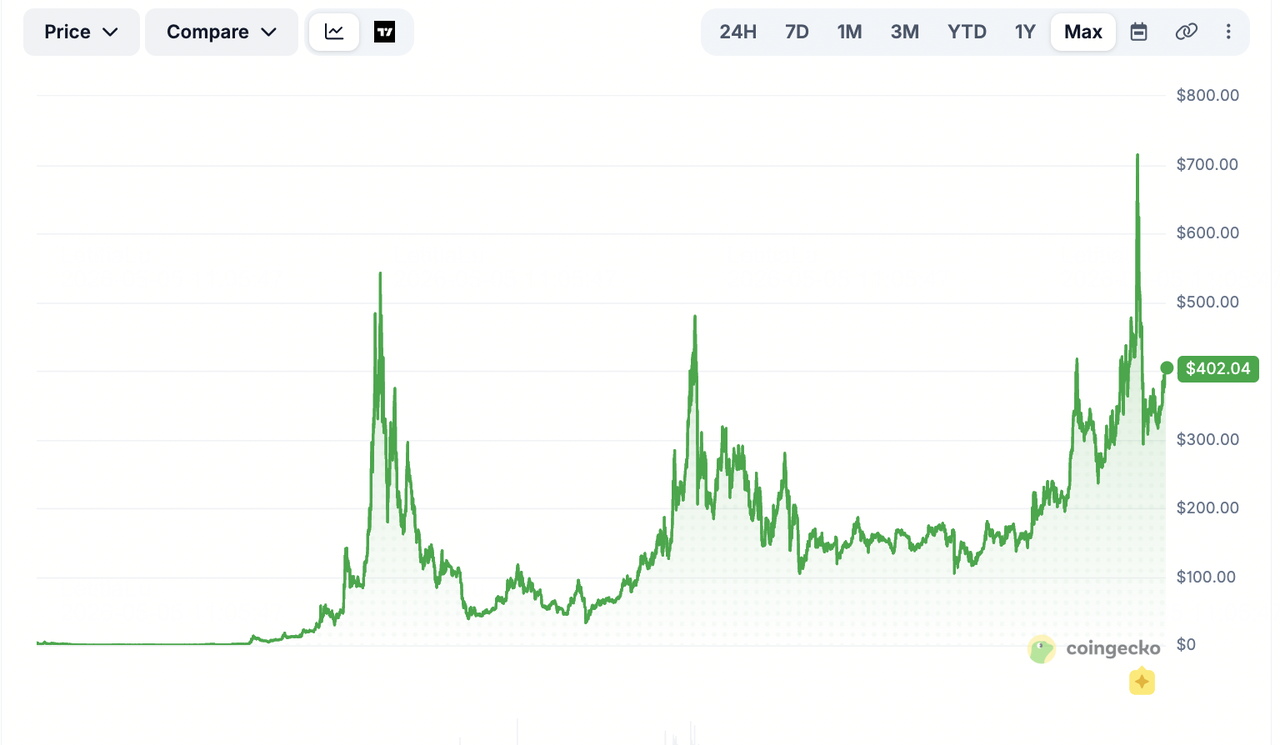
Data Source: CoinGecko
From a historical price performance perspective, Monero's long-term returns are outstanding, but its volatility is also far higher than traditional assets. In terms of annual returns, XMR surged over 1,600% in 2017, rose over 250% in 2020, and gained approximately 126% in 2025. However, it also declined approximately 86% in 2018 and 36% in 2022. This means that Monero's investment prospects cannot only consider long-term upward trends but must also understand cyclical retracements, regulatory risks unique to privacy coins, and high volatility characteristics.
2025 was a significant turning point for theprivacy coin sector. As market demand for financial privacy increased, coupled with price momentum from similar projects like Zcash (ZEC), XMR gained over 124% throughout 2025 and reached an all-time high of approximately $800 on 2026-01-14. However, after the new high, XMR entered rapid correction, falling to around $285 in February 2026, representing a correction of over 60% from the ATH. This reflects that the privacy coin sector still experiences significant volatility without structural buying support such asprivacy coin-related ETFs. In the mid-to-late first quarter, the price returned to consolidation around $350, entering a longer-term range-bound phase.
For Taiwanese investors, whether Monero is worth investing in 2026 depends on understanding which cycle position we are currently in and the regulatory environment. From historical data, XMR often experiences deep corrections after major bull years, and privacy coin regulatory dynamics can overturn original technical analysis judgments in a short time. If you haven't established a position yet, dollar-cost averaging would be more suitable than heavy one-time investments to diversify entry risks. If you already hold XMR, you should check whether the allocation ratio still matches your risk tolerance. XMR still has representative allocation value in the privacy coin sector, but it's more suitable for disciplined small-scale participation rather than as a main portfolio position.
Extended Reading:Zcash (ZEC) vs. Monero (XMR): Which is the Better Privacy Coin for 2026?
XMR Annual Price Performance Review (2016–2026)
|
Year |
Annual High (Approx.) |
Annual Low (Approx.) |
Annual Return |
Market Status Summary |
|
2016 |
~$19 |
~$0.5 |
2760% |
Privacy coin narrative emerges, first major surge |
|
2017 |
~$470 |
~$10 |
1662% |
Overall crypto bull market, XMR reaches then-new high |
|
2018 |
~$456 |
~$45 |
-86.39% |
Bear market deep correction, bubble digestion |
|
2019 |
~$120 |
~$41 |
-1.94% |
Range-bound consolidation, privacy narrative cooling |
|
2020 |
~$174 |
~$26 |
252.64% |
Overall crypto recovery, privacy coins warming up |
|
2021 |
~$518 |
~$122 |
46.83% |
Bull market peak, but gains lagged mainstream coins |
|
2022 |
~$290 |
~$97 |
-35.74% |
Rate hikes and crypto bear market, lighter decline vs mainstream |
|
2023 |
~$187 |
~$130 |
12.32% |
Mainstream exchanges begin delisting XMR |
|
2024 |
~$232 |
~$99 |
17.22% |
Fewer compliant platforms, liquidity concentration |
|
2025 |
~$500 |
~$165 |
124.43% |
Privacy coin sector rotation, XMR strong rally |
|
2026 YTD |
~$800 |
~$277 |
-19.68% |
New high followed by deep correction and range consolidation |
Note: Annual returns are calculated using publicly available historical price data; high and low points are approximate ranges compiled from publicly available historical data for market context explanation. Actual values may vary slightly depending on data sources and exchange quotes.
When Should You Buy Monero? 5 Key Indicators for Entry Timing
XMR experiences severe price volatility, making it difficult to judge entry timing based on absolute price alone. For long-term investors, a more practical approach is to simultaneously observe market sentiment, technical indicators,Relative Strength Index (RSI), privacy coin sector rotation, and regulatory dynamics. These indicators don't all need to appear simultaneously to signal a buying opportunity, but when multiple signals align within the same time period, it usually indicates the market has entered a zone worth considering for gradual accumulation. XMR's uniqueness lies in regulatory events often having greater price impact than technical signals, so investors need to treat regulatory dynamics as a high-priority judgment criterion.
|
Indicator |
Reference Threshold |
Operational Focus |
|
Fear & Greed Index |
Below 25 |
Consider gradual accumulation |
|
200-day Moving Average |
Breaks below 200-day MA |
Suitable for starting gradual accumulation |
|
XMR/BTC Ratio |
Within 3-year low range |
XMR weak vs mainstream, watch for reversal |
|
Privacy Coin Sector Rotation |
Similar projects rallying simultaneously |
Sector capital inflow, XMR typically follows |
|
Regulatory Dynamics |
No major delisting or ban announcements recently |
Stable regulatory environment is entry prerequisite |
- Fear & Greed Index below 25:When theFear & Greed Indexenters "extreme fear" territory, it indicates overall crypto market sentiment is overly pessimistic, with investors generally reducing risk positions. Historically, such emotional lows have often appeared in zones more favorable for medium-to-long-term positioning, but should still be combined with other indicators for confirmation rather than used as a standalone buying criterion.
- XMR breaks below 200-day Moving Average:The 200-day moving averageis often viewed as an important dividing line for long-term trends. When XMR breaks below the 200-day MA, it usually indicates the market has entered a weak or bear market zone. This is not suitable for one-time heavy positions but can be a starting point for planning gradual accumulation to reduce single entry point risk.
- XMR/BTC ratio within 3-year low range:The XMR/BTC ratio reflects Monero's strength relative to Bitcoin. When the ratio falls within the past three years' low range, it indicates XMR is in a relatively weak position among mainstream crypto assets. Historically, such ranges have often been followed by privacy coin catch-up rallies. For relative value investors, this is an important reference for determining whether to accumulate XMR.
- Privacy coin sector simultaneous rotation:XMR's price has some correlation with other privacy coin projects (such as Zcash,Dash). When the privacy coin sector overall experiences capital inflow, XMR typically follows the upward movement, as verified in the sector rally in the second half of 2025. Observing sector rotation helps determine whether XMR is in a narrative-driven phase.
- Stable regulatory environment:For XMR, delisting announcements from mainstream exchanges, privacy coin bans in specific regions, and regulatory events affecting similar projects often overturn original technical analysis judgments in a short time. The funds invested in XMR should be money that won't affect life and financial security even if regulatory shocks cause deep corrections. You shouldn't use emergency funds, loans, or money with clear short-term purposes to invest in XMR.
In practice, these indicators are more suitable for adjusting buying rhythm rather than predicting the lowest point. For example, maintain regular dollar-cost averaging normally, and when the Fear Index falls below 25, price breaks below the 200-day MA, or XMR/BTC ratio approaches long-term lows, consider increasing DCA amounts. If privacy coin sector capital continues flowing in and the market hasn't entered overheated territory, maintain original positioning. Conversely, if market sentiment is overly greedy, prices are far above long-term averages, or recent mainstream exchange delisting events occur, reduce investment pace or even pause accumulation.
How Much Monero Should You Hold in Your Portfolio?
XMR's allocation percentage in an investment portfolio should be determined based on overall financial situation, risk tolerance, investment timeline, and confidence in the privacy coin sector's long-term role. Since XMR faces both high volatility and regulatory uncertainty, with more limited compliant acquisition channels than other mainstream coins, allocation percentage shouldn't only consider return potential but also liquidity risks when mainstream exchanges further reduce XMR services. Below are common allocation approaches organized by three investor types.
- Conservative Taiwanese investors (mainly holding Taiwan stocks, ETFs, or time deposits):XMR is recommended to be controlled within 1% of total investable assets, or completely skipped. This percentage allows participation in XMR's long-term growth potential while avoiding excessive impact on overall assets from privacy coin-specific regulatory risks. For such investors, if choosing to participate, it's more suitable to use BingX copy trading functions for small exposure rather than directly holding spot assets, and leverage is not recommended.
- Aggressive Taiwanese investors (already having diversified allocations in stocks, ETFs, etc.):XMR percentage can be increased to 1% to 3% of total investable assets, with actual percentage adjustable based on individual understanding of cryptocurrencies and risk tolerance. It's recommended to first establish an overall asset allocation framework, such as the respective percentages of stock ETFs, bonds, cash, and other assets, then decide XMR's role within it. XMR's role is usually to diversify cryptocurrency sector risks rather than serve as the main return source, avoiding impact on original financial goals due to XMR regulatory events.
- Taiwanese investors focusing mainly on cryptocurrencies:If cryptocurrencies are already an important allocation in the investment portfolio, XMR typically serves as part of thealtcoinsector allocation, recommended to be controlled between 3% to 5% within the cryptocurrency position. This percentage allows investors to participate in privacy coin sector rotation while avoiding excessive impact on the overall crypto portfolio from single privacy coin regulatory risks. The overall cryptocurrency portfolio should still be centered on BTC and ETH, with XMR and other altcoins as supplements. High-volatility altcoin total positions generally shouldn't exceed 20% of the crypto portfolio.
How to Invest in Monero? 2 Ways to Invest in XMR in Taiwan
Investment options for Monero in Taiwan are more limited than BTC, ETH mainly because mainstream large exchanges have gradually reduced XMR spot support due to compliance factors, concentrating compliant acquisition channels on a few platforms. Different investors' capital scale, risk tolerance, and willingness to bear futures risks will have different suitable XMR investment strategies. For Taiwanese users, BingX's XMR/USDT perpetual futures and copy trading functions are currently the two most direct participation methods in the compliant environment, suitable respectively for advanced users familiar with futures operations and conservative participants who don't wish to judge entry and exit points themselves.
1. Trade Monero Perpetual Futures on BingX
BingX currently does not provide XMR spot trading but offers XMR/USDT perpetual futures, which is the most direct compliant channel for Taiwanese investors to participate in XMR price volatility. BingX futures have maker fees of 0.02% and taker fees of 0.05%, with funding rates settled every 8 hours (Taiwan time 8:00, 16:00, 00:00). Perpetual futures support both long and short positions but carry higher risks than spot trading. It's recommended to control leverage at 2 to 3 times and immediately set stop-loss and take-profit after opening positions. XMR's volatility and liquidity depth are usually greater than BTC and ETH, so leverage should be more conservative than when trading mainstream coins.
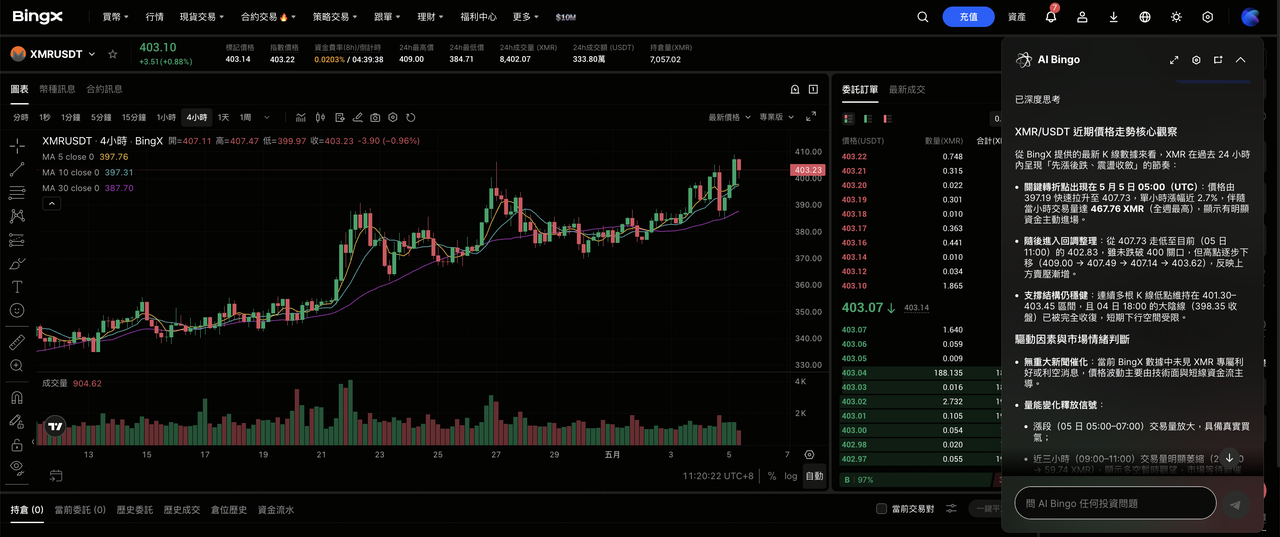
- Register a BingX account and transfer funds:Go to BingX official website or App to register an account. After completing basic identity verification and security settings, enter the "Buy Crypto" page where you canpurchase USDT with Taiwan dollars via credit card or third-party payment. After completion, the newly purchased USDT will appear in the "Spot Account."
- Ensure sufficient USDT margin in account:Go to BingX "Assets" → "Fund Transfer" to transfer USDT from spot account to perpetual futures account. The margin invested in each opening is recommended not to exceed 10% of total futures account balance to avoid single XMR trades affecting overall fund safety due to privacy coin-specific severe volatility.
- Enter XMR/USDT perpetual futures page:Go to "Futures Trading" → "Perpetual Futures" and search for XMR-USDT. Before placing orders, first check funding rates and settlement times to evaluate holding costs, avoiding long-term positions in unfavorable rate environments.
- Use BingX AI and TradingView charts to determine direction:BingX futures page has built-in TradingView charts and provides BingX AI market analysis. Before placing orders, refer to XMR market trend summary, technical signals,RSI, Bollinger Bands, andsupport and resistance levels, paying special attention to recent privacy coin sector regulatory dynamics as auxiliary basis for determining long or short positions.
- Choose isolated margin mode, set leverage and place orders:It's recommended to choose isolated margin mode to limit single trade risk within that margin amount. Leverage should be controlled at 2 to 3 times, and prioritize using limit orders to establish positions to reduce trading costs and slippage impact.
- Immediately set stop-loss and take-profit:After opening positions, immediately setStop Loss and Take Profit. XMR's volatility is usually higher than mainstream coins. For 4-hour chart operations, stop-loss can be set at 5% to 10%; for daily chart operations, it can be set at 10% to 15%. Stop-loss is a basic risk control tool for futures trading and should not be omitted especially for low-liquidity assets like XMR.
2. Follow Monero Trades via BingX Copy Trading
For Taiwanese investors unfamiliar with futures operations but wanting to participate in XMR market movements,BingX Copy Trading function provides another low-barrier option. Copy trading allows users to follow traders with stable performance and automatically replicate their XMR operation strategies, participating in the market with lower learning costs while transferring part of judgment risk to experienced traders. For conservative investors, this is a way to participate in XMR volatility while avoiding direct pressure of judging privacy coin regulatory dynamics.
Extended Reading:How to Start Copy Trading on BingX: Beginner's Guide
1. Enter BingX Copy Trading page:After logging into BingX, go to "Copy Trading" page and select "Futures Copy Trading" to browse all public trader lists and their historical performance.
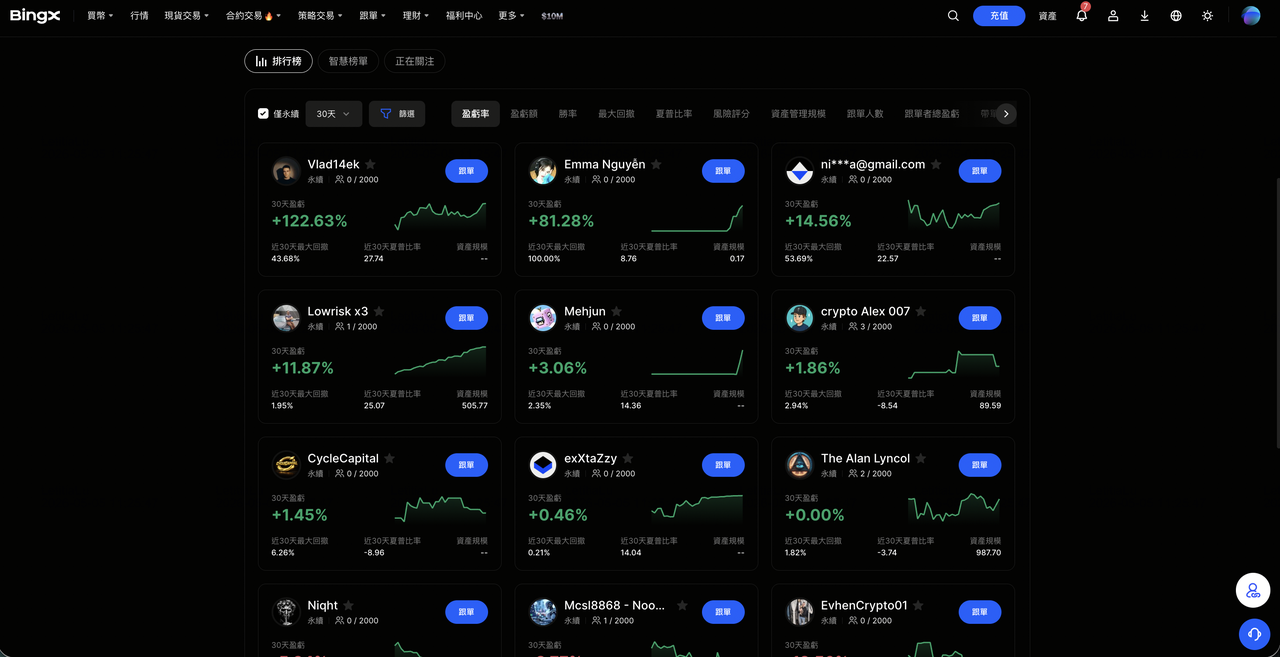
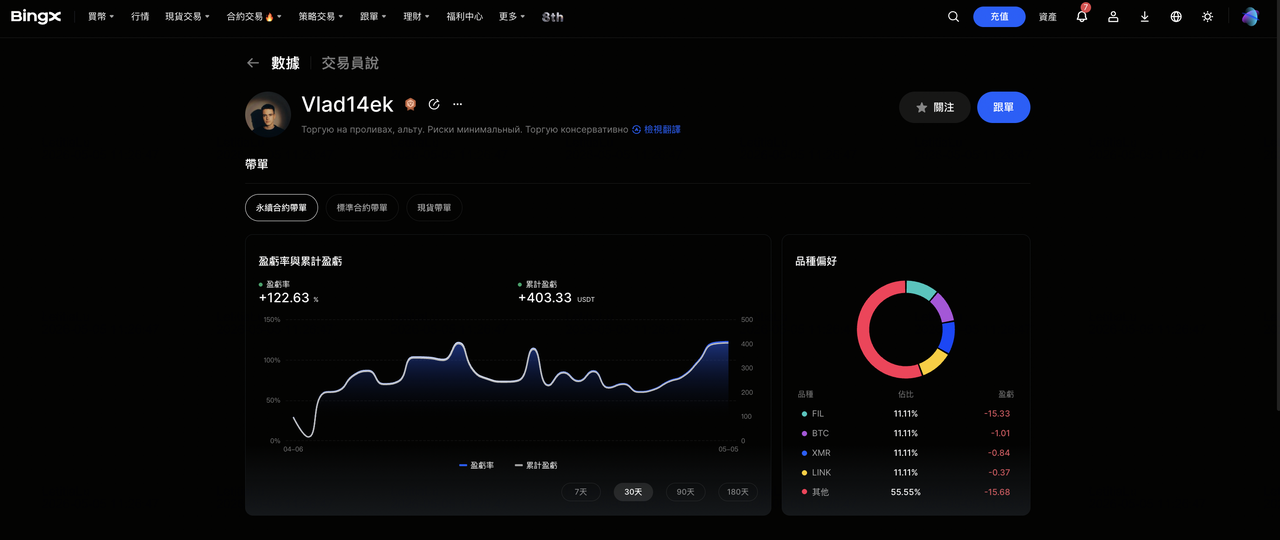
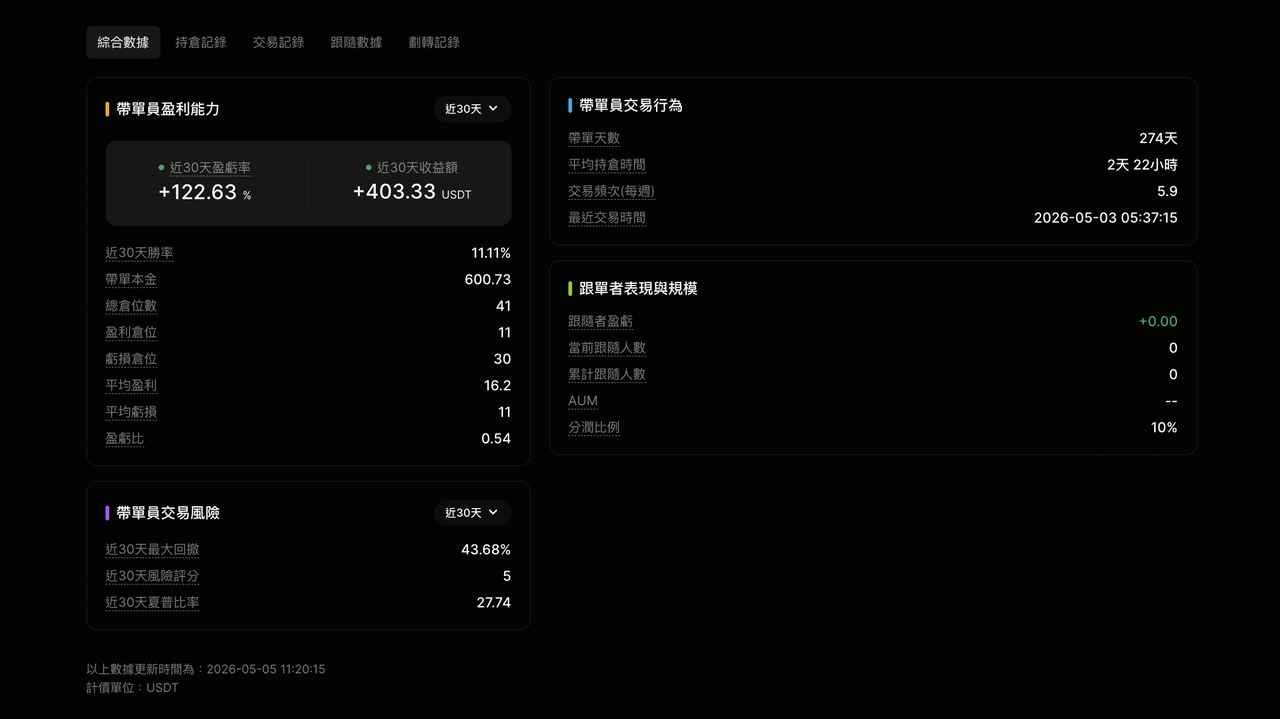
2. Filter XMR traders:In the trader list, use the "Filter" function and set the coin type to "XMR." The system will filter traders with recent XMR/USDT operation records. Prioritize observing 30-day, 90-day cumulative returns, maximum drawdown, win rate, and number of copiers.
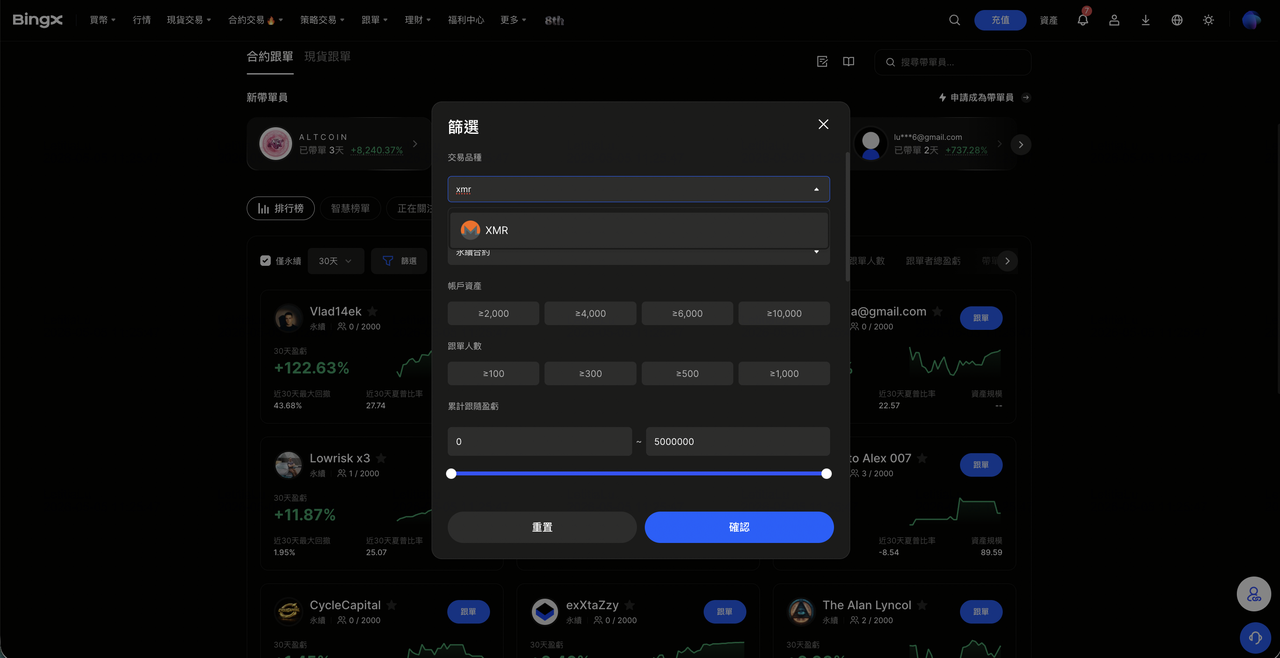
3. Evaluate trader style:Check the trader's operation frequency, average leverage multiples, and single position holding time. Since XMR has higher volatility, it's recommended to choose traders with conservative leverage and longer holding periods, avoiding copying overly aggressive operations.
Note: The copy trading traders shown in screenshots are for demonstration purposes only and do not constitute investment advice or platform recommendations. Before actual copy trading, please review the trader's historical performance, maximum drawdown, holding period, risk level, and trading strategy, and assess your own risk tolerance before making decisions.
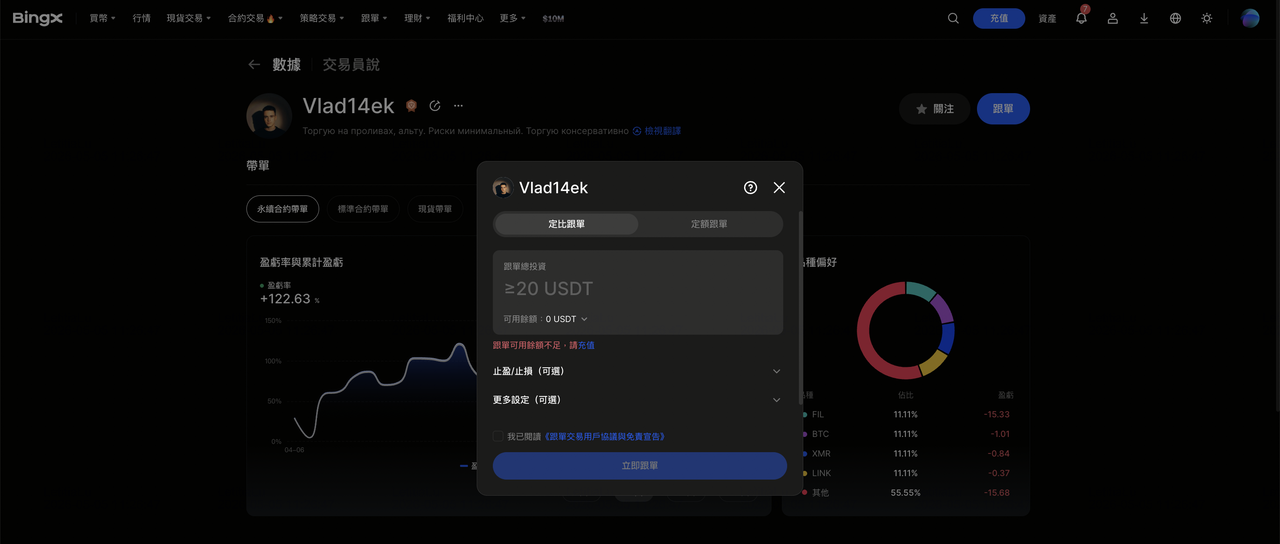
4. Set copy trading amount and risk parameters:After selecting a trader, set the principal ratio and maximum copy amount per trade. It's recommended to test with smaller amounts for the first copy trade, observe for 1 to 2 weeks, then decide whether to increase copy scale.
Note: The copy trading traders shown in screenshots are for demonstration purposes only and do not constitute investment advice or platform recommendations. Before actual copy trading, please review the trader's historical performance, maximum drawdown, holding period, risk level, and trading strategy, and assess your own risk tolerance before making decisions.
5. Regularly review copy trading performance:After copy trading starts, regularly review whether the trader's recent performance remains stable. If the trader shows consecutive losses, changes in operation style, or hasn't traded for long periods, consider stopping copy trading and reselecting.
4 Key Risks and Considerations Before Investing in XMR
Monero, as a representative asset of the privacy coin sector, has unique long-term positioning but also faces special risks that mainstream cryptocurrencies rarely need to bear. Before entering the market, besides evaluating price and purchase methods, you also need to first understand basic issues like liquidity, regulatory dynamics, tax records, and risk management, avoiding only seeing the long-term narrative of privacy coins while ignoring special risks in the actual holding process.
- Regulatory dynamics take priority over technical signals:For XMR, delisting announcements from mainstream exchanges, privacy coin bans in specific regions, and regulatory events affecting similar projects often overturn original technical analysis judgments in a short time. Mainstream large exchanges have gradually removed XMR spot trading over the past few years, further concentrating compliant acquisition channels to a few platforms. Funds invested in XMR should be money that won't affect life and financial security even if regulatory shocks cause deep corrections. You shouldn't use emergency funds, loans, or money with clear short-term purposes to invest in XMR.
- Risk of liquidity concentration:XMR's compliant liquidity is concentrated on a few exchanges. When mainstream platforms further adjust XMR services, situations may arise where it's difficult to liquidate in short periods or price spreads widen. Long-term holders of larger XMR amounts should diversify across multiple compliant platforms and consider withdrawing main positions tohardware wallets under their own control (such as Ledger or Trezor), keeping only XMR needed for short-term trading in exchange accounts. Private keys and seed phrases should be stored offline and not be screenshot or saved in the cloud.
- XMR trading profits may need to be declared in Taiwan:When cashing out XMR trading profits, they usually need to be calculated as property transaction income, with the basic logic being sale price minus purchase cost and related fees. It's recommended to regularly download transaction records from BingX or other exchanges, preserving details of every purchase, sale, transfer, and fee as basis for future tax declarations and asset management. Due to XMR's privacy characteristics, on-chain records cannot be completely traced like BTC and ETH, making exchange native records more important.
- No strategy can replace risk management:Dollar-cost averaging, futures trading, copy trading, or spot purchases are all just different participation methods and cannot guarantee profits. XMR's past cycle patterns don't guarantee future repetition. Privacy coin sector rotation, regulatory environment changes, and market sentiment may all change due to macroeconomic environment and policy events. Before investing, you should first confirm your risk tolerance, fund purpose, and holding time, and consult professional financial or tax advisors when necessary.
Conclusion: Is Monero Worth Investing in 2026?
Monero in 2026 still has representative allocation value in the privacy coin sector, but the prerequisite is that investors can accept high volatility, deep corrections, and regulatory risks unique to privacy coins. From a market structure perspective, the privacy coin sector rotation in 2025 drove XMR up over 124%, reaching new highs in January 2026, showing that in an environment of rising demand for financial privacy, XMR still has independent market narratives. However, XMR's correction of over 60% from its high reflects that the privacy coin sector still experiences much greater volatility than mainstream coins like BTC and ETH without structural buying support such as ETFs.
For Taiwanese investors, the more suitable approach is not pursuing heavy positions in XMR, but participating in small amounts through BingX perpetual futures or copy trading functions, treating XMR as a supplementary allocation in crypto portfolios rather than a core position. Perpetual futures are suitable for advanced investors familiar with futures operations who can judge entry and exit points themselves; copy trading functions are suitable for conservative investors who don't want to monitor markets themselves and hope to participate in privacy coin sector movements with lower learning costs. Overall, if you recognize privacy's long-term role in digital assets, XMR can still be included in investment portfolios in 2026, but a more reasonable approach is to treat it as a high-volatility, high-regulatory-risk sector allocation, participating in small amounts with clear proportions and disciplined strategies rather than relying on a single privacy coin as the main return source.
Related Reading
- What is Monero (XMR) Privacy Coin and How Does it Work?
- Which Trading Platform to Choose for Monero to USD (XMR/USD) in Taiwan in 2026? Comparison of Fees and Security of 5 Major Platforms
- 2026 Monero Wallet Recommendations: Which XMR Wallet is Most Suitable for Taiwanese Users?
- Where to Buy Bitcoin in Taiwan? 2026 Bitcoin Exchange Recommendations and Complete Purchase Process Tutorial
- Do You Need to Pay Taxes on Cryptocurrency in Taiwan? Cryptocurrency Taxation Regulations and Declaration Process Tutorial (2026)
- Complete Comparison and Recommendations of Cryptocurrency Futures Trading Platforms in Taiwan (2026): Comparison of Fees, Liquidity and Security
