



At the start of 2026, retail access to Elon Musk's private space venture was restricted by high venture-capital entry barriers and strict regulatory accreditation rules. However, following a confidential draft submission in April and an official S-1 registration amendment, SpaceX priced its historic Initial Public Offering (IPO) at $135 per share in mid-June 2026.
The debut instantly commanded a record-breaking valuation exceeding $1.8 trillion, briefly cementing Elon Musk's status as the world’s first trillionaire. Since its listing, the asset has experienced massive post-IPO trading volumes and violent price discovery:
- The Listing Surge: Opening day trading on the Nasdaq pushed shares up 19% to close at approximately $161, driven by relentless retail demand and institutional roadshow momentum.
- The Index Inflow Catalyst: Nasdaq fast-tracked its index-inclusion frameworks for a mega-cap asset of this scale. SPCX is scheduled to join the Nasdaq-100 Index before the open on July 7, 2026, forcing passive trackers like the QQQ ETF to execute billions of dollars in structural buying.
- Valuation Discrepancies: Wall Street analyst sentiment remains highly active but wide in dispersion. The current consensus 12-month target sits between $180 and $205 per share, though ultra-bullish models project targets up to $401 based on high-margin satellite data-center synergies. Cautious analysts maintain a low floor near $115 due to deep capital expenditure burns.
For the modern on-chain trader, this monumental corporate transition presents a massive opportunity. On BingX, you can trade this equity volatility using your existing crypto balance.
This article examines what drives the valuation of SpaceX, the structural differences between its pre-listing assets and the public instrument, and exactly how to execute long or short strategies on SPCX using crypto collateral on the BingX platform.
What Is SpaceX (SPCX) and Why Is It a Dominant Macro Asset?
Space Exploration Technologies Corp. (SpaceX) is no longer classified as a simple rocket launch provider. By mid-2026, the company has established a vertically integrated monopoly spanning aerospace engineering, planetary-scale telecommunications, and space-based AI infrastructure.
Priced globally under the stock ticker SPCX, the firm commands an unrivaled market position by capturing a dominant share of commercial, civilian, and defense orbital payloads. Unlike pure-play technology companies, SpaceX combines heavy physical infrastructure with high-margin recurring software revenues:
1. Starlink Connectivity Engine
The primary cash generator for the ecosystem. Operating a massive low-Earth orbit (LEO) constellation of roughly 9,600 satellites, Starlink serves more than 10.3 million global subscribers across 160 countries. The S-1 filing revealed that Starlink generates the vast majority of SpaceX's $18.7 billion FY2025 revenue, running at a highly lucrative 62.9% adjusted EBITDA margin.
2. Launch Services Monopoly
Through its reusable Falcon 9 and Falcon Heavy platforms, SpaceX maintains a 99.5%+ flight success heritage. Routine booster recovery protocols have successfully slashed orbital deployment costs by up to 70% compared to commercial state programs and legacy competitors.
3. Planetary AI Infrastructure and xAI Synergy
A massive paradigm shift in the company’s structural value. SpaceX recently executed a cashless corporate architecture integration with Elon Musk’s AI venture, xAI, valued at $250 billion. The partnership leverages an extraordinary compute arrangement utilizing a cluster of 325,000 Nvidia GPUs yielding a $1.25 billion per month contract through 2029. The long-term plan targets the deployment of up to one million solar-powered satellites operating as orbital AI data centers starting in late 2027.
Read more: SpaceX (SPCX) Price Prediction 2026: $227 Street-High AI Fusion or Trillion-Dollar Valuation Bubble?
SpaceX IPO vs. Tokenized Stock: What Is the Difference?
Understanding the distinction between synthetic private instruments and the newly listed public security is essential for managing your portfolio effectively.
SPCX, the Public Security
The official instrument listed on the Nasdaq and Nasdaq Texas exchanges. Buying or trading $SPCX contracts directly exposes you to the regulated public float of the company. In an unprecedented departure from standard mega-cap IPO allocations, which typically restrict retail allocations to 10%, SpaceX deliberately allocated 30% of its public issuance to ordinary retail investors, with an additional 5% directed employee program exempt from standard post-IPO lock-up periods. It directly represents corporate equity and is subject to strict SEC financial reporting, with the company's first major public earnings report slated for September 2026.
SpaceX Venture Token ($VNTL) and SpaceX PreStocks
Prior to the mid-June listing, platforms like BingX pioneered retail access via tokenized Real-World Assets (RWAs) such as SpaceX Venture Tokens ($VNTL) and SpaceX PreStocks. These are blockchain-based, synthetic derivatives, typically issued as debt promissory notes over high-speed networks like Solana, that tracked the private employee tender offer valuations, which hovered around $185 earlier in the year. They provide fractional ownership down to 10 USDT and 24/7 liquidity, but they do not confer direct equity ownership, voting rights, or claims on corporate governance, and they carry counterparty risk tied to the token issuer.
SpaceX Tokenized bStock (SPCXB)
Following the post-IPO transition in mid-2026, a new hybrid asset emerged within the RWA landscape: SpaceX Tokenized bStock (SPCXB). Unlike purely synthetic pre-IPO derivatives (VNTL) or futures contracts, SPCXB functions as an on-chain digital certificate issued by BTech Holdings Limited natively on the BNB Smart Chain (BEP-20).
Each token is fully collateralized and backed 1:1 by a physical share of Nasdaq-listed SpaceX (SPCX) common stock held securely within an institutional custody framework cleared via Alpaca Securities. With a tightly managed circulating supply of 64,000 tokens, SPCXB mirrors the price performance of the live equity, allowing international retail users to bypass traditional brokerage entry barriers and gain fractional equity exposure starting at just $5 with full 24/7/365 liquidity.
Read more: What Is SpaceX Tokenized Stock (SPCXB) and How to Buy SPCX Tokenized Stock?
How to Trade SpaceX (SPCX) Stock with Crypto on BingX
BingX provides a comprehensive ecosystem spanning its Futures, TradFi, and spot markets, giving users deep liquidity tools to capture market momentum across different asset risk profiles.
|
Product Name |
Trading Pair |
Market Type / Product Nature |
|
SpaceX Venture Token |
SPACEX(VNTL)-USDT |
Synthetic RWA Derivative on BingX Futures |
|
SpaceX PreStocks |
SPACEX(PreStocks)-USDT |
Synthetic RWA Derivative on BingX Futures |
|
SPCX Public Tracker |
SPCX-USDT |
BingX Futures / Pre-IPO Market Asset |
|
SpaceX Tokenized Bond Stock |
SPCXB-USDT |
Yield-Bearing RWA Fixed-Income Asset |
How to Trade SpaceX (SPCX) Futures with Crypto on BingX
By integrating BingX AI insights and utilizing USDT collateral, you can trade the intense post-listing volatility of $SPCX without setting up a traditional traditional fiat brokerage account.
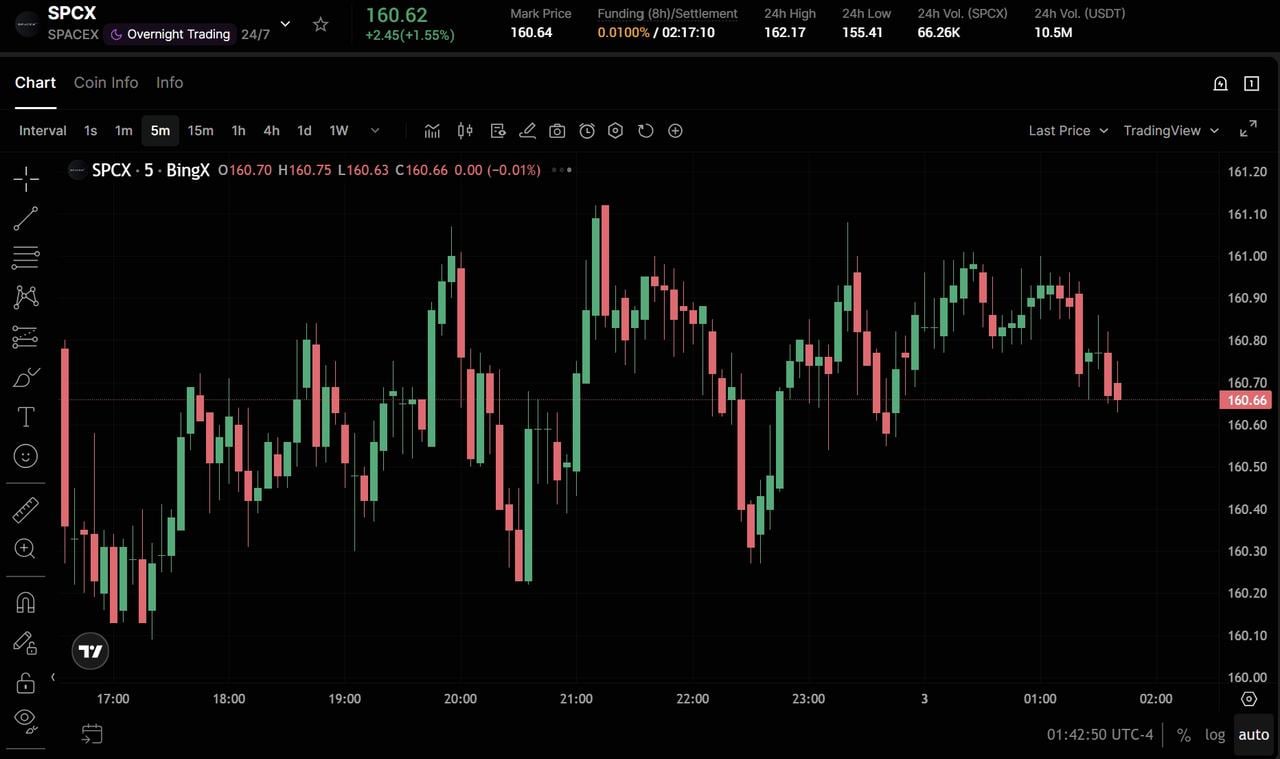
Step 1: Fund Your Futures Wallet with USDT
Log in to your verified BingX account. Navigate to the asset transfer window and move USDT from your Spot wallet into your Perpetual Futures account. USDT serves as the primary margin and settlement currency for these asset classes.
Step 2: Select Your Preferred Instrument
Go to the Futures tab on the terminal. Use the search bar to locate the SpaceX contract matching your trading framework:
- Select SPACEX(VNTL) or SPACEX(PreStocks) to interact with the synthetic RWA stock tokens.
- Select SPCX-USDT to open the contract on BingX TradFi directly tracking the live Nasdaq instrument.
Step 3: Configure Margin and Leverage Parameters
- Isolated Margin Mode: Best for risk-averse strategies, limiting your maximum potential downside exclusively to the margin assigned to that specific trade.
- Cross Margin Mode: Utilizes your broader account balance to buffer against short-term price fluctuations and avoid unwanted liquidation.
Note: Select a conservative leverage multiplier, e.g., 2x to 10x. Given the massive size and institutional focus on $SPCX, excessive leverage can expose you to sharp liquidations during daily margin adjustments.
Step 4: Execute Your Market Thesis
- Go Long (Buy): If you anticipate significant upside driven by mandatory buying pressure from passive index funds following its Nasdaq-100 index inclusion, strong institutional adoption, or milestones achieved during upcoming Starship flight tests.
- Go Short (Sell): If you believe the high valuation multiples relative to trailing revenues, combined with heavy annual capital expenditures and high hardware research and development costs, will lead to a post-IPO cooling period.
Step 5: Implement Absolute Risk Controls
Set your Stop-Loss (SL) and Take-Profit (TP) orders immediately upon order execution. Monitor major macro timelines, including upcoming satellite deployment announcements and the inaugural post-listing earnings call in September 2026.
How to Buy and Sell SpaceX Tokenized Stock (SPCXB) on BingX Spot Market
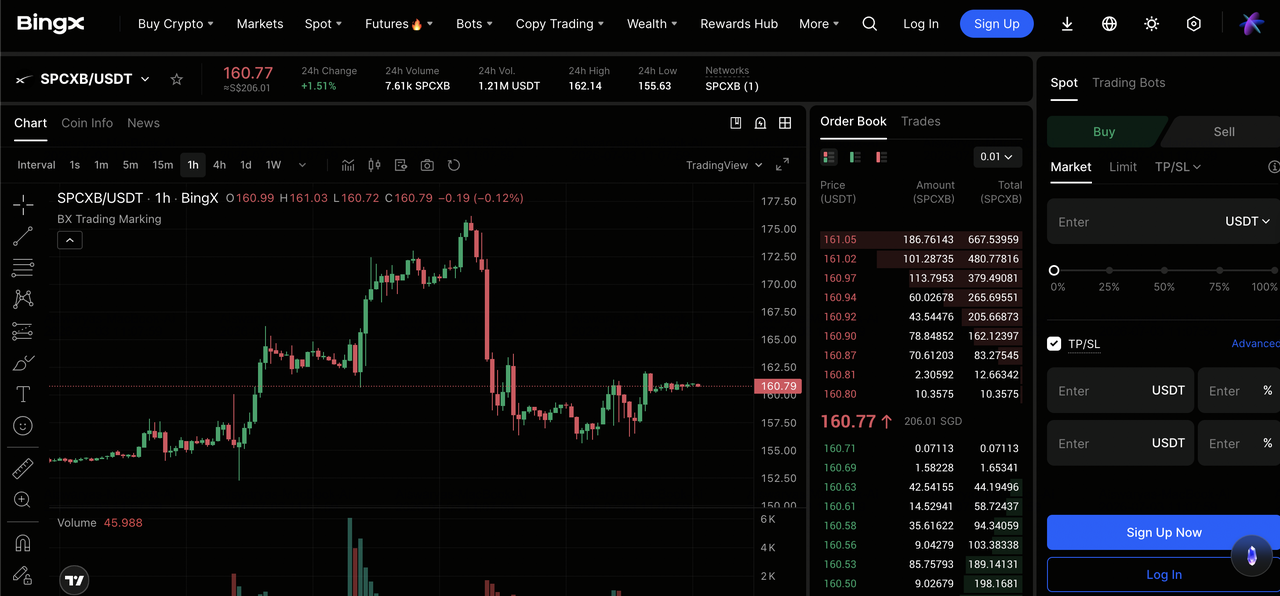
Maximize your yield strategies by using BingX AI insights to automate your entry points and monitor real-time interest rate fluctuations for $SPCXB on the spot interface.
- Access the Spot Terminal: Open your BingX app or desktop dashboard, navigate to the Spot Market tab, and enter SPCXB/USDT into the asset search bar.
- Allocate USDT Capital: Ensure you have stablecoin liquidity in your Spot account; use the internal transfer tool to instantly move funds from your Futures or Funding wallet if necessary.
- Execute Your Order: Select a Limit Order to secure a specific yield-adjusted entry price or a Market Order for instant purchase execution.
- Collect Fixed-Income Yield: Once your order fills, the SPCXB tokens will reside securely in your Spot wallet.
Read more: SpaceX (SPCX) vs. SpaceX Tokenized Stock (SPCXB): What’s a Better Asset to Trade in 2026?
Top 5 Risks to Know Before Trading SpaceX with Crypto
Combining traditional multi-trillion-dollar equity narratives with crypto leverage requires strict risk parameters.
- Extreme Post-Listing Valuation Multiples: Debuting at an aggressive valuation relative to trailing revenues leaves SPCX vulnerable to sharp pullbacks if any execution delays hit the Starship deployment timeline or Starlink subscriber growth flattens.
- The Exchange Session Gap Risk: Unlike native crypto assets that trade uninterrupted 24/7, SPCX tracking instruments are tied to standard traditional equity market sessions and daily maintenance breaks. Major aerospace announcements or launch anomalies over the weekend can cause massive price gaps at the Monday opening bell, bypassing active stop-losses.
- Corporate Cross-Holdings and Governance: The cashless structural integration of xAI, the Grok platform, and X into the corporate architecture introduces unique governance complexity. Furthermore, the dual-class share structure ensures Elon Musk retains approximately 85% of total voting power, leaving public shareholders with minimal governance control.
- Low Initial Float and Volatility: While the market capitalization fluctuates in the $2 trillion range, the initial public float is tightly controlled. This limited supply, combined with the 30% retail allocation exempt from lock-ups, can spark extreme, erratic price swings independent of broader crypto trends.
- Vesting Cliff Considerations: While immediate directed share programs are active, monitor the upcoming lock-up expiration dates where institutional backers and core contributors may introduce selling volume to the open market.
Final Thoughts: Should You Trade SpaceX Stock with Crypto?
The SpaceX public listing stands as the definitive financial milestone of 2026, successfully merging planetary-scale industrial infrastructure with the global AI hardware race. Through the BingX TradFi ecosystem, crypto-native investors possess an institutional-grade toolkit to actively trade, short, or hedge this historic macro asset using stablecoin liquidity.
Success in this market requires filtering out speculative retail hype and systematically tracking structural metrics: passive ETF index inflows, Starlink's EBITDA margins, and GPU compute delivery milestones. Trade defensively, use tight leverage limits, and carefully monitor the Nasdaq-100 index structural adjustments.
Risk Reminder: Digital asset derivatives and tokenized stocks carry high market risk and extreme price volatility. SpaceX ($SPCX) asset values may fluctuate wildly based on aerospace regulatory updates, launch mission profiles, and macro tech sentiment. Perform thorough due diligence, use strict risk mitigation parameters, and never trade capital you cannot afford to lose. BingX assumes no liability for individual trading outcomes.
Related Reading
- SpaceX (SPCX) Price Prediction 2026: $227 Street-High AI Fusion or Trillion-Dollar Valuation Bubble?
- SpaceX (SPCX) vs. SpaceX Tokenized Stock (SPCXB): What’s a Better Asset to Trade in 2026?
- What Is SpaceX Tokenized Stock (SPCXB) and How to Buy SPCX Tokenized Stock?
- Top Space Stocks to Buy Ahead of SpaceX IPO
- How the SpaceX IPO on June 12 Is Launching Elon Musk Past the Trillion-Dollar Net Worth Mark
- Top 10 Things to Know About the SpaceX IPO: Pricing, Valuation, and How to Trade It
