Pi Network (PI) finds itself at a defining operational crossroads in June 2026. Long recognized as a viral, mobile-first mining phenomenon, the protocol is attempting an aggressive transition toward programmable layer-1 utility. However, asset value remains heavily locked in a structural tug-of-war: can the network’s unprecedented, 60-million-strong human validation infrastructure generate sufficient organic demand to absorb a massive wave of circulating token emissions? This guide breaks down the macro supply dynamics, recent core protocol upgrades, and quantitative baseline targets shaping the comprehensive Pi Network price prediction layout for the remainder of 2026.
By early June 2026, the spot price action for PI highlights a steep disconnect between technical development and market gravity. While the core engineering team has successfully forced a string of mandatory network updates, rapidly activating heavy core infrastructure patches, headlined by the successful completion of the Protocol 24 upgrade on June 2, the PI token has experienced severe short-term distribution, hitting a local low near $0.1225 amid an aggregate crypto market pullback.
Plagued by an extreme risk-off backdrop in the broader crypto market and an impending wave of massive token distribution, PI has dropped roughly 25% over the past month. It is currently trading near $0.1225 with an estimated market cap stabilizing around $1.4 billion.
This guide evaluates the real-world utility frameworks, core tokenomic unlock curves, and algorithmic consensus models to project the eventual pi mainnet launch price ranges and structural realities.
Top 5 Things to Know About Pi Network (PI) in June 2026
- The Circulating Supply Threshold: Out of a rigid 100-billion max supply, roughly 10.28 billion PI (10.28%) has entered true circulation. The slow pacing is dictated strictly by manual, human-dependent KYC migrations.
- The Protocol 22 Cutoff: Activated successfully on April 27, 2026, the mandatory Protocol 22 upgrade forced all active network nodes to sync with version 0.5 under threat of immediate consensus disconnection.
- Massive June Unlock Schedules: Data tracks show over 163 million tokens entering liquid parameters throughout June 2026, introducing a daily localized sell-side pressure of over 5 million tokens into a thin trading environment.
- The AI Human-Infrastructure Moat: Pi has converted its community scale into a decentralized workforce, coordinating over 1 million identity-verified human validators who have completed more than 526 million data processing and labeling tasks.
- Bearish Triangle Breakdown: Technical charts reveal that PI has broken down below the support line of a multi-month symmetrical triangle pattern, pinned down by an Extreme Fear crypto market sentiment index score of 12.
What Is Pi Network (PI)?
Pi Network is an accessible, mobile-first Layer-1 blockchain ecosystem originally engineered to democratize token participation without the specialized hardware or severe environmental costs associated with classic Proof-of-Work mining. By implementing a customized adaptation of the Stellar Consensus Protocol (SCP), Pi utilizes an energy-efficient Proof-of-Engagement framework where users form interconnected security circles to validate trust. This enables everyday smartphone users to mine and transfer value directly from an interface requiring only minimal, daily interactions.
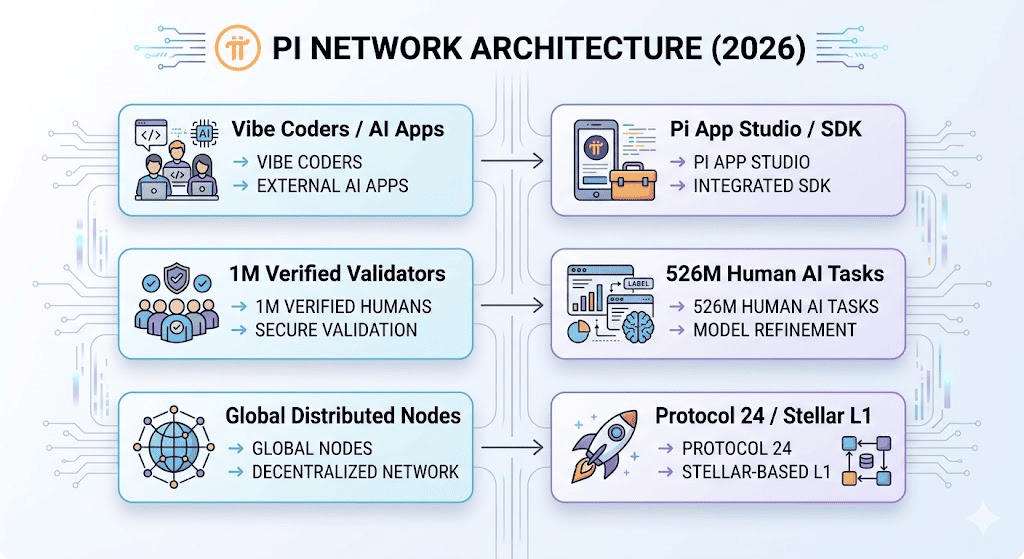
The project has entered a massive operational expansion phase. Beyond its basic historical footprint as a mobile mining network, Pi has progressively transformed its mainnet stack into a developer platform. With the integration of Pi App Studio and optimized software development kits (SDKs), non-technical creators, frequently termed vibe coders, can quickly build external applications using standalone generative AI tools, inject the Pi payment ledger within two minutes, and instantly deploy services to an ecosystem containing tens of millions of identity-verified active profiles.
Pi's Architectural Shift: The Impact of the Protocol 22, 23, and 24 Node Upgrades
The bedrock of Pi Network’s 2026 operational transformation rests on its recent core infrastructure overhauls, most notably the successful activation of Protocol 22 on April 27, 2026.
Built directly on top of Stellar Core technology, Protocol 22 was a mandatory consensus migration designed to dramatically enhance the throughput and transactional stability of the Layer-1 framework. Rather than acting as a simple superficial feature update, Protocol 22 enforced strict infrastructure alignment across all global node operators. Nodes that failed to update to the required version by the hard deadline were structurally dropped from validation, ensuring a pristine state transition.
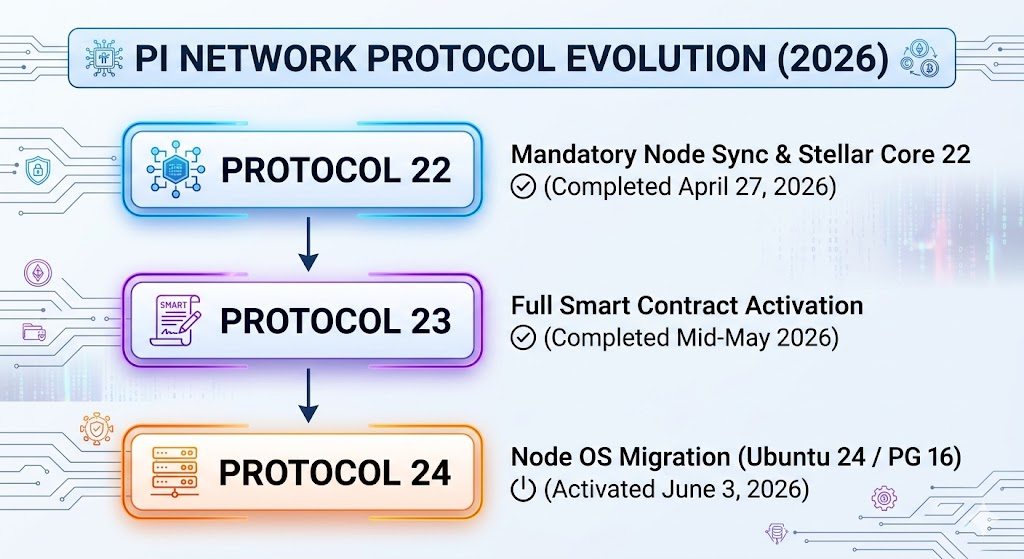
The fundamental value of the Protocol 22 framework is that it laid the direct technical pipeline for Protocol 23 launched mid-May and the recent Protocol 24, activated June 3. Protocol 23 officially introduced native smart contract capabilities and asset tokenization vectors to the mainnet environment. Protocol 24 quickly followed by modernizing the backend architecture, migrating core nodes from Ubuntu 20 to 24 and upgrading underlying database infrastructure from PostgreSQL 12 to 16.
By prioritizing deep backend stability over flashy consumer apps, this sequential upgrade timeline demonstrates that the Core Team is methodically transitioning Pi from an enclosed, speculative mining loop into a highly scalable, developer-friendly enterprise network.
What Is Pi Network Tokenomics in 2026: Circulating Supply vs. Locked Rewards
Evaluating any long-term Pi Network price prediction model requires a cold, data-driven look at the protocol's highly unique and restrictive token distribution schedule. Pi operates under a hard maximum supply cap of 100 billion tokens, split using a transparent 80/20 community-to-core-team allocation structure.
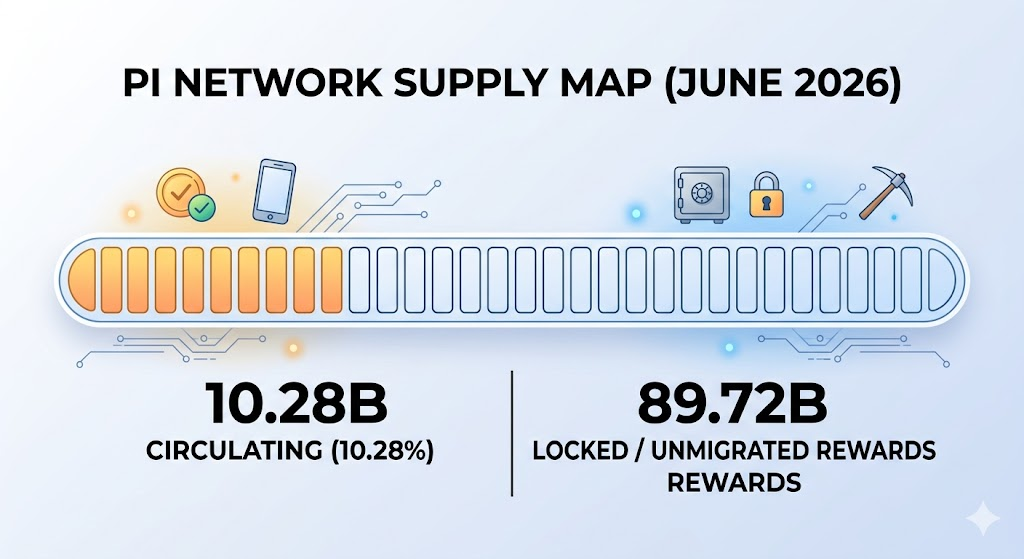
As of June 2026, the structural distribution of the network breaks down across distinct containment lines:
- Circulating Supply (10.28 Billion PI): This represents the portion of tokens that have successfully cleared the enclosed network migration protocols. These tokens belong to Pioneers who have passed manual identity verification and intentionally initialized on-chain balance transfers.
- The Total Ledger Supply (15.81 Billion PI): This figure encompasses all tokens that have been technically minted onto the mainnet ecosystem, including foundational allocations and rewards undergoing secondary release steps.
- Locked Rewards and the Mining Overhang: The remaining 84 billion tokens exist as unmigrated mining distributions, ecosystem development reserves, or core team lock-ups.
Because the migration protocol relies entirely on individual user action, KYC processing queues, and phased release schedules, new supply enters the active open market at a deliberate, measured pace. However, short-term pressures can still heavily outweigh organic spot demand. For example, throughout June 2026, the market is absorbing an estimated 163 million token unlock schedule.
With daily open-market trading volumes frequently hovering below a modest $20 million threshold, these predictable, high-volume inflows create an ongoing oversupply issue. Until full open mainnet parity is reached and automated Tier-1 automated liquidity venues are finalized, this persistent supply-side drift keeps short-term spot valuations under constant defensive pressure.
What Makes Pi Network Different From Traditional Layer-1 Blockchains?
|
Feature |
Pi Network (PI) |
Traditional L1 Altcoins |
|
Consensus Engine |
Federated Byzantine Agreement |
Proof-of-Stake / Proof-of-Work |
|
Sybil Defenses |
1M+ Native KYC Human Validators |
Purely Financial Staking Barriers |
|
Application Strategy |
Vibe-Coding Prompts & AI App Studio |
Manual Solidity/Rust Development |
|
Primary Utility Base |
Distributed AI Tasks & Local Apps |
Speculative DeFi Yield & Liquidity |
|
Supply Infrastructure |
Gradual Phased Unlocks & Mainnet Migrations |
Open Market Inflows & VC Vesting |
Pi Network isolates itself from standard Layer-1 architectures by prioritizing an integrated human-identity system directly into the core consensus and distribution logic. While conventional networks like Ethereum or Solana rely entirely on automated validator weight or financial stakes, Pi integrates a native, high-scale Know-Your-Customer (KYC) environment powered by a globally distributed human workforce. This ensures that every active account represents a distinct, authenticated individual, effectively insulating the ecosystem from the synthetic bot activity, sybil attacks, and fake transaction metrics that routinely skew open network data.
From a commercial perspective, Pi functions as a fully coordinated decentralized crowd-sourcing system. Traditional utility tokens depend almost exclusively on abstract decentralized finance (DeFi) liquidity pools to sustain on-chain momentum. Pi, conversely, redirects its scale toward servicing the broader artificial intelligence industry through its KYC-as-a-Service and decentralized human labor protocols. By offering a localized, global human workforce capable of finishing millions of verification tasks in hours, Pi converts its enormous community footprint into an active processing resource for modern tech companies.
The Utility Moat: How Does Pi Network Differ From Other AI-Agent Tokens?
|
Feature Vector |
Pi Network (PI) |
Specialized AI-Agent Tokens |
|
Workforce Base |
1M+ Fully Authenticated Humans |
Automated Code / Synthetic Agents |
|
Sybil Resistance |
Native, Multi-National KYC Logs |
Walled Financial Staking Minimums |
|
Onboarding Pipeline |
Simple AI Prompts via Pi App Studio |
Complex Smart Contract Deployments |
|
Payment Backbone |
Low-Cost Blockchain Distribution |
Multi-Hop Cross-Chain Liquidity |
To properly map a forward-looking Pi Network price prediction, analysts must look past standard payment narratives and categorize Pi alongside the explosive AI-Agent and decentralized workforce token class.
While conventional AI tokens like Virtuals Protocol, Clanker, or Artificial Superintelligence leverage algorithmic compute power or automated agents to capture market cap, Pi Network differentiates itself through its massive, authenticated Human-in-the-Loop (HITL) processing layer.
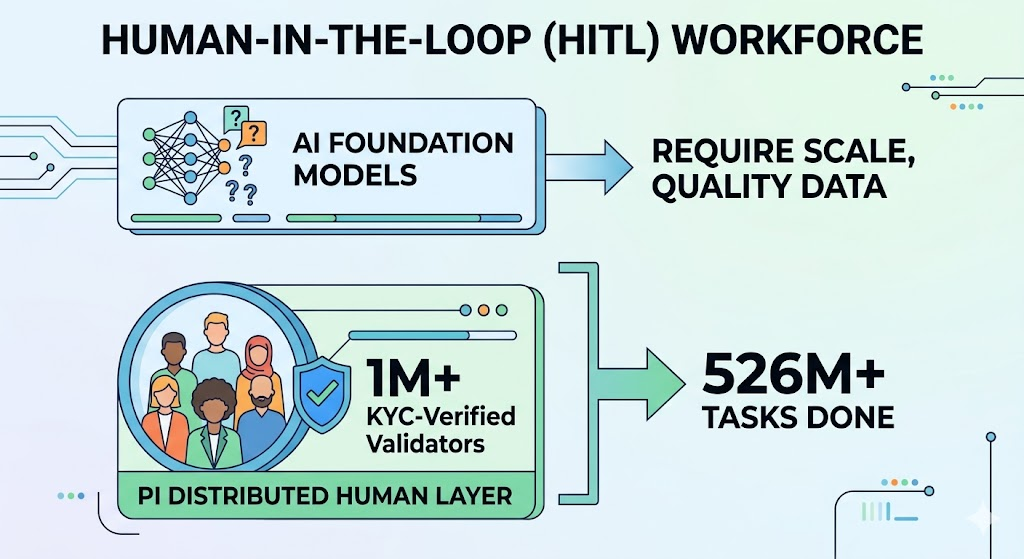
Major artificial intelligence models require massive volumes of high-quality, human-generated data to refine inference pipelines, evaluate alignment accuracy, and complete fine-grained localization tasks. This requirement creates three massive corporate bottlenecks: scaling participation, verifying data authenticity and eliminating synthetic bot feedback, and managing global micro-payout logistics.
Pi Network addresses this friction directly through its active workforce of over 1 million identity-verified human validators. This infrastructure has already demonstrated immense scale by executing over 526 million individual validation actions within its native KYC system.
By launching the Pi App Studio AI Integration, the protocol now allows external creators to utilize accessible generative platforms to build standalone services, attach the native Pi SDK via optimized text prompts, and deploy directly to a verified global community. This completely changes the underlying token thesis: instead of tracking abstract speculative yields, the asset's structural valuation behaves as an equity stake in a hyper-scalable, decentralized data processing utility.
Pi Network 2026 Price Prediction: How High Could PI Price Go?
The multi-year trajectory for Pi Network depends entirely on whether utility consumption via localized dApps can eventually outpace the structural gravity of token unlocks.
Speculative Spot Tracking and Pi Network Mainnet Horizon
It is critical for market participants to emphasize that a high percentage of current trading activity occurs via specific exchange-issued IOU frameworks. The true Pi Mainnet launch price floor will only achieve full structural definition once the Enclosed Mainnet phase yields to an un-restricted, fully open external environment with deep institutional order book depth.
Consensus and Reference Target Scenarios for PI Token Price: 2026–2030
|
Forecast Window |
Conservative Case |
Core Base Case |
Optimistic Case |
|
End of 2026 |
$0.087 – $0.110 |
$0.150 – $0.250 |
$0.300 – $0.450 |
|
2027 – 2028 |
$0.075 – $0.150 |
$0.180 – $0.400 |
$0.600 – $1.200 |
|
2030 Horizon |
$0.100 – $0.350 |
$0.4000 – $0.750 |
$2.200 – $3.500+ |
- The Bull Scenario: If the upcoming Protocol 25.1 and 26.0 updates trigger a wave of functional dApp deployments and spark listing updates from Tier-1 exchanges, the asset could confidently invalidate its current bearish breakdown. Reclaiming the $0.155 resistance shelf would open a clear path toward the $0.30 – $0.45 target range by late 2026.
- The Bear Scenario: If the 163-million token unlock schedule continues to saturate thin exchange order books of less than $20 million daily volume while market-wide sentiment stays in Extreme Fear, the asset will likely continue printing consecutive lower wicks. A failure to defend the current support levels could trigger a deeper flush toward the absolute historical support baseline near $0.059 – $0.095.
How to Trade Pi Network (PI) on BingX: Step-by-Step Guide
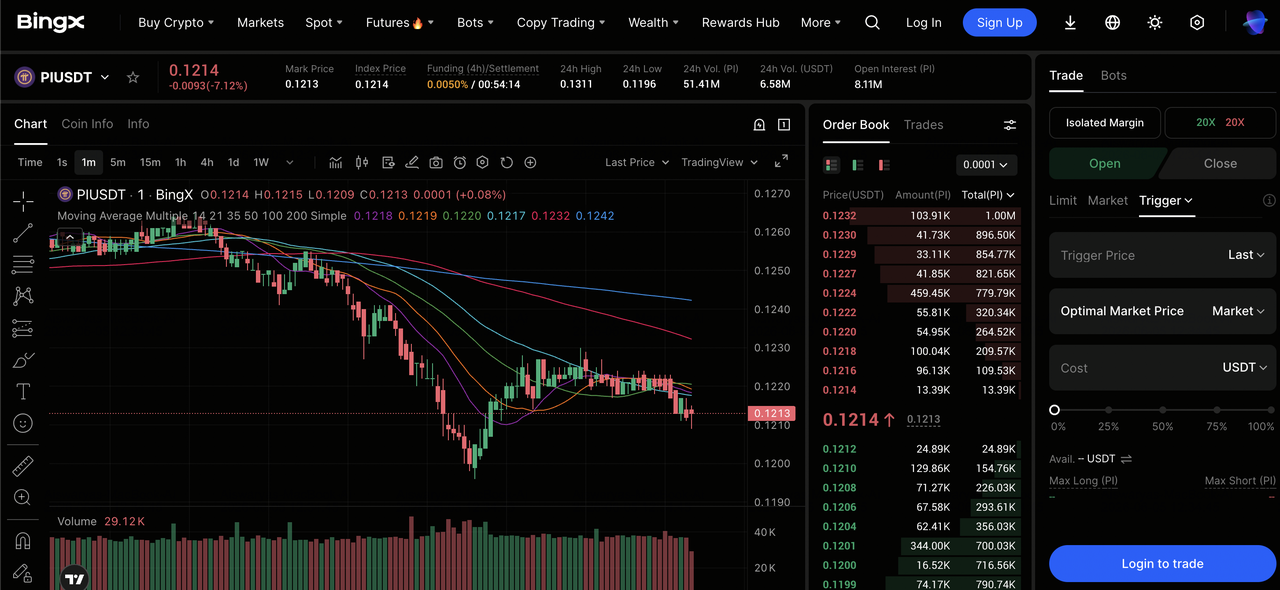
PI/USDT perpetuals on BingX futures market
You can navigate high-velocity token movements with precision by leveraging BingX AI, which provides real-time trend analysis and automated strategy suggestions directly within your derivatives interface.
- Access the Futures Interface: Log in to your account, hover over the Futures tab on the top navigation bar, and select Perpetual Futures.
- Locate the Trading Pair: Use the terminal's search bar to look up the PI/USDT perpetual contract ticker to load the live candlestick chart and order book dynamics.
- Select Your Margin Mode: Configure your risk boundaries by choosing Isolated Margin to restrict potential liabilities to a single position, or Cross Margin to utilize your unified account balance as collateral.
- Adjust Target Leverage: Select your leverage multi-multiplier toggle; given the elevated structural volatility of early-stage assets, conservative parameters, such as 2x–5x, are recommended to mitigate sudden liquidation risks.
- Establish Order Parameters: Input your desired entry metrics under a Limit Order to control execution price, or choose a Market Order to fill your position instantly at the prevailing index rate.
- Apply Risk Safeguards: Define precise target bounds by toggling the Take-Profit (TP) and Stop-Loss (SL) fields to automatically protect your collateral from unexpected directional reversals.
- Execute the Trade: Click Open Long if your fundamental analysis points toward an upward technical bounce, or click Open Short to profit from supply-side corrections toward key support baselines.
5 Key Risks for Pi Network Traders to Watch
While the network's human-in-the-loop framework introduces a unique fundamental moat, market participants must carefully navigate specific underlying vulnerabilities to protect their trading capital.
- Liquidity Concentration: On-chain data indicates that a notable percentage of circulating tokens are held within a small group of large wallets. A strategic rebalancing by these whale accounts can spark severe volatility waves.
- Thin Exchange Depth: Because native token portability remains restricted within the Enclosed Phase, daily trading volumes are small. This thin liquidity profile can easily amplify everyday price fluctuations.
- Mandatory Cutoff Risk: Node operations require regular, mandatory synchronization profiles. Failures to meet node deadlines, such as upcoming June infrastructure cutoffs, can temporarily impact network consensus density.
- Velocity Bottlenecks: While the AI-human workforce model is conceptually robust, the real-world velocity of external business onboarding could be slow, leaving the asset short-term dependent on retail speculation.
- Macro Asset Correlation: Despite its isolated identity and specialized data-labeling features, PI remains highly sensitive to macro liquidity cycles and aggregate altcoin capital rotations.
Conclusion: Can Pi Network Balance Execution Against Emissions in 2026?
Determining if Pi Network warrants an allocation within your trading strategy requires drawing a sharp line between short-term technical gravity and long-term ecosystem execution. In the immediate trading window, the asset faces a tough technical trendline, pinned below its historical moving averages and working through a substantial supply expansion. Meticulous risk management dictates viewing the $0.155 – $0.165 zone as the definitive trend-reversal macro metric.
However, from an institutional perspective, Pi's growing footprint as an authenticated human-workforce engine for the artificial intelligence era presents a legitimate fundamental moat. If the protocol successfully leverages its low-code AI development prompts to convert tens of millions of users into active software consumers, the long-term utility baseline will likely establish a floor significantly higher than traditional, speculative layer-1 peers.
