

Sandisk (SNDK) is a flash-storage company serving data centers, edge devices, and consumer markets. Its business centers on NAND flash memory and solid-state storage products, with enterprise SSDs becoming increasingly important as AI infrastructure drives demand for high-capacity, power-efficient storage. This gives Sandisk growing exposure to hyperscaler and data-center spending, but also leaves results sensitive to NAND pricing, customer inventory, supply discipline, and the timing of new industry capacity.
The growth story increasingly centers on AI-related storage demand and a tighter NAND market. Fiscal Q4 2026 revenue rose 51% sequentially, supported by higher pricing and a sharp increase in data-center sales, while gross margin expanded again. Sandisk is also using long-term customer agreements and more disciplined capacity planning to strengthen earnings durability. For investors, the key question is whether enterprise SSD demand and AI-driven storage growth can keep margins elevated after the current supply shortage begins to normalize.
The SNDK stock forecast for 2026 now centers on two competing views:
- The AI-storage growth case: Bulls expect stronger enterprise SSD demand, higher NAND content per AI server, long-term customer commitments, and disciplined supply to extend the cycle and support a higher through-cycle earnings base.
- The NAND normalization case: Bears expect slower price increases, customer inventory digestion, and additional industry capacity to pressure margins as supply conditions ease, limiting how much data-center growth and capital returns can offset the downturn.
This guide breaks down the SNDK stock forecast, 2026 price scenarios, key risks, and analyst views, drawing on the August 5 fiscal Q4 earnings release and latest market data, plus how to trade SNDK stock futures on BingX TradFi with USDT collateral.
Top 5 Things for Sandisk Investors to Know in September 2026
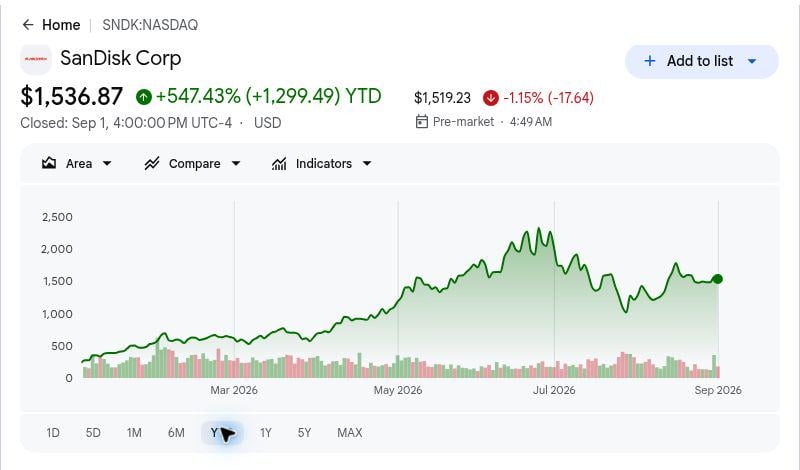
- A 547.43% YTD gain has raised the execution threshold: The September 1 close is a historical reference. Further upside now depends on earnings delivery, durable pricing and cash returns rather than initial recognition of Sandisk as an independent AI-storage supplier.
- Fiscal Q4 revenue of $8.97 billion grew 51% sequentially: Management attributed roughly one-third of the increase to volume and two-thirds to pricing. The mix shows that the quarter combined real shipment growth with unusually favorable industry economics, leaving pricing durability central to the next phase.
- Data-center revenue doubled sequentially to $2.98 billion: The segment expanded 103% from fiscal Q3 as enterprise SSD deployments accelerated. This moved data centers from an optional growth narrative toward a material revenue pillar, although quarterly comparisons will become more demanding after the rapid ramp.
- Fiscal Q1 2027 guidance calls for another revenue increase: Management expects revenue of $10.30 billion to $10.80 billion and non-GAAP diluted EPS of $44.00 to $46.00. The outlook supports continued demand, yet the projected gross-margin range also signals that incremental profitability may no longer rise every quarter.
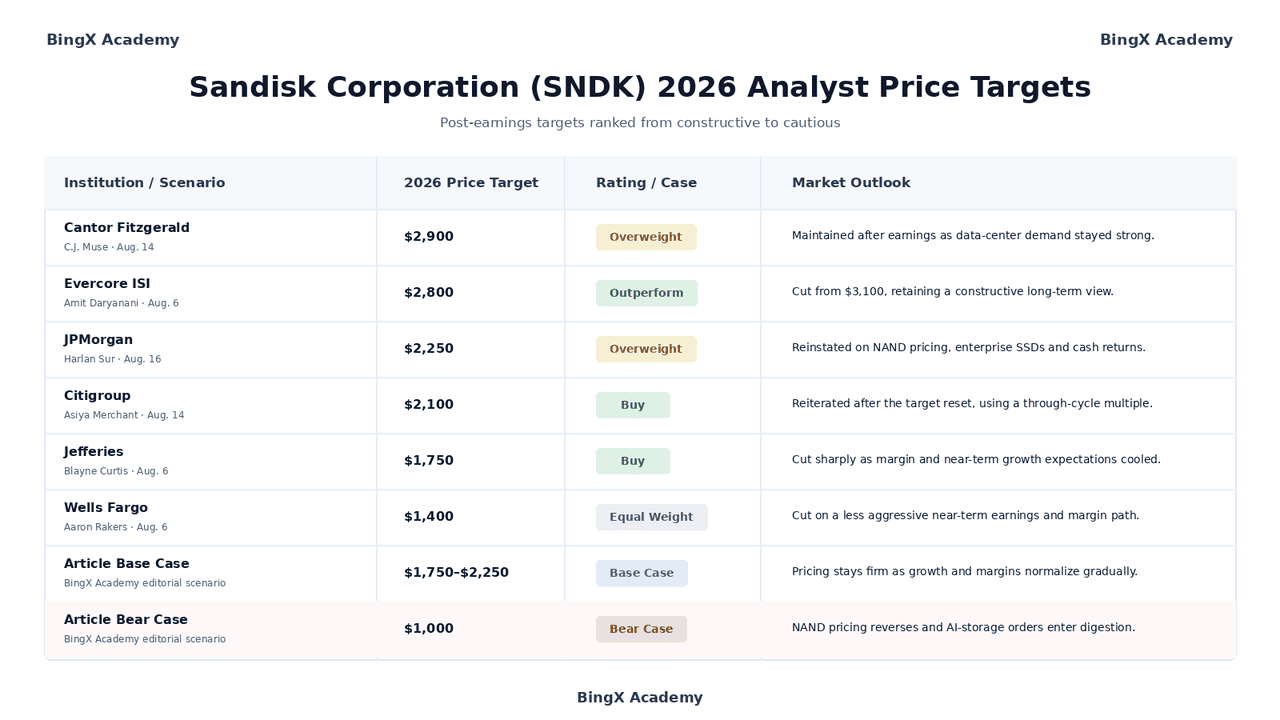
- Post-earnings targets span $1,400 to $2,900: The range reflects disagreement over how long tight NAND conditions and elevated margins can persist. It maps competing cycle assumptions rather than a single consensus promise.
What Is Sandisk Corporation (SNDK)?
Sandisk is a Milpitas, California-based NAND flash company that became independent from Western Digital in February 2025. It develops flash memory technology and sells enterprise SSDs, embedded and removable products, client storage, memory cards and USB drives. Manufacturing economics are supported by long-running Flash Ventures joint operations with Kioxia in Japan, giving Sandisk access to scaled wafer production without owning every fabrication asset outright.
The strategy now has three connected parts: shift revenue toward higher-value data-center customers, use New Business Model agreements to improve demand and pricing visibility, and return surplus cash without weakening technology investment. Sandisk added five NBM agreements after announcing five in April, including new customers and expansions with existing partners. It ended fiscal 2026 with $4.76 billion in cash and cash equivalents, $1.78 billion in marketable equity securities and $15.5 billion of remaining repurchase authorization.
Read More: Top AI Memory Stocks to Buy in 2026: DRAM, HBM, and AI Storage Demand Explained
Sandisk (SNDK) Fiscal Q4 2026 Earnings Overview: Pricing and Data-Center Demand Reset the Earnings Base
- Revenue reached $8.97 billion, above the prior guidance ceiling. Revenue exceeded management’s $7.75 billion to $8.25 billion range and rose 372% year over year. Higher NAND pricing drove much of the sequential increase, highlighting both strong supply-demand conditions and sensitivity to a future pricing reversal.
- Non-GAAP diluted EPS climbed to $39.25. Results came well above the previous $30.00 to $33.00 outlook as higher pricing flowed through the cost base and boosted profitability. Future earnings remain highly sensitive to NAND average selling prices.
- Data-center revenue doubled sequentially to $2.98 billion. Revenue from the segment increased 103% as AI infrastructure customers absorbed more high-value enterprise SSD capacity. Edge revenue rose 48%, while consumer revenue declined 32%, shifting the business mix further toward infrastructure.
- GAAP gross margin expanded to 84.6%. Margin improved 6.2 percentage points sequentially on stronger pricing, mix, and utilization. Fiscal Q1 guidance of 83.0% to 84.9% suggests profitability could remain elevated even as sequential margin expansion slows.
- Adjusted free cash flow reached $5.04 billion. Strong cash generation supported balance-sheet improvement and a larger share-repurchase program. Investors should still compare adjusted cash flow with reported results because the adjusted figure excludes NBM payments and Flash Ventures activity.
Sandisk Fiscal Q4 2026 Financial and Consensus Profile: Revenue, EPS and Margins
Fiscal Q4 combined a large guidance beat with another step-up in profitability. The table separates reported operating results from the next-quarter outlook and highlights where current earnings depend on pricing, data-center mix and customer commitments.
|
Financial Metric |
Guidance / Comparison |
Reported / Actual |
Surprise |
|
Fiscal Q4 revenue |
$7.75B–$8.25B guidance |
$8.965B |
Beat. Above the prior ceiling. |
|
Non-GAAP diluted EPS |
$30.00–$33.00 guidance |
$39.25 |
Beat. Pricing expanded earnings leverage. |
|
GAAP net income |
— |
$6.903B |
Improved. Up 91% sequentially. |
|
GAAP diluted EPS |
— |
$43.97 |
Improved. Up from $23.03. |
|
GAAP gross margin |
— |
84.60% |
Expanded. Up 6.2 percentage points. |
|
Data-center revenue |
— |
$2.977B |
Accelerated. Up 103% sequentially. |
|
Edge revenue |
— |
$5.432B |
Expanded. Up 48% sequentially. |
|
Consumer revenue |
— |
$556M |
Declined. Down 32% sequentially. |
|
Adjusted free cash flow |
— |
$5.035B |
Strengthened. More than doubled sequentially. |
|
Fiscal Q1 2027 revenue outlook |
— |
$10.30B–$10.80B |
Raised base. Implies further sequential growth. |
|
Fiscal Q1 2027 non-GAAP gross margin |
— |
83.0%–85.0% |
Maintained. Holds near the Q4 peak. |
|
Fiscal Q1 2027 non-GAAP diluted EPS |
— |
$44.00–$46.00 |
Positive. Extends the earnings ramp. |
Operating cash flow totaled $7.13 billion in fiscal Q4 and $11.67 billion for the full year. Full-year free cash flow reached $11.49 billion, compared with $8.74 billion of adjusted free cash flow after NBM and Flash Ventures items.
Sandisk Corporation (SNDK) 2026 Investment Outlook: $3,000 Bull Case vs. $1,000 Bear Case
The central test is whether AI-driven storage demand and customer agreements can preserve high earnings after the first surge in NAND pricing passes.
The Bull Case: AI Data Center Demand Pushes SNDK Toward $2,500
The bull case assumes that NAND demand for AI inference, model storage and data pipelines remains structurally stronger than traditional PC and smartphone cycles. Enterprise SSD revenue continues to expand, customers accept multi-year commercial commitments, and industry capacity additions remain disciplined. In that setting, data-center mix can offset slower consumer demand and keep cash generation well above the pre-spin base.
This outcome requires Sandisk to hold gross margin near the guided range, convert NBM agreements into repeat volume and avoid an aggressive supply response from competitors. Cantor Fitzgerald's post-earnings target is the highest named reference in the selected current set.
The Base Case: Strong Pricing Keeps SNDK Between $1,750 and $2,250
The base case assumes that enterprise SSD demand remains healthy as the rate of sequential pricing improvement slows. Revenue can continue growing, supported by the next-quarter outlook and contracted customer demand, although margins stabilize rather than expanding every quarter. Buybacks reduce the share count gradually and help translate cash generation into per-share value.
The range aligns with the middle cluster formed by Jefferies, JPMorgan, Citigroup and Wedbush. Confirmation would come from stable data-center orders, gross margin holding above historical cycle levels and continued adjusted free cash flow after NBM payments. This range is an editorial scenario, not a guaranteed trading band.
The Bear Case: NAND Normalization Pulls SNDK Toward $1,000
The bear case begins with a normal memory-cycle mechanism: high prices encourage more supply, customers build inventory and purchasing pauses before end demand disappears. A smaller pricing contribution would reduce revenue growth and compress margin quickly because fiscal Q4 results captured unusually strong scarcity economics.
The clearest triggers would be weaker enterprise SSD bookings, a sharp increase in customer inventories, capacity expansion across the NAND industry or gross-margin guidance falling materially below the current range. In that environment, the market could value Sandisk on normalized earnings rather than peak-cycle cash flow.
SNDK Stock Price Forecasts for 2026 By Wall Street Analysts
Wall Street remains constructive on Sandisk, yet post-earnings revisions show meaningful disagreement over margin durability. The rows below are dated, named third-party actions. The final two rows are BingX Academy editorial scenarios and are separated from analyst targets.
|
Institution / Scenario |
2026 Price Target |
Rating / Case |
Market Outlook |
|
Cantor Fitzgerald / C.J. Muse Aug. 14 |
$2,900 |
Overweight |
Maintained after earnings as data-center demand stayed strong. |
|
Evercore ISI / Amit Daryanani Aug. 6 |
$2,800 |
Outperform |
Cut from $3,100, retaining a constructive long-term view. |
|
JPMorgan / Harlan Sur Aug. 16 |
$2,250 |
Overweight |
Reinstated on NAND pricing, enterprise SSDs and cash returns. |
|
Citigroup / Asiya Merchant Aug. 14 |
$2,100 |
Buy |
Reiterated after the target reset, using a through-cycle multiple. |
|
Jefferies / Blayne Curtis Aug. 6 |
$1,750 |
Buy |
Cut sharply as margin and near-term growth expectations cooled. |
|
Wells Fargo / Aaron Rakers Aug. 6 |
$1,400 |
Equal Weight |
Cut on a less aggressive near-term earnings and margin path. |
|
Article Base Case BingX Academy editorial scenario |
$1,750–$2,250 |
Base Case |
Pricing stays firm as growth and margins normalize gradually. |
|
Article Bear Case BingX Academy editorial scenario |
$1,000 |
Bear Case |
NAND pricing reverses and AI-storage orders enter digestion. |
How to Trade Sandisk (SNDK) Stock on BingX
Trade Sandisk's NAND pricing and AI data-center outlook using BingX TradFi and BingX AI tools. Define the operating catalyst and acceptable loss before opening a position.
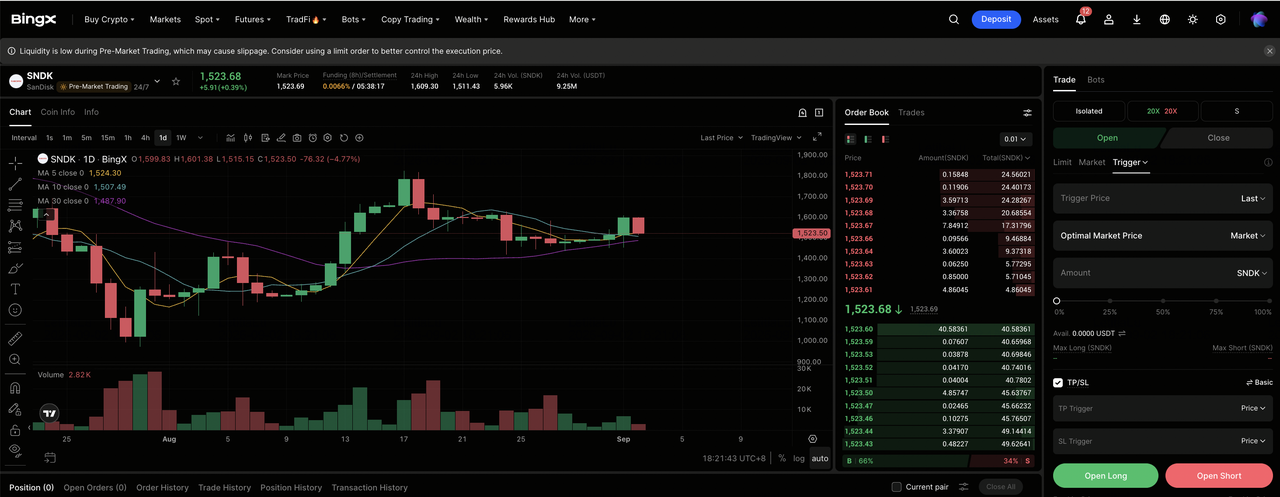
Step 1: Access BingX TradFi. Sign up, complete identity verification, enable two-factor authentication and open the TradFi market.
Step 2: Select Sandisk (SNDK). Select the SNDK-USDT perpetual contract and confirm the ticker before ordering.
Step 3: Choose your direction. Select Open Long or Open Short according to the thesis. A long position may fit expectations for sustained enterprise SSD demand and pricing, whereas a short position may fit expectations for inventory digestion or margin compression.
Step 4: Select leverage and margin mode. Choose Isolated or Cross-Margin based on risk tolerance. SNDK's large YTD move and post-earnings volatility make conservative leverage and deliberate position sizing important.
Step 5: Execute strict risk protocols. Set Take-Profit and Stop-Loss levels before or immediately after entry. Monitor NAND pricing, enterprise SSD orders, gross-margin guidance, NBM contract progress, industry capacity and hyperscaler capital spending.
Top 5 Risks to Watch for Sandisk Investors in 2026
Sandisk combines exceptional pricing, fast data-center growth and substantial cash generation, yet five risks will determine whether the stronger earnings base persists.
- NAND pricing can reverse before end demand contracts: Customers adjust orders quickly when inventories rise or supply becomes easier to secure. Because pricing supplied most of fiscal Q4's sequential increase, stable shipments could still produce weaker revenue and margin.
- AI infrastructure spending remains concentrated: Enterprise SSD demand depends on a limited group of cloud customers. Delayed projects, architecture changes or spending digestion could create abrupt order volatility.
- New Business Model agreements exchange margin for visibility: Longer commitments can reduce volatility, although contract economics may cap near-term upside or require prepayments. Durability and adjusted cash-flow treatment remain central.
- Flash Ventures and Asian manufacturing create execution exposure: Sandisk relies on joint operations and a concentrated supply chain. Yield problems, natural disasters, trade restrictions or partner disagreements can affect supply and cost.
- Peak-cycle earnings can distort valuation: A low multiple may appear inexpensive even if profits are unusually high. The relevant test is how much revenue, margin and cash flow remain after pricing normalizes.
Final Thoughts: Should You Invest in Sandisk in 2026?
Sandisk closed fiscal 2026 with a materially stronger business than it began the year. Revenue increased 175% for the full year, data-center sales grew 437%, gross margin reached an exceptional level and cash generation supported a much larger repurchase authorization. The company has also moved beyond a consumer-storage identity by making enterprise SSDs and multi-year customer relationships central to its strategy.
The bull case depends on AI storage demand, disciplined NAND supply and NBM agreements sustaining a higher earnings floor. The base case allows pricing and margins to normalize gradually without undermining data-center growth. The bear case becomes more credible if inventories rise, capacity expands or customer spending enters a digestion phase. Conservative traders may wait for another quarter of margin and order visibility rather than relying on any single analyst target.
Risk Reminder: Trading and investing in equities like SNDK involves a high risk of capital loss. Sandisk is exposed to NAND cycles, concentrated data-center demand, manufacturing partnerships, technology transitions, supply-chain disruptions, contract execution and valuation compression. Leveraged perpetual contracts can be liquidated. Conduct independent research before allocating capital.
Related Reading
- Top AI Memory Stocks to Buy in 2026: DRAM, HBM, and AI Storage Demand Explained
- Top AI Data Center Stocks to Buy in 2026: Cloud, Servers, and AI Compute Infrastructure
- Top AI Server Stocks to Buy in 2026: Rack-Scale Systems, GPU Servers, and AI Servers Infrastructure
- Western Digital Prediction 2026: Can Data Storage Recovery, AI Infrastructure Drive WDC to 580+?
- Seagate (STX) Price Prediction 2026: Can AI Storage Demand Drive STX Stock to $1,600?
- Micron Stock Price Prediction 2026: $1,500 AI Supercycle or Peak Margin Cyclical Trap?
