
As the Web3 ecosystem expands across thousands of independent networks, the industry faces a crippling crisis of fragmentation. Fragmented liquidity, isolated user bases, and localized scaling barriers force developers to build in silos. To connect these disparate networks, the industry has historically relied on cross-chain bridges. However, these traditional bridges introduce highly vulnerable external trust domains, such as centralized operator committees, multi-sigs, and multi-party computation (MPC) networks. Empirically, the vast majority of cross-chain exploits have stemmed from compromises within these bridge perimeters rather than failures of the underlying base blockchains.
Launched in August 2025, c8ntinuum solves these systemic architectural vulnerabilities. Positioned as a fundamental Layer 0 data fabric, c8ntinuum shifts the multi-chain narrative from competition to cooperation. By introducing a bridgeless, aggregated interoperability framework, it turns cross-chain communication into a problem of mathematically verifiable state consensus rather than human or committee attestation.
What Is c8ntinuum (CTM)?
c8ntinuum is a universal interoperability network that combines a dedicated Layer 0 chain with an extensible, forward-compatible Ethereum Virtual Machine (EVM) layer. At its core, the project eliminates the trust assumptions that plague modern cross-chain systems by focusing on three definitive goals:
- Trust Minimization by Construction: It bypasses privileged third-party verifiers. Instead, safety reduces entirely to the security assumptions of the underlying chains' consensus plus the mathematical soundness of zero-knowledge (zk) proof systems.
- A Forward-Compatible EVM: The protocol treats the EVM as an adaptable surface. It runs any standard Ethereum contract out of the box while exposing next-generation cryptographic primitives through specialized on-chain precompiles.
- The All-in-One SuperApp Experience: Beyond its business-to-business (B2B) messaging layer, c8ntinuum integrates a consumer-facing Web3 SuperApp. This single interface enables users to trade, launch assets, earn, and stake natively across multiple chains simultaneously.
How Does c8ntinuum Work?
The protocol coordinates cross-chain communication through an advanced horizontal topology, allowing any-to-any chain connectivity without relying on a centralized hub-and-spoke model.
Trust-Minimized Interoperability via zk-Light Clients
Instead of trusting an external validator network to witness and sign off on transactions, c8ntinuum uses on-chain zk-light clients.
When a transaction occurs on a source network like Ethereum or Solana, off-chain relayers fetch the transaction data and state transitions. These relayers compile the information into compact zero-knowledge proofs, such as SP1 Groth16 or Plonk circuits. Smart contracts on the destination chain verify these block headers and state transitions directly on-chain. Because the verification is purely cryptographic, the off-chain relayers require zero privileged trust; the system remains secure as long as there is at least one honest node and the underlying zero-knowledge circuit remains sound.
The Extensible EVM and Cryptographic Precompiles
For developers, c8ntinuum acts identically to a standard EVM environment, fully supporting standard tools like Hardhat, Foundry, Remix, and libraries like ethers.js. However, c8ntinuum introduces advanced cryptographic features directly accessible as precompiles from Solidity code.
Rather than waiting for upstream Ethereum Improvement Proposals (EIPs) to be adopted, builders can natively call zero-knowledge verification, such as Poseidon hashing, post-quantum digital signatures (ML-DSA and SLH-DSA), and Solana transaction parsing directly inside their smart contracts.
Modified CometBFT Consensus
The c8ntinuum Layer 0 chain relies on a modified CometBFT consensus engine that delivers deterministic, 1-block protocol finality. With an expected block time of 4 seconds, the network eliminates the reorganizations (reorgs) and multiple confirmation delays common to legacy Proof-of-Stake protocols.
c8ntinuum vs. Alternative Data Infrastructure: Key Differences
|
Feature |
c8ntinuum (CTM) |
Standard EVM Chains |
Traditional Bridge Interop |
|
Cross-Chain Trust |
Light clients + zk proofs |
N/A (Isolated) |
Trusted Intermediaries / Multi-sigs |
|
Finality Time |
1-block finality (~4s) |
Variable (Multiple confirmations) |
Variable (Dependent on bridge lockups) |
|
Cryptographic Primitives |
zk, Post-Quantum, Solana-aware |
Standard EVM Only |
Standard EVM Only |
|
Solana Interoperability |
Native transaction parsing |
Not native |
Requires external wrapping |
|
On-Chain zk Verification |
Native SP1 Groth16 + Plonk |
Highly limited / Expensive |
N/A |
|
Quantum Resistance |
Native Layer 0 (ML-DSA, SLH-DSA) |
None |
None |
What Is c8ntinuum (CTM) Tokenomics?
The economic framework of c8ntinuum is designed around a deflationary, asset-backed model that aligns token emissions with the tangible value locked within the protocol's treasury.
The Public Generation Minting Model
c8ntinuum eschews traditional Initial Coin Offerings (ICOs), heavy venture capital allocations, and venture-backed private sales. Instead, the native token, CTM, is generated through a dynamic Public Generation Event.
To mint new CTM, users must permanently lock whitelisted counter-assets, such as ETH, SOL, or other approved tokens, into the protocol’s decentralized treasury. The minting protocol utilizes a dynamic pricing curve: as the aggregate volume of minted tokens increases, the minimum asset-locking requirement rises to match real-time market valuations. This establishes a mint-burn equilibrium, ensuring that every circulating CTM token is natively backed by a multi-chain treasury.
CTM Token Supply and Allocations
The CTM token features 18-decimal precision and is hard-capped at a maximum supply of 8,888,888,888 tokens. As of mid-2026, approximately 50% of the maximum supply (4.5 billion CTM) is in active circulation.
The whitelisted counter-assets captured during the Public Generation Event are systematically allocated as follows:
- 40% Liquidity Provision: Seeded directly into automated market maker (AMM) liquidity pools across supported ecosystems to guarantee deep trading books.
- 10% Community Ecosystem: Disbursed to fuel user referral incentives and community participation milestones.
- 50% Protocol Re-staking: Staked by the protocol across participating external networks to generate continuous structural yields.
The Sustainability Feedback Loop: The yields generated by the 50% protocol re-staking allocation are programmatically routed to execute market buybacks and permanent burns of CTM. Combined with cross-chain message fees, this continuous buyback architecture creates systemic deflationary pressure aimed at retiring up to 50% of the total token supply over time.
How to Trade c8ntinuum (CTM) on BingX
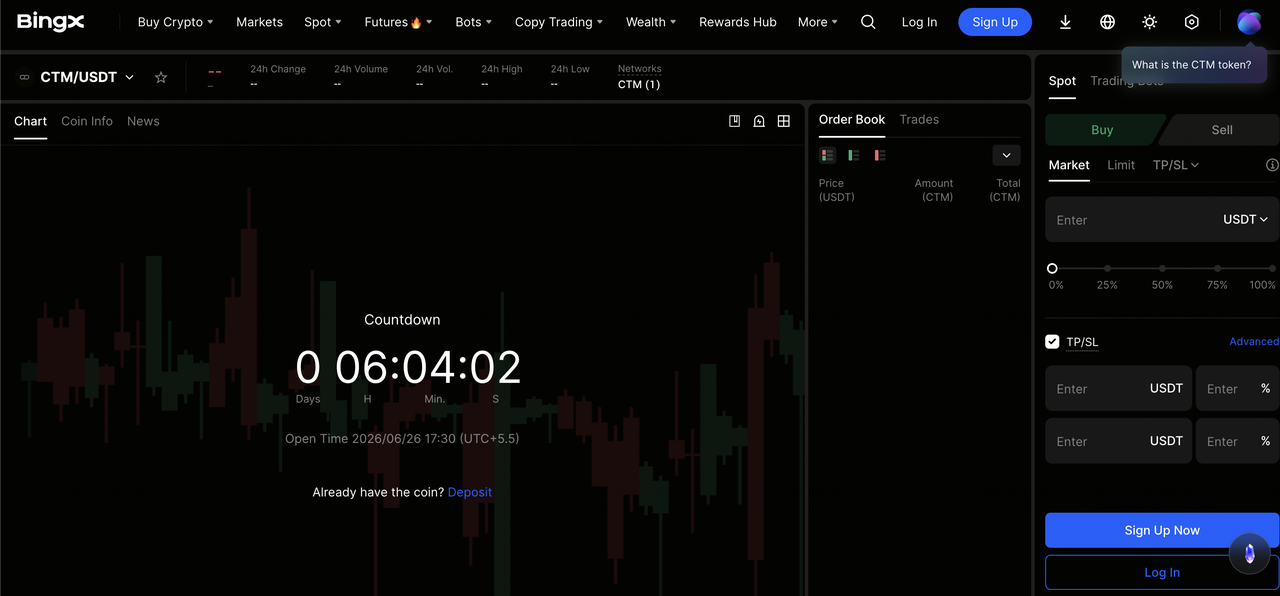
CTM/USDT trading pair on the BingX spot market
You can utilize the highly optimized BingX spot trading terminal to track real-time liquidity distributions and manage your positions. Follow this concise guide to trade the CTM/USDT asset pair:
- Access the Spot Terminal: Log into your BingX account, hover over the Spot navigation header, select Spot Trading, and enter CTM in the asset search bar to launch the dedicated trading layout.
- Fund Your Account: Ensure your funding wallet holds an adequate balance of Tether (USDT). If your funds are sitting in your derivatives account, execute an instant, zero-fee internal transfer to your spot wallet.
- Configure Order Parameters: Navigate to the order execution panel on the right side of the layout. Choose a Limit Order to set a precise manual target entry price, or a Market Order to fill your allocation immediately at the prevailing market depth.
- Execute and Monitor: Enter the total quantity of USDT or CTM you wish to exchange, verify your input metrics, and click Buy CTM to route the transaction to the high-frequency matching engine.
5 Critical Considerations Before Investing in c8ntinuum (CTM)
Before allocating capital or integrating with the c8ntinuum network, keep these primary structural risks in mind:
- Multi-Chain Smart Contract Exposure: Because c8ntinuum deploys smart contract states across multiple host networks, including Ethereum, BNB Chain, and Solana, it remains exposed to vulnerabilities within any of those external execution environments.
- Interactive Staking Demands: The network's staking mechanism is not a passive revenue model. It requires active participation and ongoing interaction with protocol contracts; failure to maintain active engagement can result in a reduction of staking yields.
- Anonymity of Core Team: Public information regarding specific founders or executive entities remains limited, with development structured through decentralized global collectives and infrastructure groups in Monaco.
- Dependencies on Circuit Soundness: While cryptographic light clients bypass human human-error vectors, the security of the protocol relies entirely on the mathematical soundness of its zk-SNARK and SP1 proof circuits.
- Treasury Asset Volatility: The deflationary buyback mechanism depends heavily on the yields generated by the treasury’s locked counter-assets. Severe, prolonged downturns in the broader crypto market can reduce these yields and slow down the token-burning rate.
Final Thoughts: Is c8ntinuum (CTM) a Good Investment?
c8ntinuum introduces a highly distinct, zero-knowledge approach to blockchain interoperability by eliminating the trusted intermediaries that have historically caused multi-billion-dollar cross-chain bridge exploits. By combining an extensible EVM with built-in post-quantum resistance, native Solana parsing, and an unconventional asset-backed token generation model, the protocol sets a solid foundation for secure, universal multi-chain communication.
Ultimately, its long-term market success will depend on organic developer adoption of its cryptographic precompiles and the volume of volume-driven transactional fees flowing through its Web3 SuperApp.
Risk Reminder: Engaging with Layer 0 cross-chain protocols, utility token systems, and multi-chain treasury environments involves inherent technical, execution, and market volatility risks. Users should thoroughly audit contract documentations and treasury states before deploying capital or liquidity. BingX assumes no responsibility for external deployment decisions or financial outcomes.
Related Reading
- What Is LayerZero (ZRO) Omnichain Interoperability Protocol and How Does It Work?
- What Is Synapse (SYN)? Interchain Programming Interface for Cross-Chain DeFi
- What Is Hyperlane (HYPER) Cross-Chain Connectivity Protocol?
- What Is Polkadot (DOT) Cross-Chain Crypto and How to Buy It?
- What Is Chainlink: the Oracle Network Powering DeFi, RWAs, and the Future of Finance?
- What Is Owlto Finance (OWL), the AI-Powered Highway for Omnichain Interoperability?
