
Understanding what GateToken(GT) is requires looking at the modern convergence of Centralized Exchanges (CEXs) and decentralized Web3 application layers. In the 2026 digital asset ecosystem, GateToken coin functions as a hybrid financial instrument. It serves a dual mandate: providing loyalty perks and trading tier fee discounts on the centralized Gate.io exchange while operating natively as the foundational gas layer for GateChain and the high-performance Gate Layer 2 network.
Backed by one of the most aggressive algorithmic tokenomics models in crypto, which has successfully permanently removed over 62% of its original total supply, GT has transitioned into a highly sought-after utility asset. Whether you are seeking entry to early-stage project launches via CEX-based Launchpads or building highly scalable decentralized apps (dApps) utilizing EVM-compatible infrastructure, this ultimate guide will give you an in-depth breakdown of GateToken’s technology, utilities, economics, and long-term ecosystem positioning.
What Is GateToken (GT) and How Does It Work?
GateToken (GT) is the dual-purpose native asset powering both the Gate.io cryptocurrency exchange and its underlying Layer-1 blockchain infrastructure, GateChain. Launched in 2019 without an ICO or private funding, GT functions as a hybrid utility token that bridges centralized financial services with decentralized Web3 application layers. As of June 2026, GT trades at approximately $6.42 with a market capitalization of $683 million, ranking it among the top 70 digital assets globally.
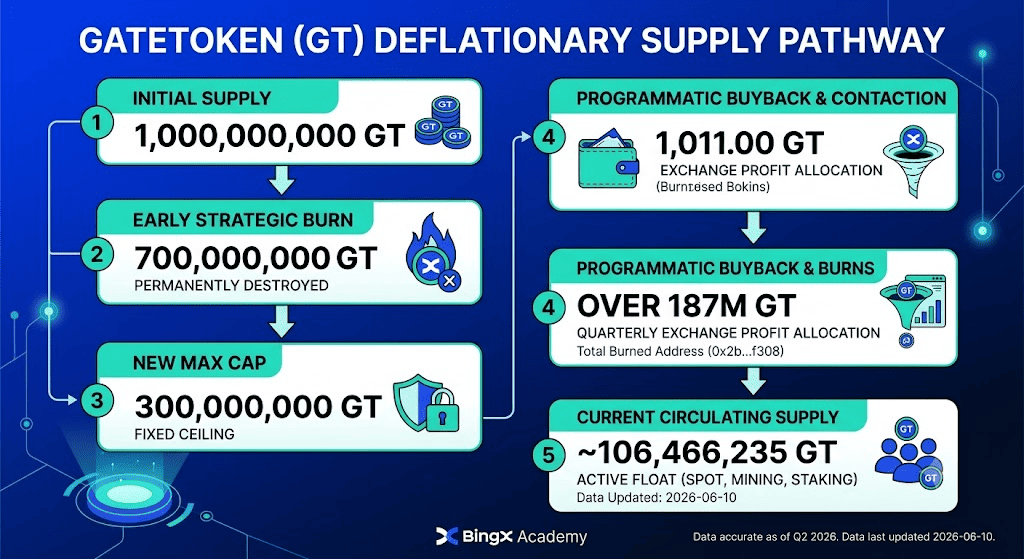
Its core financial framework is strictly deflationary; through a programmatic burn mechanism funded by 15% of the platform’s quarterly trading profits, over 187 million tokens, representing more than 62% of its maximum supply, have been permanently removed from circulation, leaving a highly liquid circulating supply of roughly 106.4 million GT.
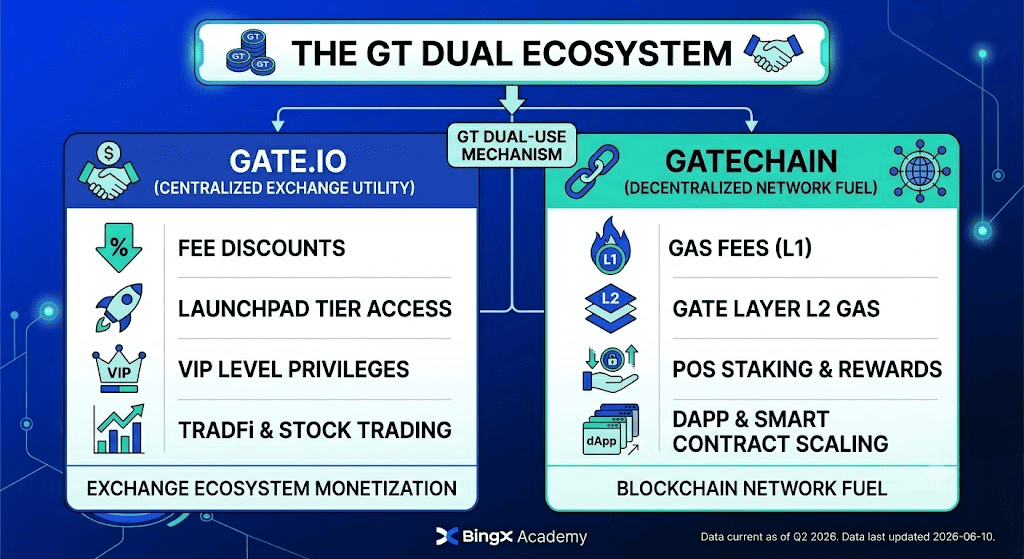
The asset works by executing a dual-loop utility model across two distinct ecosystems. On the centralized exchange side, holding GT dynamically unlocks spot and futures trading fee discounts, VIP tier privileges, and priority allocation rights for early-stage web3 projects via the platform’s Launchpad and HODLer airdrop programs. On the decentralized side, GT operates as the exclusive native gas token required to execute smart contracts and transfer assets across the EVM-compatible GateChain mainnet and its high-performance Layer-2 network, Gate Layer.
Operating on a Proof-of-Stake (PoS) consensus model backed by a Verifiable Random Function (VRF), the blockchain achieves 4-second block times, real-time settlement, and handles up to 2,745 transactions per second (TPS) for an average cost of just $0.0001 per transaction, allowing GT to function as an efficient network fuel and a reliable staking asset generating localized validation yields.
Why Understanding GateToken’s Dual Nature Matters
In 2026, the utility parameters for exchange tokens have fundamentally shifted. No longer regarded purely as passive defensive assets, modern tokens function more like venue-specific liquidity derivatives. Their market valuation responds dynamically to cross-chain transactions, decentralized governance applications, and the structural health of the underlying exchange.
For traders exploring the GateToken coin, navigating this setup requires an understanding of how its utility is balanced between Web2 centralized services and Web3 decentralized smart contracts.
When Did GateToken (GT) Launch?
Originally launched in 2019 without an Initial Coin Offering (ICO) or private institutional funding rounds, GateToken was built to incentivize user engagement across the platform. On March 2, 2020, it was officially designated as the ecosystem's main utility token.
Today, GT sits directly at the center of a fast-expanding infrastructure that caters to retail spot traders, institutional derivatives players, and smart contract programmers.
GateToken (GT) Current Market Overview as of June 2026
|
Metric |
Metric Details (June 2026) |
|
Current Market Price |
$6.42 |
|
24-Hour Range |
$6.26 – $6.49 |
|
Market Capitalization |
$683.84 Million |
|
Global Market Rank |
#69 |
|
Circulating Supply |
106,466,235 GT |
|
Total Permanently Burned |
187,377,156 GT (62.46% of initial max supply) |
GateToken's Role in the Gate Ecosystem Role: Gas, Rewards, and Governance
The primary valuation driver for the GT token is its diverse array of structural utilities across both centralized applications and decentralized on-chain consensus networks.
1. Network Gas and Smart Contract Execution
On the native Layer 1 blockchain network (GateChain), GT operates identically to how ETH operates on Ethereum. Every peer-to-peer transfer, token creation, or smart contract interaction requires a network transaction fee paid entirely in GT.
Thanks to the proprietary GateMint consensus mechanism, transaction execution achieves instant block confirmation with ultra-high throughput capabilities:
- Block Times: 4 seconds
- Throughput: Up to 2,745 Transactions Per Second (TPS)
- Average Transaction Cost: ~$0.0001 (Almost zero gas fees)
Furthermore, following the mid-2025 core mainnet upgrades v19 and v20, GateChain implemented standard Ethereum Cancun optimizations, such as EIP-4844 (Proto-Danksharding). This advancement lowered operational costs for the Layer 2 scaling layer, where GT serves as the exclusive gas token for high-frequency decentralized applications like Perp DEX and the Gate Fun launchpad.
2. Proof-of-Stake (PoS) Staking and Security
GateChain employs a dynamic Proof-of-Stake model incorporating a Verifiable Random Function (VRF) algorithm to select 160 global consensus nodes in real time. GT holders can directly lock their tokens to participate in network security through consensus validation or by delegating holdings to established nodes. Staking yields vary across products:
- Consensus Node Validator Rewards: Generates an estimated 0.98% APR sourced directly from unmined emissions blocks.
- On-Chain Ecosystem Staking Programs: Special promotional staking pools offer dynamic yield distributions yielding up to 20% in promotional cycles.
3. Centralized Platform Governance and VIP Privilege Rights
When utilized inside the centralized exchange infrastructure, holding GT opens up direct ecosystem governance and monetization lanes:
- Launchpad and Launchpool Access: Holding 1 GT serves as an all-access entry ticket to secure primary allocations in early-stage project initial exchange offerings (IEOs) and free token airdrops via HODLer Airdrop pipelines without forcing token lockups.
- Fee Tier Offsets: Trading fees across Spot, Margin, and Futures are programmatically discounted based on the volume of GT maintained in user fund accounts.
- Listing Voting Rights: 1 GT equals 1 vote, allowing the trading community to directly dictate which incoming digital assets receive official primary market spot listings.
GateToken Tokenomics and Deflationary Burn Mechanism
A vital factor behind the long-term structural value proposition of the GT coin is its highly aggressive programmatic deflationary architecture.
The Programmatic Scarcity Engine
Though initial conceptual frameworks detailed a supply cap of 1 billion tokens, the architecture underwent a dramatic adjustment that burned 700 million uncirculated tokens, reducing the structural maximum ceiling to 300 million GT.
To systematically shrink this supply pool over time, a programmatic buyback-and-burn schedule was put into production. Every quarter, a dedicated 15% of total platform trading profits aggregated from Spot, Margin, and Futures contract volumes is deployed directly to purchase circulating GT on the secondary market. An additional 5% of profits is allocated to security R&D and ecological marketing expansions, with these tokens permanently locked from re-entering open market circulation.
Q1 2026 On-Chain Burn Achievements
Proving its absolute dedication to multi-year deflationary transparency, the platform completed its latest quarterly on-chain burn on April 30, 2026:
- Tokens Destroyed: 2,557,729.38 GT
- Estimated Capital Value: Over $20.68 Million
- Cumulative Impact: The total burned token amount stands at 187,377,156 GT, effectively locking up over 62.46% of the original maximum token float into publicly verifiable null addresses.
This persistent shrinkage of the supply float creates a predictable, structural supply-side crunch. Assuming baseline user activity and volume on the platform remain steady, the reduction in circulating tokens acts as a long-term supply floor.
GateChain vs. Gate.io: Understanding the Difference
Newcomers trying to understand what GateToken is frequently confuse the trading platform with the blockchain network. Maximizing operational efficiency requires separating these components.
The Centralized Hub: Gate.io
Gate.io is a top-tier centralized exchange (CEX) platform handling billions of dollars in daily trading volumes across spot, derivatives, and fractional asset vehicles. In a massive June 2026 expansion into traditional finance (TradFi), the exchange launched a strategic integration with US broker-dealer Alpaca.
This alliance permits international users to directly trade over 10,000 US equities and ETFs fractionally from $1 using a unified account settled natively in USDT. Within this ecosystem, GT serves as an account status and tier modifier.
The Decentralized Engine: GateChain and Gate Layer
GateChain is an open, trustless, EVM-compatible Layer 1 public blockchain built to provide high security and seamless decentralized application deployment. It features an innovative online hot vault account and liquidation safeguard infrastructure specifically coded to mitigate asset thefts and lost private keys.
To achieve comprehensive asset transparency in 2026, the network migrated entirely to an on-chain cross-chain solution. This structural upgrade completely replaced older centralized bridging models. Now, all transfers across the four native formats of the asset, Ethereum-based ERC-20 GT, GateChain Mainnet GT, EVM-compatible formats, and Gate Layer L2 native gas, are carried out via transparent smart contracts. This allows for end-to-end auditability across public blocks.
GateToken Technical Deep Dive: Upgrades and Account Abstraction
For developers assessing Web3 scalability, recent infrastructure developments have drastically minimized historical entry barriers:
- Account Abstraction (AA) Integration: As of April 20, 2026, the GateScan block explorer rolled out native support for AA Transactions. Users can directly initiate batched executions and manage advanced smart-contract wallets directly from the block explorer interface, paving the way for sponsored, gasless retail experiences.
- Simplified Developer Architecture: GitHub documentation updates released in late 2025 modularized the deployment pipelines on the GateLayer Layer 2 network. By providing pre-configured seed nodes and distinct transaction submission RPC paths, developers can easily migrate existing Ethereum dApps to the network with nearly zero code modification.
Final Thoughts: Is the GateToken Ecosystem Poised for Growth in 2026?
GateToken represents a highly calculated approach to modern tokenomics, combining the revenue-generating engine of a top-tier global CEX with a highly scalable, EVM-compatible Layer 1 and Layer 2 ecosystem. Its programmatic quarterly burn schedule ensures a steadily declining supply, while initiatives like the Alpaca TradFi stock integration and advanced Account Abstraction developer tools continue to open up new utility channels.
However, like all exchange-linked tokens, GT’s performance is closely tied to its parent venue's ongoing regulatory compliance and competitive edge. For long-term holders and decentralized builders, monitoring quarterly burn volumes and the growth of on-chain transaction metrics on Gate Layer remains the most effective way to gauge the token's structural network health.
Risk Reminder: Digital asset prices are subject to high market risks and severe cyclical price volatility. Always verify local jurisdictional compliance guidelines and ensure proper portfolio risk management parameters are active before committing capital.
Related Reading
- What Is VeChain (VET) Enterprise-Focused Supply Chain Network in 2026? Complete Beginner’s Guide
- What Is Polygon (POL) in 2026? From Sidechain to Aggregated Layer
- What Is Ethereum Classic (ETC) and How Does the Olympia Upgrade Power the Original EVM Ecosystem?
- What Are the Top Layer-1 (L1) Blockchains to Know in 2026?
- What Are the Best Ways to Convert Ethereum (ETH) to USD in 2026?
FAQs on GateToken (GT)
1. What is the difference between GateToken (GT) on Ethereum vs. GateChain Mainnet?
Ethereum-based GT is an ERC-20 token format widely used for trading across decentralized applications on Ethereum. GateChain Mainnet GT is the native coin utilized to pay for gas fees and secure the PoS consensus layer on its own high-speed blockchain network. All conversions between formats are handled instantly through an auditable, on-chain cross-chain solution.
2. How exactly does the deflationary burn model support the price of GT?
Every quarter, the platform deploys 15% of its transaction profits to purchase circulating GT from the open marketplace and sends those tokens to a verifiable null address, permanently removing them from existence. This continuous reduction in circulating supply is designed to establish a long-term supply-side crunch.
3. Can developers migrate Ethereum dApps to GateChain without rewriting smart contracts?
Yes. GateChain is fully EVM-compatible and supports standard Ethereum tools, developer RPC configurations, and smart contracts. Following recent consensus updates, it also natively accommodates EIP-4844 optimizations and Account Abstraction transactions, making migrations fast and cost-efficient.
