
Navigating the high-octane 2026 futures market requires more than just a "buy low, sell high" mentality; it requires a surgical understanding of borrowed power. On BingX, leverage is the tool that allows you to control a large market position with a fraction of the total value. Whether you are hedging a Bitcoin spot position or seeking 2x gains on Ethereum volatility, choosing the correct leverage ratio is the difference between a calculated profit and a sudden liquidation.
As a top 5 global exchange, BingX provides a flexible leverage toolkit, ranging from conservative 1x spot-like trading to high-intensity 500x, designed to suit both institutional risk managers and retail beginners. By mastering leverage, you can increase your capital efficiency, diversify across more assets, and participate in liquid markets like Gold and Oil with minimal upfront cost.
This guide breaks down exactly what leverage is, the mechanics of margin, and how to safely deploy these tools on the BingX futures trading platform.
What Is Leverage and How Does It Work in Futures Trading?
In the futures market, leverage is the use of margin (collateral) to gain exposure to a much larger position. Unlike the spot market, where $1,000 buys exactly $1,000 worth of BTC, a 10:1 leveraged futures position allows that same $1,000 to control $10,000 worth of Bitcoin.
Every leveraged trade consists of two parts: your Margin or the performance bond you provide and the Borrowed Capital provided by the exchange. This creates a multiplier effect on your PnL (profit and loss). If the underlying asset moves by 1%, a 10x leveraged position moves by 10%.
Execution involves the Notional Value, the total market value of your position. For example, if you trade one Micro E-mini S&P 500 (MES) contract at 5,000 points with a $5 multiplier, the notional value is $25,000. If BingX requires an initial margin of $1,320, your effective leverage is approximately 18.9:1. This allows you to 'Ride the Wave' of price movements in massive indices without tying up six figures of liquidity.
The Essentials of Leverage Management: Initial vs. Maintenance Margin
Understanding the difference between your "buy-in" and your "stay-in" requirement is the first step for any BingX trader.
1. Initial Margin
The Initial Margin is the minimum amount of equity required to open a position. Think of this as the down payment on your trade. The higher the leverage you select, the lower your initial margin requirement becomes. For instance, at 2x leverage, you need 50% of the position value upfront; at 20x, you only need 5%.
2. Maintenance Margin
The Maintenance Margin is the minimum account balance you must maintain to keep a position open. If market volatility causes your account equity to drop below this level, a Margin Call or automatic liquidation is triggered. On BingX, these values are settled in real-time through a process called Mark-to-Market, ensuring your account reflects the global average price (Mark Price) rather than temporary scam wicks.
When and How to Use Low Leverage When Trading Futures
For beginners, high leverage is often a wipeout waiting to happen. Professional traders frequently advocate for the Training Wheels approach: using 1.5x to 2x leverage.
Use this strategy to capitalize on market trends while maintaining a massive safety net. With 2x leverage, a market would need to drop nearly 50% for you to face liquidation, a rare occurrence for major assets like BTC or ETH.
- Safety Net: Place a stop-loss 5-10% below your entry.
- Profit Lock: Set take-profit targets at 10-20% above. By adding a turbo boost to your trades with only 1.5x leverage, you amplify gains without the high-stakes pressure of 50x or 100x positions. It’s like using a magnifying glass: you get clearer insights and better returns without burning your fingers.
Read more: Riding the Wave: A Beginner’s Guide to Using 1.5x–2x Leverage in Futures Trading
How to Adjust Leverage on BingX: Step-by-Step
Managing your leverage is one of the most important skills in futures trading. On BingX, you can adjust your multiplier before opening a trade or even while a position is currently active to manage your risk in real-time.
Adjusting Leverage on BingX Web
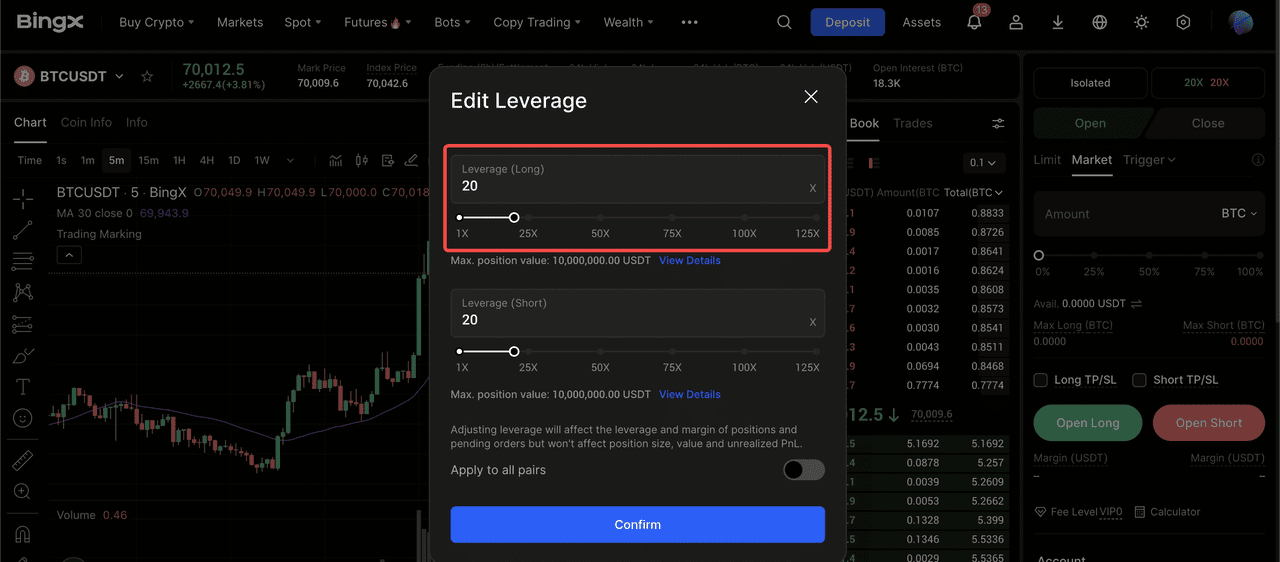
The desktop interface provides a comprehensive view of the order book and chart while you adjust your settings.
- Access Perpetual Futures: Log in to your account, hover over the Derivatives tab in the top navigation bar, and select Perpetual Futures.
- Select Your Trading Pair: Use the search bar on the top left to select the asset you wish to trade. e.g., BTC/USDT or ETH/USDT.
- Locate the Leverage Module: Look at the order panel on the right side of the screen. You will see a button labeled with a multiplier, e.g., 20x.
- Open the Leverage Settings: Click that button to open the adjustment window.
- Modify the Multiplier:
- Slider: Drag the slider left to decrease or right to increase leverage.
- Manual Input: Type the exact number into the input box for precision.
- Check Long vs. Short: Note that BingX allows you to set different leverage levels for Long and Short positions independently. Ensure you are adjusting the correct side.
- Confirm: Click Confirm. Your Available Margin and Max Open values will update immediately.
How to Adjust Leverage on the BingX App: A Beginner's Tutorial
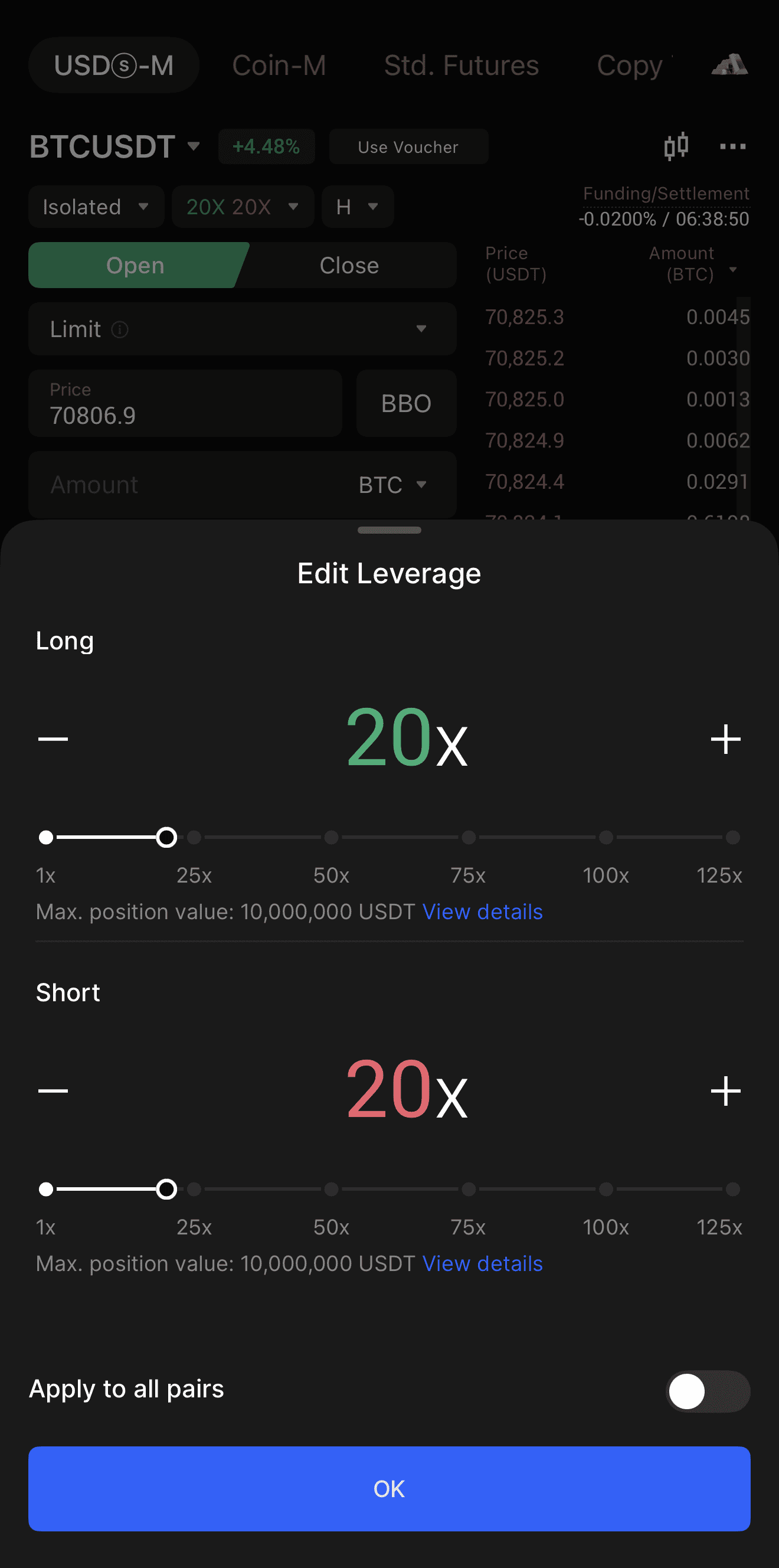
The BingX mobile app is designed for speed, allowing you to toggle your gearing with just a few taps.
- Enter the Futures Tab: Open the BingX app and tap Futures in the bottom navigation menu. Ensure you are in the Perpetual Futures section at the top.
- Choose Your Pair: Tap the trading pair icon, e.g., BTC/USDT, in the top left corner to switch to your desired market.
- Tap the Leverage Value: In the trading terminal under the Long/Short buttons, you will see the current leverage ratio displayed, e.g., 10x. Tap directly on this number.
- Adjust the Multiplier:
- Slider: Swipe the slider bar to your preferred level.
- Plus/Minus: Use the + and - buttons for granular adjustments.
- Review the Impact: The app will show you the Max Open amount for your current balance based on the new leverage.
- Confirm the Change: Tap the Confirm button at the bottom of the pop-up.
- Adjusting Active Positions: If you have an open trade, go to the Positions tab at the bottom, tap on your active trade, and look for the Leverage icon to modify your risk on the fly.
Note: Your maximum available leverage depends on your position size and KYC status. Large positions typically have lower maximum leverage to prevent market instability.
Pro-Tips for BingX Futures Traders: Manage Leverage and Protect Your Capital
Leverage is a double-edged sword, the same multiplier that turns a 2% market move into an 18% gain can turn a 2% dip into an 18% loss. Use these five professional guardrails to navigate the BingX futures market safely:
- Understand Fee Scaling: Remember that Trading Fees are calculated on the Total Notional Value, not just your margin. For example, opening a $10,000 position using $1,000 margin (10x leverage) means your fee is based on the full $10,000. While the fee percentage stays the same, the dollar amount increases as you scale your leverage.
- Respect Tiered Margin and KYC Caps: BingX uses a Tiered Margin system to protect market liquidity. If you are trading very large positions, the system may automatically cap your maximum leverage, e.g., at 20x instead of 100x. Additionally, ensure you have completed Level 1 or 2 KYC, as unverified accounts face stricter leverage and withdrawal limits.
- Eliminate Complacency with Low Leverage: Even safe strategies like low leverage require vigilance. The relative safety of low gearing can lead to overconfidence, but even shallow waters hide sharp rocks of volatility. Always perform thorough technical analysis and treat every trade with the same discipline as a high-leverage position.
- Automate Your Exit with Stop-Losses: Never enter a leveraged trade without a predefined pain threshold. Use the BingX Stop-Loss (SL) tool to set a hard exit point. This ensures a temporary market correction doesn't turn into a permanent account depletion or liquidation.
- Rehearse with VST on BingX Demo Trading: If you are transitioning from 2x to 10x leverage, use the BingX VST (Virtual Support Token) account first. This allows you to experience how rapid price swings impact your real-time margin and liquidation price without risking a single dollar of live capital.
Read more: What is Demo Trading on BingX and How to Get Started
Conclusion: Use Leverage and Trade the Futures Market with Precision in 2026
Leverage remains one of the most transformative features of the futures market, offering traders the ability to control large notional positions with minimal upfront capital. By utilizing BingX’s flexible leverage tools, particularly conservative strategies, you can enhance capital efficiency and diversify across multiple asset classes without the extreme liquidation risks associated with high-multiple trading. When paired with professional-grade execution like Guaranteed Stop-Losses, leverage functions as a strategic power tool for scaling a proven edge.
However, the primary objective of any professional trader is capital preservation. While leverage amplifies potential gains, it equally magnifies potential losses and can lead to rapid account depletion if market volatility is disrespected. Traders should always calculate their liquidation price and risk-per-trade before entering a position. Risk Reminder: Futures trading involves substantial risk; never invest more than you can afford to lose, and ensure you fully understand the mechanics of margin calls and mark-to-market settlements before deploying live capital.
Ready to calculate your next trade? Use the BingX Futures Calculator to see your exact liquidation price before you open a position.
Related Reading
- BingX Tutorial | How to Get Started With Futures Trading
- 8 Best Crypto Futures Platform for Beginners in 2026
- How to Get Started with Perpetual Futures Trading on BingX: A 2026 Beginner's Guide
- What Are the Different Order Types Supported on BingX Futures and How to Use Them?
- Cross Margin vs. Isolated Margin to Master Your Risk on BingX Futures: A 2026 Beginner's Guide
- 2026 Guide to Risk Management on BingX Futures: Protect Your Capital with Professional-Grade Tools
FAQs on Leverage in Trading Futures
1. Does leverage increase my futures trading fees?
Yes. Trading fees are calculated based on the Total Notional Value, not just your margin. If you open a $10,000 position using $1,000 margin (10x), your fee is based on the full $10,000.
2. Why can't I increase my leverage beyond 20x on certain pairs?
Due to BingX's Tiered Margin feature, maximum leverage is often restricted based on the asset's volatility and your current position size. Additionally, unverified accounts may face lower leverage caps until KYC Level 1 is completed.
3. Does changing leverage affect my entry price?
No. Adjusting the leverage slider only changes the amount of Initial Margin required to hold the position and your resulting Liquidation Price. It does not alter the price at which your trade was executed.
4. What is the Mark Price and why does it matter for leverage?
The Mark Price is a weighted index price used by BingX to calculate unrealized PnL and liquidations. It protects leveraged traders from scam wicks or temporary price manipulations that may occur on a single exchange's order book.
5. If I use 2x leverage, am I 100% safe from liquidation?
No. While 2x leverage is much safer than 50x, a 50% move against your position would still result in liquidation. Always use a Stop-Loss to protect your balance from extreme market corrections.
6. How are fees charged on leveraged trades?
Fees are calculated as a percentage of the Total Position Value (Margin × Leverage). This means a $1,000 trade at 10x leverage ($10,000 position) will incur higher absolute fees than a $1,000 trade at 1x leverage.
