Liquidity in traditional finance (TradFi) trading refers to how easily an asset can be bought or sold without significantly affecting its price. Whether trading stocks, forex, or commodities, liquidity influences execution prices, trading costs, and how quickly investors can enter or exit positions.
When there are too few buyers or sellers near the current market price, even a promising trade can become more expensive due to wider spreads and slippage. Understanding liquidity on BingX helps traders assess market conditions, compare execution costs, and choose suitable order sizes, trading hours, and order types across traditional financial markets.
Key Takeaways
- High liquidity helps reduce trading costs: More buyers and sellers near the market price generally mean tighter spreads, less slippage, and easier entry and exit.
- Trading volume alone does not measure liquidity: Bid-ask spreads and order book depth show whether a market can handle larger trades without significant price changes.
- Liquidity varies by market and trading hours: Stocks, forex, and commodities have different liquidity conditions, which can change during market openings, major news events, and extended trading sessions.
- BingX Stocks and TradFi futures have different liquidity conditions: Stock purchases and perpetual futures use different execution arrangements, so traders should compare available prices, order depth, and trading costs for each product.
What Is Liquidity in TradFi Trading and Why Does It Matter?
Liquidity in traditional finance (TradFi) refers to how easily stocks, bonds, currencies, or commodities can be bought or sold without significantly affecting their prices. A highly liquid market has enough buyers and sellers to execute trades quickly at competitive prices, while a less liquid market may involve wider spreads, higher trading costs, or slower execution.
Liquidity also depends on order size. For example, if only 10 shares are available at $100, buying five shares may have little price impact, but purchasing 1,000 shares could require paying higher prices for the remaining shares. This makes liquidity important for managing trading costs, especially when placing larger orders or trading with leverage.
Read More: What Is Liquidity and Slippage and How Does It Work on BingX Spot Trading?
High Liquidity vs. Low Liquidity: Key Differences in Trading Costs and Execution
|
Factor |
High Liquidity |
Low Liquidity |
|
Bid-ask spread |
Usually narrower, reducing trading costs |
Often wider, increasing trading costs |
|
Order book depth |
More buy and sell orders near the market price |
Fewer orders available at nearby prices |
|
Large orders |
Easier to execute with limited price impact |
More likely to cause slippage |
|
Entering or exiting |
Generally faster at competitive prices |
May require more time or less favorable prices |
Liquidity matters for four main reasons:
- Lower trading costs: Highly liquid markets generally have tighter bid-ask spreads and less slippage, helping traders buy and sell closer to their intended prices.
- Easier entry and exit: More active buyers and sellers make it easier to open or close positions without waiting for suitable counterparties or accepting unfavorable prices.
- Less price impact from large orders: Deeper markets can absorb larger trades without significant price movements, while thin markets may require execution across multiple price levels.
- Better execution for leveraged trades: Slippage can have a greater impact when trading futures with leverage. For example, a 0.2% unfavorable price difference on a $10,000 position creates a $20 cost, equivalent to 2% of a $1,000 initial margin, before fees.
How Does Liquidity Affect Bid-Ask Spreads and Slippage?
Liquidity directly affects trading costs through bid-ask spreads and slippage. Highly liquid markets have more buyers and sellers competing at nearby prices, generally resulting in tighter spreads and more favorable execution. In less liquid markets, fewer available orders can widen spreads and increase the cost of buying or selling.
How Do Bid-Ask Spreads and Slippage Work?
The bid is the highest buying price, while the ask is the lowest selling price. Their difference is the bid-ask spread. For example, a stock quoted at $99.95 bid and $100.05 ask has a $0.10 spread, or 0.10%. Buying 100 shares at the ask and immediately selling at the unchanged bid would cost $10 before fees.
Slippage occurs when an order executes at a different price than expected. If there are not enough shares available at the quoted price, a larger order may execute across multiple price levels, increasing its average cost.
Read More: What Are Crypto Trading Fees and Spreads? A Complete Guide to Trading Costs
Example: How Liquidity Affects a $10,000 Stock Order
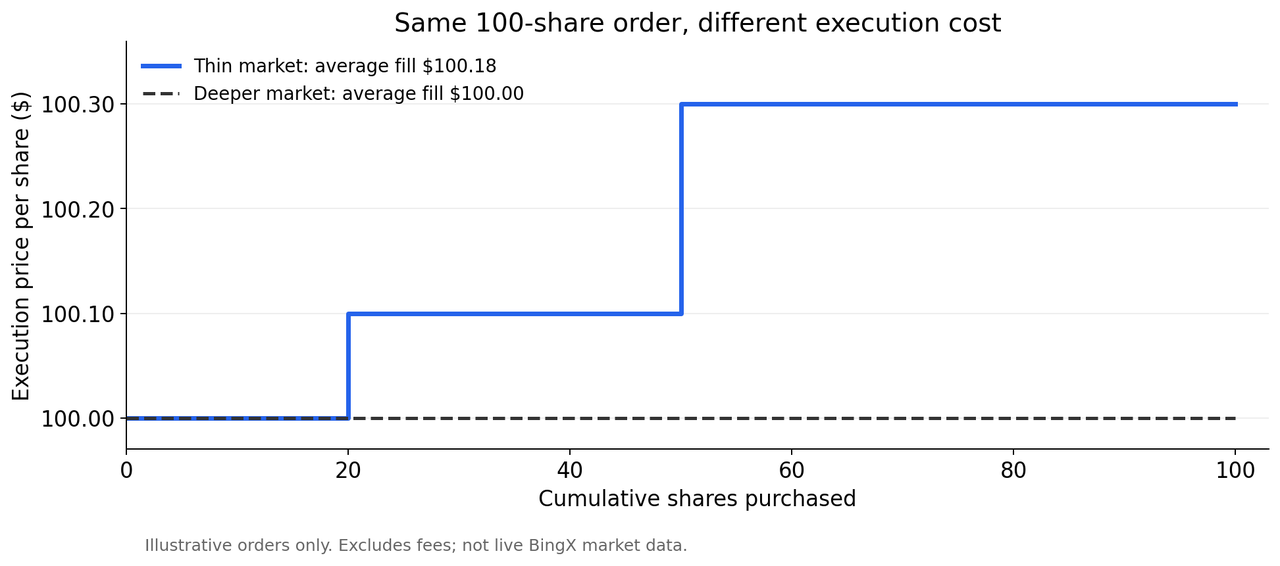
Suppose a trader places a market order to buy 100 shares at a quoted ask price of $100, but only 20 shares are available at that price. The remaining shares must be purchased at higher prices.
|
Ask Price |
Shares Purchased |
Amount Paid |
|
$100.00 |
20 |
$2,000 |
|
$100.10 |
30 |
$3,003 |
|
$100.30 |
50 |
$5,015 |
|
Total / Average |
100 shares |
$10,018 / $100.18 |
In this thin market, the average execution price reaches $100.18, creating $18 in slippage (0.18%). In a deeper market with all 100 shares available at $100, the same purchase would cost $10,000 before fees.
How Does Liquidity Work on BingX TradFi?
BingX provides deep liquidity across major traditional financial markets, helping traders execute orders efficiently with less price impact. According to BingX's September 2026 liquidity report, the platform ranked No. 1 in TradFi perpetual futures order-book depth across selected popular assets, outperforming competing exchanges in several key categories.
How Deep Is BingX TradFi Liquidity?
BingX's analysis compared available order-book depth within 0.1%, 0.5%, and 1% of market prices across major exchanges. Its findings highlight three areas of strong liquidity:
|
TradFi Market |
Examples |
BingX Order-Book Depth |
|
Commodities |
Gold, silver, WTI and Brent crude |
1.6x the second-ranked exchange |
|
AI and semiconductor stocks |
GOOGL, AVGO, SKHYNIX, INTC |
1.7x the second-ranked exchange |
|
Major U.S. stocks |
AAPL, TSLA, SPCX |
2.2x the second-ranked exchange |
Deeper order books allow larger trades to execute closer to the quoted price, helping reduce slippage. Combined with more than 600+ TradFi perpetual instruments, BingX offers broad market coverage and strong liquidity across stocks, forex, commodities, and indices.
How Do Trading Hours and Fees Work on BingX?
BingX offers two ways to trade traditional financial assets, with different execution arrangements and trading costs.
|
Feature |
BingX TradFi Futures |
BingX Stocks Trading |
|
Available markets |
600+ TradFi perpetual contracts |
7,000+ U.S. stocks and ETFs |
|
Trading hours |
24/7 for many contracts |
24/5 access |
|
Liquidity |
Deep order books across leading TradFi assets |
U.S. securities execution through Alpaca |
|
Trading costs |
Trading fees, potential funding, spreads and slippage |
Zero commissions; approximately 0.08% spread-based charge |
|
Ownership |
Price exposure without underlying asset ownership |
Actual shares and ETFs |
- TradFi Perpetual Futures: Trade major global assets using USDT as margin, with deep order-book liquidity across selected stocks, commodities, and indices. Many contracts support 24/7 trading.
- BingX Stocks Trading: Buy and hold U.S. stocks and ETFs through Alpaca's brokerage infrastructure using USDT or USDC, with purchases starting from 5 USDC. Market orders submitted outside regular hours execute at the next regular session.
- Transparent trading costs: BingX Stocks charges approximately 0.08% of filled value through its spread-based pricing, equivalent to about $8 on a $10,000 trade. TradFi futures have separate trading fees and possible funding payments.
Together, BingX's extensive TradFi market selection, strong order-book depth, and stock trading integration provide flexible access to traditional financial markets through one platform.
Read More: What Is BingX Stocks Trading? A Beginner's Guide to Trading U.S. Stocks and ETFs With Crypto
How to Trade AI Stock Perpetual Futures on BingX
BingX TradFi allows traders to gain exposure to leading AI stocks, including NVIDIA (NVDA), Microsoft (MSFT), Alphabet (GOOGL), and AMD, through USDT-margined perpetual futures. These contracts support long and short positions without requiring share ownership. BingX also offers deep order-book liquidity across selected U.S. stocks and semiconductor contracts, helping traders manage execution costs.
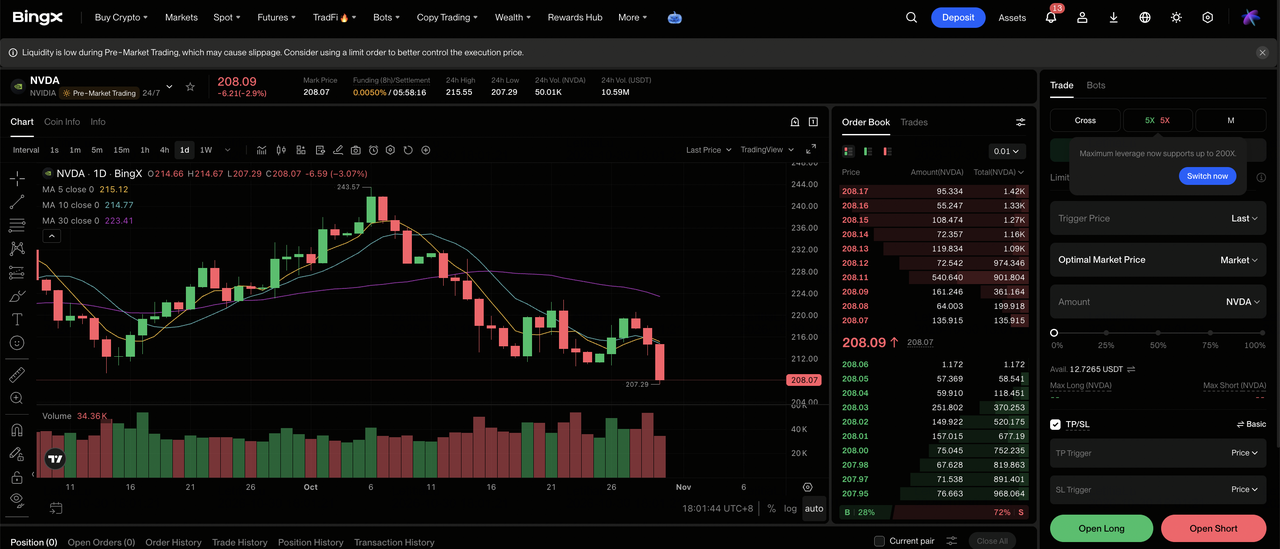
Step 1: Access BingX TradFi. Sign up or log in to BingX, complete the required identity verification, and open BingX TradFi.
Step 2: Select an AI Stock Contract. Search for AI-related stock perpetuals such as NVDA-USDT, MSFT-USDT, GOOGL-USDT, or AMDUS-USDT. Review the current bid-ask spread, available order-book depth, and contract specifications before trading.
Step 3: Prepare USDT Margin. Transfer USDT into your Futures account and choose Isolated or Cross Margin. Review the available leverage, margin requirements, and estimated liquidation price.
Step 4: Open a Long or Short Position. Select Open Long or Open Short based on your market outlook. Consider a limit order to control your entry price, particularly around earnings announcements or major AI industry news.
Step 5: Manage Liquidity and Trading Risk. Set Take-Profit and Stop-Loss (TP/SL) levels, monitor funding fees, and check available liquidity before adjusting or closing positions. Leverage can magnify losses, and stop-loss orders do not guarantee execution at the selected price.
AI stock perpetual futures provide price exposure rather than actual share ownership, so they do not grant dividends or voting rights. Contract availability, trading hours, and leverage limits vary by instrument and region.
4 Ways to Manage Liquidity Risk on BingX
Even in highly liquid markets, trading conditions can change with order size, market activity, and major news. These four strategies can help traders reduce slippage, control execution costs, and manage liquidity risks on BingX.
- Check Bid-Ask Spreads and Order Book Depth: Compare buying and selling prices before placing an order. Narrower spreads generally mean lower execution costs, while deeper order books indicate more available liquidity near the market price. On BingX TradFi Futures, check the available depth against your intended order size.
- Use Limit Orders to Control Execution Prices: A limit order sets the highest price you will pay when buying or the lowest price you will accept when selling. This helps control execution costs during volatile or less liquid conditions, although orders may remain partially or completely unfilled.
- Adjust Order Size Based on Market Liquidity: Large orders can cause greater slippage when liquidity is limited. Splitting a $10,000 trade into smaller orders may reduce immediate price impact, although market prices can change between executions.
- Monitor Market Hours and Major News Events: Liquidity can change around market openings, earnings announcements, and economic releases. Even with 24/7 TradFi trading, execution conditions may vary.
Final Thoughts: How BingX Liquidity Supports More Efficient TradFi Trading
Liquidity plays an important role in trading costs, execution quality, and the ability to enter or exit positions. Understanding bid-ask spreads, order book depth, and slippage helps traders make more informed decisions, particularly when trading larger positions or during volatile market conditions.
With over 600 TradFi perpetual contracts, deep order-book liquidity across leading assets, and access to more than 7,000 U.S. stocks and ETFs, BingX offers flexible ways to trade traditional financial markets. Traders can benefit from these options by choosing suitable order types, monitoring market conditions, and managing position sizes to improve execution efficiency.
Risk Reminder: Stocks and derivatives can lose value. Low liquidity, price gaps, and leverage can magnify losses, while limit orders may not execute. Product availability depends on regional eligibility and platform requirements.
Related Reading
- How to Trade Forex, Commodities, Stocks, and Indices With BingX TradFi: A Beginner’s Guide (2026)
- What Is a Multi-Asset Trading Platform? A Guide to Trading Crypto and TradFi on BingX
- What Is Liquidity and Slippage and How Does It Work on BingX Spot Trading?
- How to Trade Stock Indices With Crypto as TradFi Goes On-Chain in 2026
- How to Trade Commodities With Crypto in 2026 as Oil, Gold, Silver, and TradFi Go On-Chain
- What Are Crypto Trading Fees and Spreads? A Complete Guide to Trading Costs
FAQs About Liquidity in TradFi Trading
1. Is High Liquidity Good for Trading?
Yes. High liquidity generally means tighter spreads, lower slippage, and easier entry and exit. However, it does not guarantee profits or protect against market volatility.
2. How Do You Measure Liquidity in Trading?
The main indicators are bid-ask spreads, order book depth, and trading volume. Narrow spreads and sufficient orders near the market price generally indicate better liquidity.
3. What Happens When Market Liquidity Is Low?
Low liquidity can cause wider spreads, greater slippage, and slower execution. Large market orders may fill at unfavorable prices, while limit orders may remain unfilled.
4. What Is the Difference Between Liquidity and Trading Volume?
Trading volume measures how much of an asset has traded over a period. Liquidity measures how easily an asset can be bought or sold at current prices without significantly affecting its value.
5. Does BingX Offer High Liquidity for TradFi Trading?
BingX reported leading order-book depth across selected TradFi perpetual futures in its September 2026 liquidity comparison, including major U.S. stocks and commodities. Actual liquidity varies by contract, order size, and trading session.
