

Sentient (SENT) is an AI crypto project focused on building an open-source intelligence network for AGI, AI agents, models, data, tools, and compute. Instead of keeping advanced AI development inside closed labs, Sentient aims to create a community-built alternative where intelligence can be developed, coordinated, and monetized more openly.
As AI becomes one of the strongest narratives in crypto, Sentient has gained attention because it offers a clearer thesis than many generic AI tokens: if AGI becomes one of the most important technologies in the world, it should not be controlled only by a few centralized companies. Sentient GRID is positioned as the project’s coordination layer for open intelligence, while SENT gives traders exposure to the open-source AI and decentralized AGI narrative. This guide explains what Sentient is, how the network works, why SENT is gaining attention in 2026, how SENT tokenomics function, the main risks to consider, and how to trade SENT on BingX.
What Is Sentient (SENT)?

Source: Sentient
Sentient (SENT) is the token connected to Sentient, an open-source intelligence network focused on AGI, AI agents, models, data, tools, and compute. The project is designed as a decentralized alternative to closed AI labs, where advanced intelligence is developed behind private systems and controlled by a small number of companies.
The core idea behind Sentient is simple: AI should be open, monetizable, and aligned with the communities that build it. Instead of treating advanced AI as a closed product owned by a few centralized labs, Sentient focuses on open intelligence coordination, where contributors can participate in building and improving the network.
Key components of the Sentient ecosystem include:
- SENT token: The crypto asset connected to the Sentient ecosystem and its open-source AGI narrative.
- Sentient GRID: The broader coordination layer for agents, models, data, tools, and compute.
- AI agents: Machine agents that can plan, execute, reason, verify, and coordinate tasks.
- Open models: AI models designed to stay open while still giving builders and communities a path to capture value.
- Search and reasoning infrastructure: Tools that connect open-source models with search, reasoning, and agent workflows.
Read More: What Are the Top 10 AI Crypto Projects to Watch in 2026?
How Does Sentient Work?
Sentient works by combining AI agent development, open model ownership, reasoning infrastructure, and blockchain-based incentives into one broader open-source AI network. Instead of building only one model or one AI app, Sentient is trying to create a system where agents, models, data, tools, and compute can coordinate through Sentient GRID.
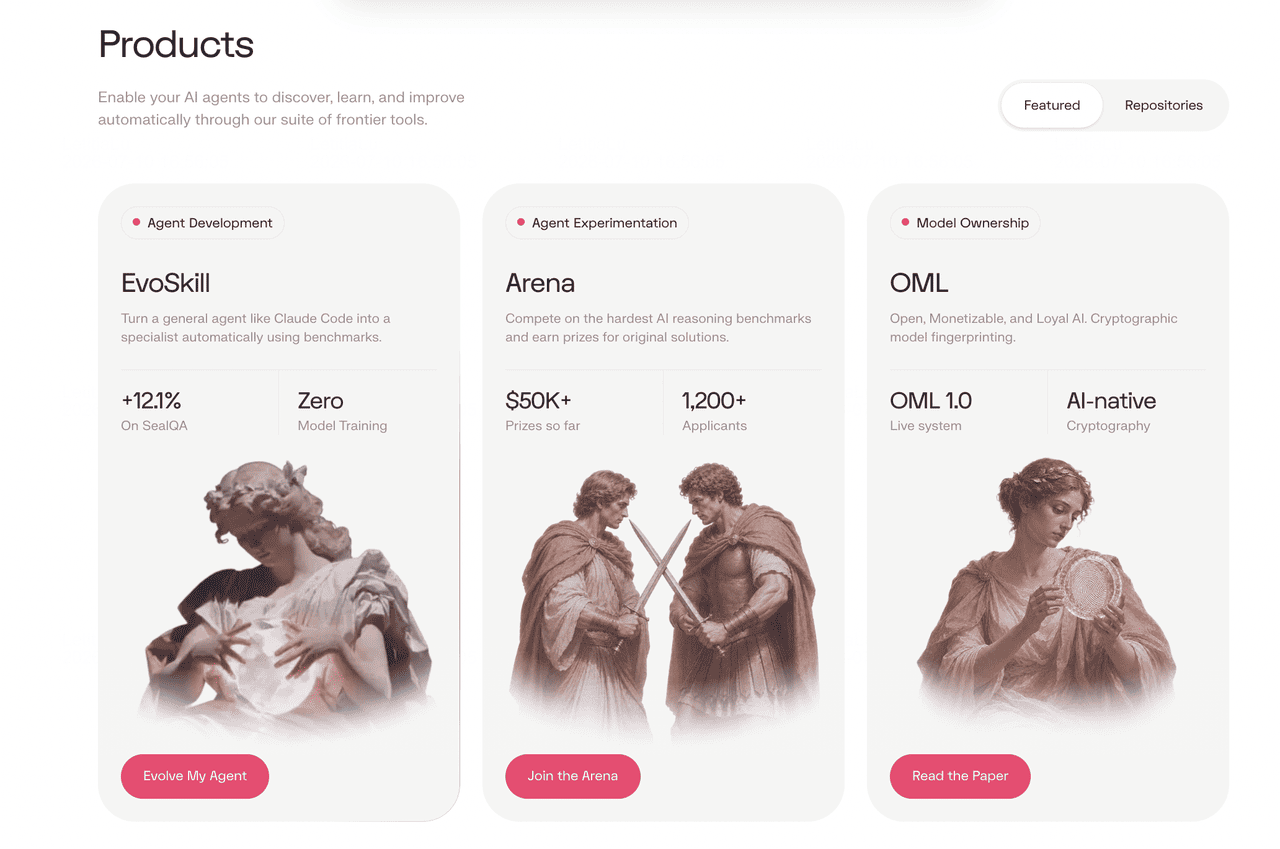
Source: Sentient
- EvoSkill helps AI agents improve: EvoSkill is part of Sentient’s agent development layer. It supports the idea that general AI agents can become more specialized and capable through structured evaluation and improvement, making agent performance easier to measure and refine.
- Arena tests agents through open competition: Arena gives Sentient a way to evaluate AI agents in a more open environment. Instead of relying only on closed internal testing, agents can be compared through difficult reasoning tasks, benchmarks, or competitive challenges.
- OML supports open model ownership: OML stands for Open, Monetizable, and Loyal Models. It is designed to make AI models open while still giving builders a way to protect, monetize, and align their work. This matters because Sentient’s thesis depends on open AI being both accessible and economically sustainable.
- Sentient GRID connects the broader network: Sentient GRID acts as the coordination layer that brings together agents, models, data, tools, and compute. EvoSkill, Arena, and OML each support a different part of that network: agent improvement, agent testing, and model ownership.
- SENT powers incentives and coordination: SENT is the token used across the Sentient ecosystem. According to Sentient Foundation, SENT powers the chain, Sentient GRID, and incentive systems that reward positive work toward open-source AGI.
In simple terms, Sentient works by helping AI agents improve, giving them a place to compete, supporting ownership for open models, and using SENT to coordinate incentives across the network.
Read More: What Are the Top 10 AI Agent Crypto Projects of 2026?
Sentient vs. Bittensor vs. ASI: Key Differences Between Open-Source AGI and Decentralized AI Networks
Sentient, Bittensor (TAO), and the Artificial Superintelligence Alliance (FET) all sit inside the decentralized AI narrative, but they give investors different types of exposure. Sentient focuses on open-source AGI and intelligence coordination, Bittensor is built around subnet-based AI incentive markets, while ASI combines Fetch.ai, SingularityNET, and Ocean Protocol into a broader alliance for decentralized AI agents, services, and data.
|
Feature |
Sentient (SENT) |
Bittensor (TAO) |
Artificial Superintelligence Alliance (ASI) |
|
Core focus |
Open-source AGI, AI agents, model coordination, and decentralized intelligence |
Decentralized machine-learning markets and subnet-based AI incentives |
Decentralized AI agents, AI services, data, and model coordination |
|
Main narrative |
Advanced AI should be open, community-built, and not controlled only by closed AI labs |
Machine intelligence can become an open market where useful outputs are rewarded |
Major AI crypto projects are combining ecosystems to build a larger decentralized AI network |
|
Network design |
Sentient GRID coordinates agents, models, data, tools, and compute |
Subnets compete and contributors earn rewards based on network value |
Alliance structure combines agent infrastructure, AI services, and data marketplace narratives |
|
Token exposure |
SENT gives exposure to open-source AGI and decentralized intelligence |
TAO gives exposure to one of the most established decentralized AI infrastructure networks |
ASI gives exposure to the merged Fetch.ai, SingularityNET, and Ocean Protocol ecosystem |
|
Relative maturity |
Newer and more narrative-driven |
More established, larger, and more liquid |
Broader alliance with multiple legacy AI crypto communities |
|
Main risk |
Needs to prove real usage and token utility inside Sentient GRID |
Valuation, subnet quality, and AI market rotation risk |
Execution complexity from merging multiple ecosystems and communities |
For investors, the difference comes down to the type of AI exposure they want. SENT is more focused on open-source AGI and AI coordination, TAO is more focused on decentralized AI incentive markets, and ASI is broader, combining agents, AI services, data, and ecosystem consolidation.
Read More: What Is Bittensor (TAO)? A Beginner's Guide to How Bittensor Works (2026)
Sentient Ecosystem in 2026: Open-Source AI, Token Launch, and AI Market Rotation
Sentient’s 2026 story is shaped by the market’s shift from broad AI hype toward more specific AI infrastructure themes. Instead of only asking whether a token has “AI” in its name, traders are paying more attention to whether a project has a clear role in agents, open models, compute, data, or intelligence coordination.
The most important catalyst is the open-source AGI narrative. As closed AI labs become more powerful, crypto investors are looking for decentralized alternatives that connect AI development with community ownership, transparent systems, and tokenized incentives.
- Open-source AGI becomes a stronger market theme: Sentient benefits from growing concern that advanced AI may be controlled by a small number of centralized companies. Its core narrative is that AGI should be more open, accountable, and community-built.
- SENT enters the AI & Big Data category: SENT sits inside one of crypto’s strongest recurring narratives, giving traders a clear way to connect the token with other AI infrastructure assets.
- Ethereum ecosystem exposure gives SENT a familiar on-chain base: SENT’s Ethereum ecosystem positioning makes it easier for traders to compare it with other Ethereum-based AI and infrastructure tokens.
- High early trading activity supports market attention: Strong early trading activity can attract short-term traders during AI token rotations, especially when liquidity is moving into smaller AI assets.
- Sentient GRID gives the project a broader story: The GRID narrative makes Sentient easier to frame as an AI coordination network rather than a single AI app or simple token launch.
- AI agent and open model demand continues to grow: As AI agents, open models, and reasoning systems become more important, projects that connect these themes to crypto markets may continue to attract attention.
Sentient is gaining attention because it sits at the intersection of three strong themes: AI crypto, open-source AI, and decentralized intelligence. The upside is that the project has a clear long-term narrative. The challenge is whether Sentient can turn that narrative into real usage, clear token utility, and sustained ecosystem activity.
What Are the Sentient (SENT) Tokenomics?
SENT is the coordination layer for the Sentient ecosystem. According to Sentient Foundation, SENT powers the chain, Sentient GRID, and the incentive systems that reward positive work toward open-source AGI. The total supply is 34,359,738,368 SENT, equal to 2³⁵.
Sentient’s tokenomics are designed around a community-first model. The largest share goes to users and builders, while team and investor allocations use longer vesting schedules to support long-term alignment.
SENT Token Utility and Supply Mechanisms
SENT is designed as the utility token for the Sentient network. Its role is not only market exposure to AI, but also governance, staking, access, fees, payments, and ecosystem incentives.
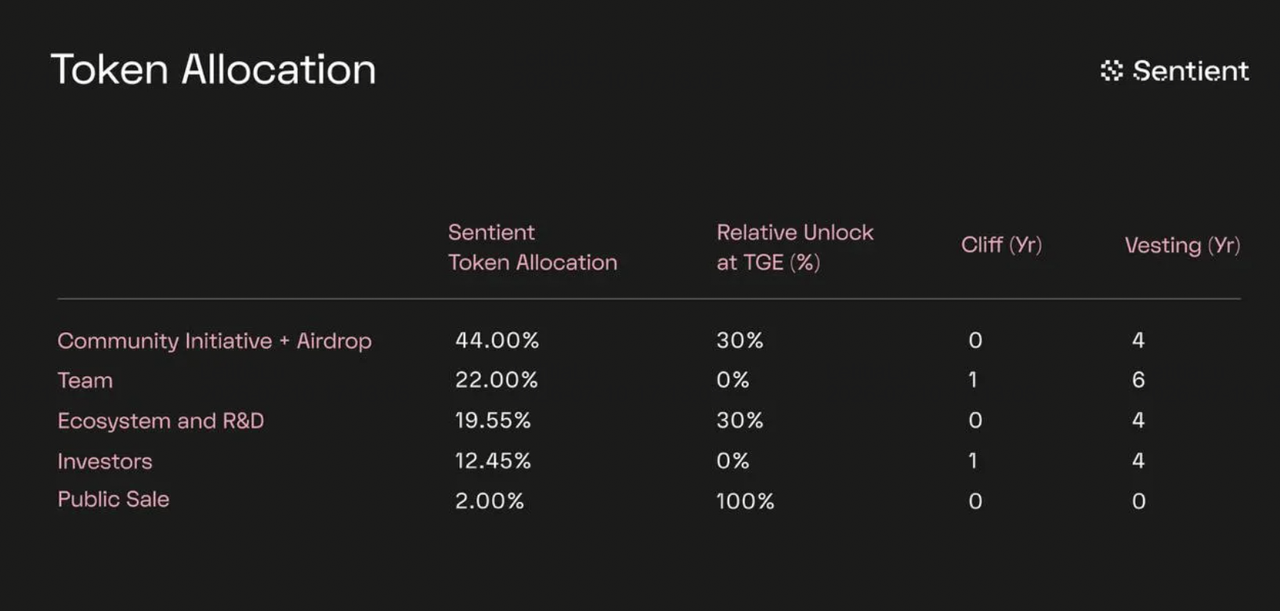
Source: Sentient Foundation
- Staking for governance and access: Community members can stake SENT to participate in governance, direct funding to AI initiatives, and unlock access to artifacts such as models, data, frameworks, and Sentient-built products. Developers can also stake SENT to unlock access, complete tasks, participate in governance, and become eligible for rewards.
- Governance through the Sentient DAO: SENT governs the Sentient DAO. Staked SENT represents voting power, and holders can vote on emissions, treasury spending, and core protocol upgrades.
- Fees and payments across the ecosystem: SENT is used across agents, models, data services, and other artifact-powered products. Users of Sentient services use SENT as the utility currency, and artifacts can pay each other in SENT, creating composable on-chain value flow between services.
- Community emissions: Annual emissions are set at 2% and directed into a dedicated Community Emission Pool. The pool is used for GRID artifacts or protocol incentive programs, and any unspent amount is locked at year-end before the next year begins with a fresh 2% allocation.
- Community-first supply design: Sentient’s allocation gives the largest share to users and builders, while team and investor tokens have cliffs and long vesting periods. This structure is designed to reward verifiable work across the GRID and align contributors with the long-term development of open-source AGI.
SENT Token Allocation
SENT has a total supply of 34,359,738,368 tokens. According to Sentient Foundation, the initial allocation is split across community initiatives and airdrop, ecosystem and R&D, team, investors, and public sale.
|
Holder Category |
Initial Allocation |
Description |
|
Community initiatives and airdrop |
44.00% |
Dedicated to airdrops, community grants, bounties, and incentive programs that reward verifiable work on the GRID by users and builders. 30% of this bucket unlocks at TGE, while the remaining 70% vests linearly over 4 years. The airdrop is fully unlocked at TGE. |
|
Ecosystem and R&D |
19.55% |
Allocated to ecosystem development, R&D, growth, infrastructure, Sentient Foundation operations, and long-term GRID development. 30% unlocks at TGE, while the remaining 70% vests linearly over 4 years. |
|
Team |
22.00% |
Reserved for Sentient Foundation and Sentient Labs team members, including employees, founders, and key contractors. Locked at TGE, then vests linearly over 6 years with a 1-year cliff. |
|
Investors |
12.45% |
Allocated to private-round investors. Locked at TGE, then vests linearly over 4 years with a 1-year cliff. |
|
Public sale |
2.00% |
Designed to support broader community participation at launch. This allocation unlocks fully at TGE. |
Early circulating supply is designed to be dominated by community, ecosystem, and public sale allocations, while team and investor allocations unlock later over multi-year schedules. This makes SENT more community-weighted at launch than a typical insider-heavy token, but investors should still monitor unlocks, emissions, and whether SENT’s utility grows across staking, governance, fees, payments, and GRID incentives.
How to Trade Sentient (SENT) on BingX
BingX offers two practical ways to gain exposure to Sentient, depending on whether the goal is direct ownership or short-term trading. Spot trading is better suited for users who want to buy and hold SENT directly, while futures trading is designed for active traders who want long or short exposure to SENT price movements.
Spot Trading: Buy and Own SENT Directly
Spot trading is the most straightforward way to buy Sentient on BingX. When users buy SENT on the spot market, they own the asset directly and can hold it in the BingX spot account, transfer it, or withdraw it to a compatible self-custody wallet if withdrawals are supported.
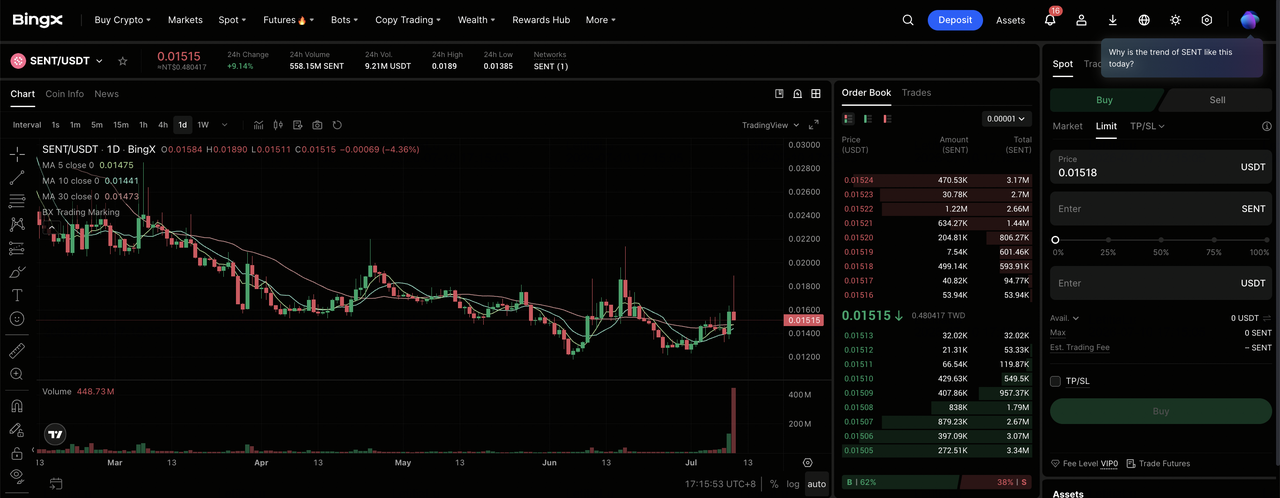
Step 1: Account setup and security. Sign up and log into your BingX account, complete the identity verification (KYC) required in your region, and enable two-factor authentication.
Step 2: Fund your spot account. Deposit USDT or another supported asset into your BingX spot account. Where available, users can also use supported fiat on-ramp options.
Step 3: Navigate to the spot market. Search for the SENT/USDT trading pair.
Step 4: Place your order. Choose a market order to buy SENT immediately at the current price, or use a limit order to set the price you want to pay.
Step 5: Manage your SENT. Once filled, your SENT appears in your spot account. You can keep it on BingX for convenience or withdraw it to a compatible self-custody wallet for on-chain storage if withdrawals are supported.
Futures Trading: Trade SENT Price Movements
For active traders, BingX may offer USDT-margined SENT perpetual futures. Futures allow users to trade SENT price movements without holding the underlying asset, with the flexibility to open long positions if they expect SENT to rise or short positions if they expect SENT to fall.
Because futures involve leverage, they can amplify both gains and losses. This approach is more suitable for traders who already have a clear risk plan and understand liquidation risk, particularly for an asset like SENT that is sensitive to AI market rotation, open-source AGI narratives, exchange liquidity, and Sentient GRID development.
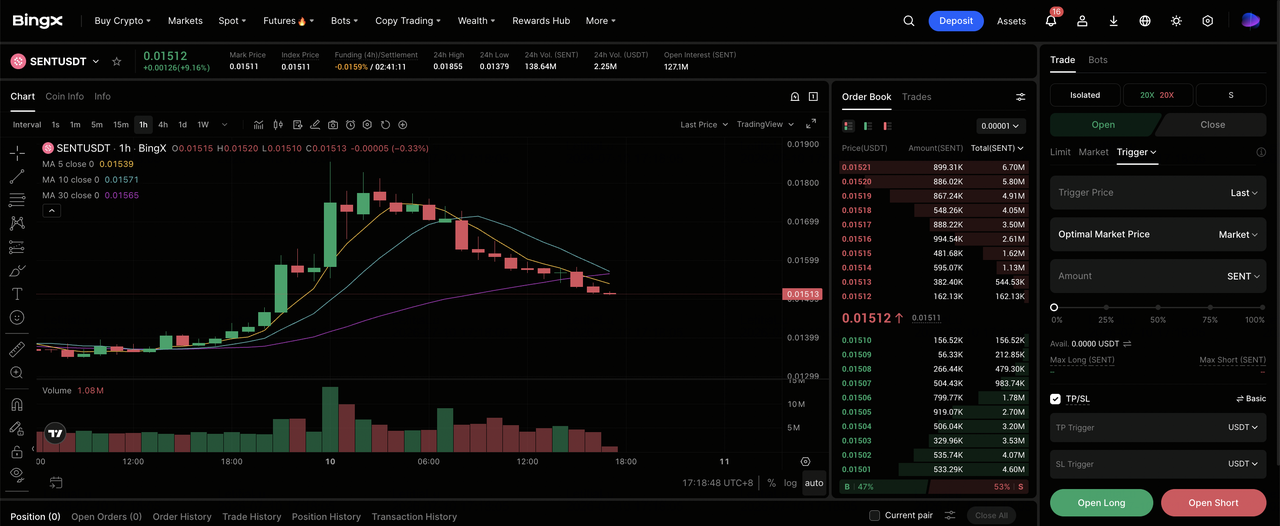
Step 1: Transfer collateral. Move USDT from your spot account into your futures account, where it will serve as margin.
Step 2: Select the contract. Search for the SENT-USDT perpetual contract.
Step 3: Set direction and leverage. Open long if you expect SENT to rise, or open short if you expect SENT to decline. Choose leverage based on your risk tolerance and position size.
Step 4: Execute the trade. Enter the order amount and choose a market or limit order depending on your trading plan.
Step 5: Manage risk. Set stop-loss and take-profit orders before or immediately after entering the position. Profit and loss settle dynamically in USDT.
Risks and Considerations Before Investing in Sentient (SENT)
Sentient has a strong AI narrative, but investors should not treat SENT as low-risk. The project’s vision is ambitious, and the token is still exposed to both crypto market volatility and AI-sector narrative swings.
- AI narrative volatility: AI tokens can rise quickly when market attention returns to the sector, but they can also fall sharply when liquidity rotates elsewhere.
- Execution risk: Building an open-source AGI network is much harder than launching a token. Sentient needs to prove that its research, agent frameworks, and ecosystem tools can attract real developers and users.
- Token utility risk: SENT needs a clear role inside the network. If the token remains mainly a narrative asset, long-term demand may be difficult to sustain.
- Supply risk: The gap between total supply and circulating supply means investors should monitor future unlocks, emissions, and tokenomics updates.
- Competition risk: Sentient competes for attention with other decentralized AI projects, AI compute networks, agent platforms, data networks, and centralized AI companies.
- Technical complexity risk: Open-source AGI, agent coordination, and model ownership are complex areas. The market may need time to understand whether Sentient’s approach can become practical at scale.
Final Thoughts: Should You Invest in Sentient (SENT) in 2026?
Sentient is one of the more direct crypto narratives around open-source AGI. While many AI tokens focus on compute, data, or simple agent branding, Sentient’s positioning is broader: it wants to build an open intelligence network that coordinates agents, models, data, tools, and compute.
The upside is that Sentient sits inside one of crypto’s strongest long-term themes: decentralized AI. The risk is that the project still needs to prove real adoption, clear token utility, and meaningful differentiation from other AI infrastructure projects.
For investors and traders, SENT is best understood as a high-risk AI crypto asset tied to the open-source AGI narrative. The key metrics to watch are Sentient GRID development, research releases, developer adoption, user activity, token unlocks, trading volume, and whether Sentient can turn its open-source AI vision into real network demand.
Related Reading
- What Are the Top 10 AI Crypto Projects to Watch in 2026?
- What Are the Top 10 AI Agent Crypto Projects of 2026?
- What Is Tagger (TAG)? A Beginner’s Guide to AI Data and Decentralized Labeling in 2026
- What Is Bittensor (TAO)? A Beginner's Guide to How Bittensor Works (2026)
- What Is Artificial Superintelligence (FET), the Complete Guide to the ASI Alliance?
- What Is Render (RENDER)? A Beginner’s Guide to Render Network, AI, and GPU Compute in 2026
FAQs About Sentient (SENT)
1. Which chain is SENT on?
SENT is listed under the Ethereum ecosystem, and public market data links it to Ethereum-based token explorers. Users should treat SENT as an Ethereum ecosystem token and always verify the official token details through trusted sources before transferring funds.
2. What wallets support SENT?
SENT can generally be checked in Ethereum-compatible wallets such as MetaMask, Rabby, Trust Wallet, or supported hardware wallets. Before sending funds, users should confirm that the wallet supports SENT and that the exchange or wallet they use supports the correct deposit and withdrawal network.
3. When was the SENT airdrop?
Sentient’s tokenomics page lists Community Initiatives and Airdrop as 44% of total supply. It states that the airdrop is unlocked at TGE, while the remaining community allocation follows a longer vesting schedule. The exact calendar date of the airdrop is not separately stated on that page.
