



Zscaler (ZS) provides cloud security that connects enterprise users and workloads to applications through its Zero Trust Exchange. Subscription contracts create the established revenue engine, while data protection, AI security and Red Canary broaden opportunities beyond user seats. The investment depends on whether that expansion generates organic recurring growth and cash after the infrastructure spending needed to deliver a larger platform.
The latest quarter showed strong reported growth alongside a wider gap between profit and cash. Zscaler Q4 FY2026 revenue rose 25% to $898.2 million, while ARR excluding Red Canary grew 20%. Adjusted operating margin reached 24%, but free cash flow fell to $60.8 million after heavier investment. The next test is the $935 million to $939 million Q1 revenue guide and progress toward healthier cash conversion.
The ZS stock forecast for 2026 now centers on two competing views:
- The organic platform case: Large zero-trust and AI security contracts expand recurring sales, while easing infrastructure intensity lets improving operating profit become stronger free cash flow.
- The growth and cash case: Acquired ARR obscures slower core expansion as cloud investment absorbs operating cash, limiting the premium investors assign to platform breadth.
This guide breaks down the ZS stock forecast, 2026 price scenarios, key risks and analyst outlooks, drawing on Zscaler earnings, official product information and Stock Analysis records through October 21, plus how to buy ZS stock on BingX TradFi with USDT or USDC.
Top 5 Things for Zscaler Investors to Know in October 2026
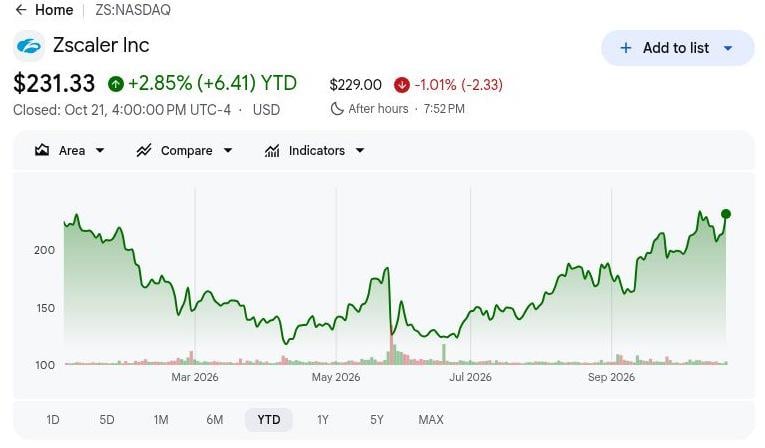
- ZS closed at $231.33 on October 21, up 2.85% YTD: Shares remain near their opening-year level, making the $300 bull scenario dependent on organic expansion and cash recovery. Continued gains require subscription scale to produce sustainable free cash flow rather than relying on acquisition-enhanced growth.
- Q4 revenue reached $898.2 million, up 25% year over year: The result supported a 24% adjusted operating margin, demonstrating subscription earnings leverage. However, Q1 guidance of $935 million to $939 million implies roughly 19% growth, making the durability of underlying demand important to the valuation.
- ARR reached $3.771 billion with a contribution from Red Canary: The acquisition added $141 million, leaving acquisition-adjusted ARR of $3.630 billion and approximately 20% growth versus 25% consolidated growth. Organic customer expansion and renewal quality will determine whether the larger platform sustains its subscription momentum.
- FY2027 ARR guidance sets a $4.396 billion to $4.426 billion test: The range implies 16.6% to 17.4% growth, below Q4's consolidated pace of 25%. Large-deal conversion and paid adoption of newer products will determine whether the platform generates enough organic expansion to support its valuation.
- Q4 free cash flow fell to $60.8 million as spending increased: Cash conversion reached 7% of revenue, while property and software spending rose to $218.5 million from $78.7 million. Investment supports expansion, although stronger utilization and cash margins are essential to earning returns for shareholders.
What Is Zscaler?
Zscaler (ZS) provides cloud-based cybersecurity solutions that help enterprises securely connect users, devices, and workloads to applications and data. Its Zero Trust Exchange platform verifies identity and access permissions rather than relying on traditional network security. Core products include Zscaler Internet Access (ZIA), Zscaler Private Access (ZPA), and data protection services. Its subscription-based business generates recurring revenue, with growth driven by enterprise customer expansion, additional security modules, and broader adoption of zero-trust architecture.
Zscaler's growth strategy focuses on expanding beyond secure connectivity into data protection, AI workload security, and automated security operations. Its Z-Flex purchasing model encourages broader product adoption, while the Red Canary acquisition strengthens threat detection and response capabilities. Notable customers include Siemens, United Airlines, T-Mobile, Johnson Controls, and General Electric, demonstrating adoption across major industries. With approximately 11,000 customers worldwide and FY2026 ARR of $3.771 billion, Zscaler aims to increase enterprise spending through additional security products and larger contracts.
Zscaler (ZS) Q4 FY2026 Earnings Overview: Subscription Growth Lifts Margins as Infrastructure Spending Reduces Cash Flow
Zscaler reported Q4 FY2026 revenue of $898.2 million, up 25% year over year, alongside ARR of $3.771 billion that included $141 million from Red Canary. Adjusted operating margin reached 24%, while free cash flow fell to $60.8 million as capital expenditure and internal-use software spending increased to $218.5 million. With Q1 FY2027 revenue guidance of $935 million to $939 million, future growth depends on converting organic platform demand into recurring sales and stronger returns on infrastructure investment.
Read More: Zscaler (ZS) Q4 FY2026 Earnings Overview: Slower FY2027 ARR Growth Sends Shares Down 4.50%
|
Financial Metric |
Guidance / Consensus |
Reported / Actual |
Surprise |
|
Revenue |
~$718.1M Q4 FY2025 |
$898.2M |
Improved. Up 25% YoY. |
|
Total ARR |
Prior-year comparison |
$3.771B |
Expanded. Up 25% YoY. |
|
ARR excluding Red Canary |
Acquisition-adjusted basis |
$3.630B |
Organic. Up 20% YoY. |
|
Adjusted operating margin |
22% Q4 FY2025 |
24% |
Improved. Up two points. |
|
GAAP operating loss |
$32.2M Q4 FY2025 |
$15.5M |
Narrowed. $16.7M smaller loss. |
|
Free cash flow |
$171.9M Q4 FY2025 |
$60.8M |
Lower. Down about 65%. |
|
Capex and internal software |
$78.7M Q4 FY2025 |
$218.5M |
Higher. $139.8M increase. |
|
FY2027 ARR guidance |
New forward guidance |
4.396B–4.426B |
Slower. 16.6%–17.4% growth. |
- Q4 revenue increased 25% to $898.2 million. ARR reached $3.771 billion, including $141 million from Red Canary, reflecting expanding subscription demand and acquired contributions. Revenue growth supported operating performance, although sustained organic expansion remains important as acquisition-related growth normalizes.
- Organic ARR grew approximately 20% to $3.630 billion. Excluding Red Canary, Zscaler continued expanding its subscription base through enterprise adoption of its Zero Trust Exchange platform. Larger contracts and additional security modules can support recurring revenue growth, helping spread operating costs across a broader customer base.
- Adjusted operating margin improved to 24% as subscription revenue expanded. The margin increased from 22% a year earlier, while GAAP operating losses narrowed to $15.5 million from $32.2 million. Revenue growth outpaced some operating costs, supporting profitability improvements even as the company continued investing in its platform.
- Infrastructure spending rose to $218.5 million, reducing free cash flow by 65%. Capital expenditure and internal-use software investment increased from $78.7 million a year earlier, contributing to a decline in free cash flow from $171.9 million to $60.8 million. While these investments support future platform capacity, stronger customer utilization and cash generation will be needed to justify the higher spending.
- FY2027 ARR guidance of $4.396 billion to $4.426 billion signals slower growth. The projected 16.6% to 17.4% increase compares with Q4's reported 25% ARR growth, which included Red Canary. Sustaining margin improvements while recovering free cash flow will depend on organic subscription expansion and returns from recent infrastructure investments.
Zscaler (ZS) 2026 Investment Outlook: $300 Bull Case vs. $175 Bear Case
The ZS investment test is whether Zero Trust and AI security bookings can lift organic ARR even as FY2027 guidance points to roughly 17% total growth. Q4's 24% adjusted operating margin shows scale, but the 7% free-cash-flow margin makes infrastructure cost central. The year-end cases below connect large-deal conversion, acquisition contribution and cash return to distinct equity values.
The Bull Case: Organic Growth and Cash Recovery Push ZS Toward $300
Faster organic platform expansion would increase subscription profit while easing infrastructure intensity converts more of that profit into cash. Q4 acquisition-adjusted ARR grew 20%, adjusted operating margin reached 24%, and free-cash-flow margin was only 7%. Broader paid deployments would strengthen the revenue base as prior investment supports customers without requiring another comparable spending increase.
The $300 scenario would gain support if Q1 sales exceed $939 million, organic ARR additions stay strong and cash conversion improves. Those results would connect the broader platform with earnings that require less incremental capital.
The Base Case: Steady Subscription Growth Keeps ZS Between $220 and $260
Recurring subscriptions would sustain adjusted operating profit while infrastructure investment and slower ARR growth restrain cash returns. Q4 adjusted margin reached 24%, but FY2027 ARR guidance implies roughly 17% growth and quarterly free-cash-flow margin was 7%. Delivering the revenue plan would preserve platform scale without immediately resolving the cost of supporting its wider product footprint.
A 220–260 range would fit Q1 revenue within $935 million to $939 million and gradual cash recovery toward the annual plan. Steady subscription demand would support the valuation while lower growth and ongoing investment limit further multiple expansion.
The Bear Case: Slower ARR Growth and High Costs Pull ZS Toward $175
Slower organic deal conversion would weaken incremental subscription profit and leave the expanded cloud infrastructure harder to monetize. Q4 free cash flow was $60.8 million after $218.5 million of capital and internal-software spending, while acquired ARR lifted headline growth. If new demand disappoints, persistent investment would absorb cash before the larger platform earns its expected return.
The $175 scenario would become more likely if ARR expectations fall and cash conversion remains weak despite the existing investment base. A lower growth outlook combined with missed cash targets would justify a smaller multiple on future subscription earnings.
ZS Stock Price Forecasts for 2026 By Wall Street Analysts
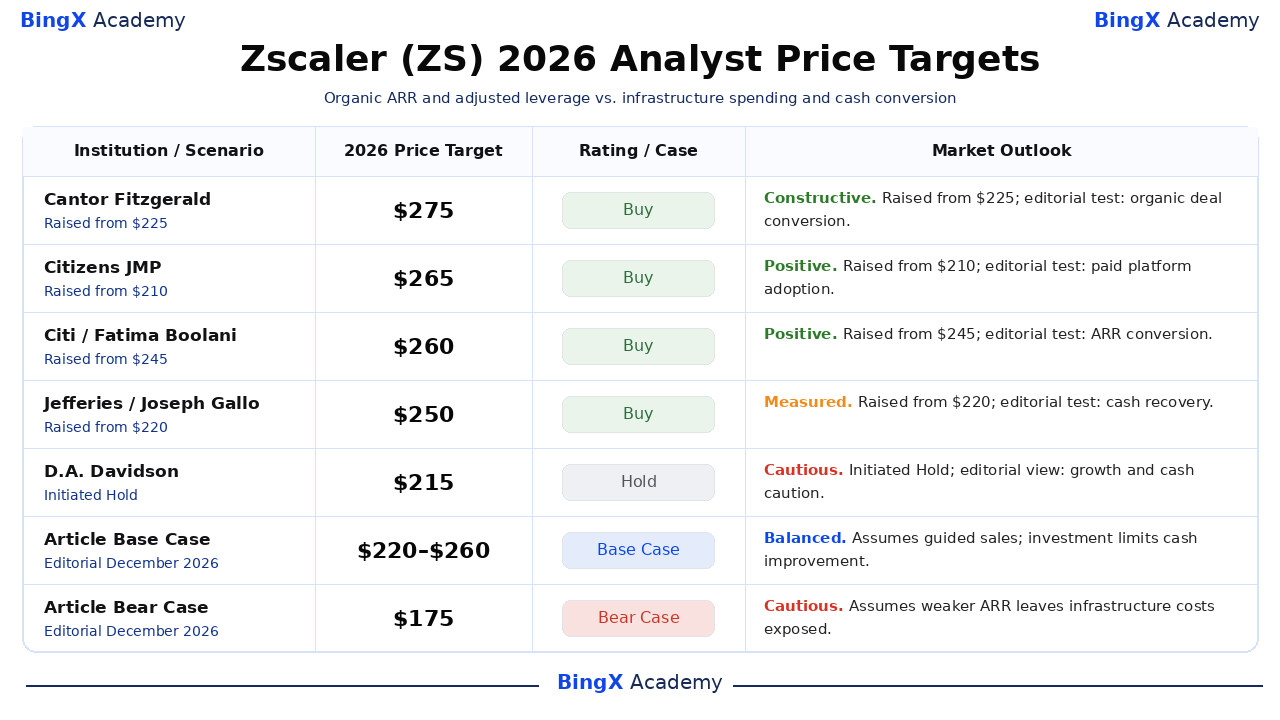
The selected calls concern ZS common shares on NASDAQ and span approximately 12-month analyst horizons, often beyond December 2026. Stock Analysis records the dated actions; ratings use its standardized labels. The spread reflects differing valuation assessments, while the explanations marked editorial are this article’s interpretation. Base and Bear rows are separate editorial year-end scenarios.
|
Institution / Scenario |
2026 Price Target |
Rating / Case |
Market Outlook |
|
Cantor Fitzgerald |
$275 |
Buy |
Constructive. October 12, 2026: Raised from $225; reiterated Buy. Editorial view: Organic large-deal conversion must improve cash returns. |
|
Citizens JMP |
$265 |
Buy |
Positive. October 9, 2026: Raised from $210; maintained Buy. Editorial view: Platform breadth needs durable subscription expansion. |
|
Citi |
$260 |
Buy |
Positive. October 15, 2026: Raised from $245; maintained Buy. Editorial view: ARR growth must support the expanded cost base. |
|
Jefferies |
$250 |
Buy |
Measured. October 7, 2026: Raised from $220; maintained Buy. Editorial view: A recovery still requires stronger cash generation. |
|
D.A. Davidson |
$215 |
Hold |
Cautious. October 20, 2026: Initiated Hold at $215. Editorial view: Slower growth and investment limit valuation support. |
|
Article Base Case |
220–260 |
Base Case |
Balanced. Editorial December 2026 scenario. Assumes guided sales; investment limits cash improvement. |
|
Article Bear Case |
$175 |
Bear Case |
Cautious. Editorial December 2026 scenario. Assumes weaker ARR leaves infrastructure costs exposed. |
How to Buy Zscaler (ZS) Stock on BingX
Buy and hold Zscaler shares through BingX Stocks Trading using USDT or USDC, subject to listing and account eligibility. Zscaler offers exposure to Zero Trust cybersecurity, cloud security and data protection for enterprise customers. Eligible users can size holdings according to their investment goals without using leverage or paying perpetual funding fees.
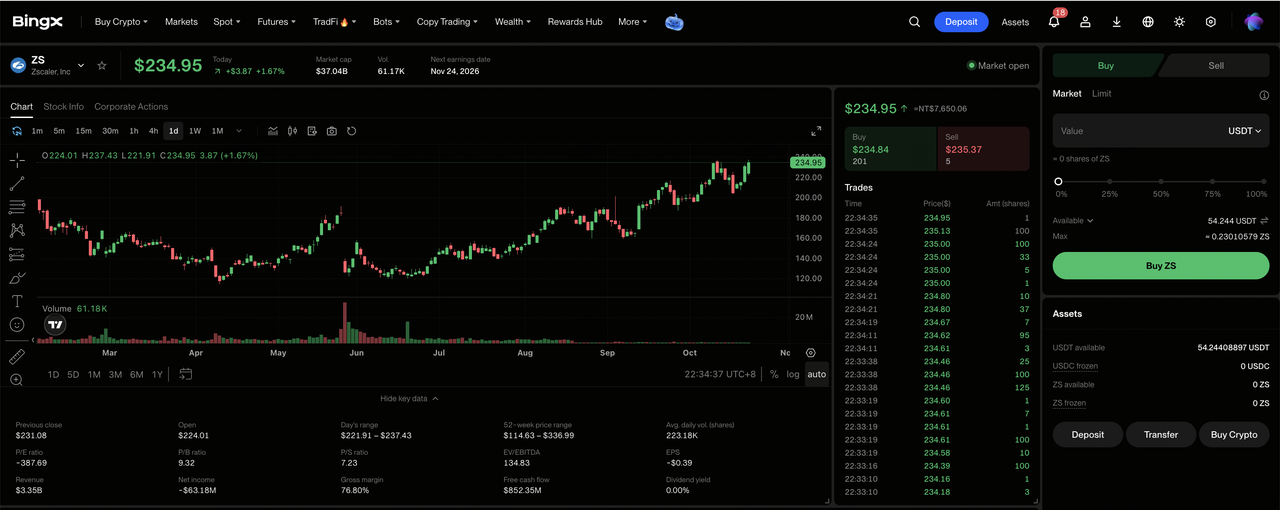
Step 1: Access BingX Stocks Trading. Sign up or log in to BingX, complete the required identity verification, and navigate to “TradFi > Stocks”. Accept the Stock Trading Risk Disclosure if accessing the product for the first time.
Step 2: Prepare USDT or USDC. Ensure your Spot Account has sufficient funds for the purchase. Transfer USDT or USDC from your Fund Account or Wealth Account if needed. Review the selected stock’s minimum order amount and fractional eligibility before choosing the investment size.
Step 3: Select Zscaler (ZS). Open the Stocks market, search for Zscaler (ZS), and confirm that the share is available to your account. Review the company identity, current share price, trading session and available order types.
Step 4: Buy Zscaler Shares. Select “Buy”, enter an allowed investment amount or share quantity, and choose a supported market or limit order. Market orders use available prices during supported sessions, while limit orders require the specified price or better and sufficient liquidity to execute.
Step 5: Review and Manage Your Holdings. Open “Stocks > Positions” to monitor your ZS shares and unrealized profit or loss. Use All Orders to review transactions or sell shares when needed. T+1 settlement generally affects when sale proceeds become withdrawable, rather than when purchased shares can be sold.
Top 5 Risks to Watch for Zscaler Investors in 2026
Zscaler's growing subscription base, expanding security platform, and enterprise relationships support its long-term outlook. However, slower organic growth, profitability challenges, deal delays, and infrastructure spending could pressure earnings and shareholder returns.
- Slower organic demand could pressure growth: Q4 ARR reached $3.771 billion, including $141 million from Red Canary, while acquisition-adjusted ARR grew 20%. Weaker enterprise spending or delayed customer expansion could slow recurring revenue growth and pressure valuation.
- Stock-based compensation could limit shareholder returns: Q4 adjusted operating income reached $218.4 million, but Zscaler still reported a $15.5 million GAAP operating loss. Continued stock-based compensation and other excluded expenses could constrain GAAP profitability and dilute shareholders.
- Enterprise deal delays could weaken revenue visibility: Large customer contracts and implementation schedules remain important to subscription growth. Slower deal conversion could challenge the FY2027 ARR guidance of $4.396 billion to $4.426 billion and reduce earnings expectations.
- Infrastructure spending could pressure cash generation: Q4 capital expenditure and internal-use software investment increased to $218.5 million from $78.7 million. Continued spending without sufficient customer adoption or utilization could weaken free cash flow and investment returns.
- Slower growth could pressure Zscaler's valuation: FY2027 ARR guidance implies 16.6% to 17.4% growth, below Q4's reported 25% increase. Increased competition, weaker organic expansion, or disappointing cash recovery could trigger further share-price declines.
Final Thoughts: Should You Invest in Zscaler in 2026?
Zscaler's $3.771 billion in ARR and 24% adjusted operating margin demonstrate the scale and earnings potential of its subscription platform. Zero Trust, data security and newer AI products broaden expansion opportunities, while Red Canary adds capabilities that need to earn returns. Sustaining that progress will depend on stronger organic demand and converting infrastructure investment into better free cash flow.
The $300 bull case assumes stronger organic ARR growth, platform expansion, and recovering cash margins. The $220 to $260 base case reflects guided growth, while the $175 bear case accounts for slower demand and heavy infrastructure spending. With ZS closing at $231.33 on October 21, investors should watch whether subscription scale translates into sustainable free cash flow growth.
Risk Reminder: Zscaler's large subscription base does not eliminate investment risk. Slower organic ARR growth, acquisition integration problems, or heavy infrastructure spending could weaken cash generation and shareholder returns. Investors should assess valuation, cash conversion, and their risk tolerance before buying ZS shares.
Related Reading
- What Is BingX Stocks Trading? A Beginner's Guide to Trading U.S. Stocks and ETFs With Crypto
- How to Buy U.S. Stocks on BingX With USDT or USDC: A Beginner's Guide
- Palo Alto Networks (PANW) Price Prediction 2026: Can AI Security Growth Push PANW Toward $475?
- CrowdStrike (CRWD) Price Prediction 2026: Can AI Security and Falcon Flex Push CRWD Toward $280?
- SentinelOne (S) Price Prediction 2026: Can AI Cybersecurity Demand Push S Toward $32?
- Cisco (CSCO) Stock Price Outlook for 2026: Can AI Growth and Splunk Drive CSCO Back to $90?
