
Success in spot trading in 2026 is no longer just about picking the right assets; it is about execution efficiency. While futures and margin trading offer high-risk leverage, spot trading remains the bedrock of a stable crypto portfolio because it grants full ownership with zero liquidation risk. However, the silent killers of long-term returns are fee leakage, poor order book reading, and emotional entry timing.
By understanding how the BingX matching engine prioritizes your trades and how to navigate the spread, you can turn a series of individual bets into a high-performance financial machine. This guide explores the mechanics of professional-grade spot trading, from optimizing maker-taker fees to implementing an automated Dollar-Cost Averaging (DCA) system that compounds your wealth over time.
What Is Spot Trading: The Foundation of Crypto Portfolios
Spot trading is the most direct form of asset acquisition. When you buy BTC/USDT on the BingX spot market, you receive the actual underlying asset in your account with no expiry dates. In the 2026 landscape, where institutional participation has stabilized price action, the Buy and Hold strategy remains king for those who prioritize security and full asset control.
Spot Trading vs. Futures Trading: Key Differences
|
Feature |
Spot Trading |
Futures Trading |
|
Ownership |
Direct ownership of the asset |
Derivative contract |
|
Leverage |
None (1:1) |
Up to 500× on BingX |
|
Liquidation Risk |
None |
High risk of total loss |
|
Fees |
One-time Maker/Taker |
Recurring Funding Rates |
|
Best For |
Long-term wealth building |
Hedging & Speculation |
In 2026, the primary differentiator between these two modes is the cost of carry and the velocity of capital. While spot trading requires 100% upfront collateral, it eliminates the funding rate, which in bullish cycles can average 0.01% to 0.03% every 8 hours, effectively costing futures traders 10.9% to 32.8% annually just to maintain a long position.
Conversely, futures allow for capital efficiency, using a 10% margin to control a full position, but introduce the liquidation price, a hard mathematical boundary where a 12% to 15% market wick can result in a 100% loss of collateral. For a stable portfolio, spot trading acts as the non-perishable core, while futures are best utilized as high-velocity instruments for short-term hedging or capturing intraday volatility.
Key Elements of Spot Trading on BingX
To master spot trading in 2026, you must navigate the technical mechanics of order execution and fee structures that dictate your ultimate profitability.
1. High-Frequency Execution via the Matching Engine
Every order on BingX is processed via a high-frequency matching engine, where understanding execution logic allows you to queue your orders effectively to avoid overpaying during high volatility.
- Price Priority: The engine always fills the best price first; a buy order at $84,500 will always jump ahead of an order at $84,400.
- Time Priority: When prices are equal, the earliest order is filled first, making early entry into the order book a distinct competitive advantage in 2026’s fast-moving markets.
2. Market Depth and Order Book Analysis
Before hitting Buy, analyzing the order book reveals the market's depth and protects you from unnecessary implicit costs. Thick books with high volume at each price level ensure minimal slippage, whereas thin books indicate that a large market order could move the price significantly against you, eroding your entry value.
3. Fee Optimization: Maker vs. Taker Dynamics
In 2026, professional traders treat fees as an expense line item, focusing on the distinction between Maker Fees (limit orders) and Taker Fees (market orders) to reduce long-term fee drag.
- Maker Fees: By adding liquidity and waiting for a fill, you secure a lower cost-per-trade and eliminate slippage.
- Taker Fees: While offering instant execution, taking liquidity is more expensive and can lead to significant leakage over a high volume of trades.
Why Trading Fees Matter for Portfolio Growth
At first glance, 0.1% per trade sounds trivial. But across an active spot portfolio, fees compound quickly:
|
Trades per month |
Trade size |
Fee per trade (0.1%) |
Monthly fee cost |
|
20 |
$500 |
$0.50 |
$10 |
|
20 |
$2,000 |
$2.00 |
$40 |
|
50 |
$1,000 |
$1.00 |
$50 |
|
50 |
$5,000 |
$5.00 |
$250 |
Annual impact of $250/month in fees: $3,000 a meaningful drag on a mid-sized portfolio.
Pro Tip: Across 50 trades of $5,000, a standard 0.1% fee results in $250/month in leakage. By scaling into higher VIP Volume Tiers, you can reclaim thousands of dollars in annual returns that would otherwise be lost to the exchange.
Top 3 Conditions to Help You Master Market Timing
Even in spot trading where you own the asset outright, entry timing affects your cost basis and therefore your eventual return. The same Bitcoin bought at $82,000 vs $86,000 produces very different results, even if both are held for years.
1. Trending Market: Clear Higher Highs, Higher Lows
The most favourable condition for spot accumulation. Price is in a sustained uptrend with healthy pullbacks.
Strategy: Buy the dip, wait for price to pull back to a prior support level or the rising trend line, then place a limit order at that zone. This gives you a lower average cost basis than buying into momentum.
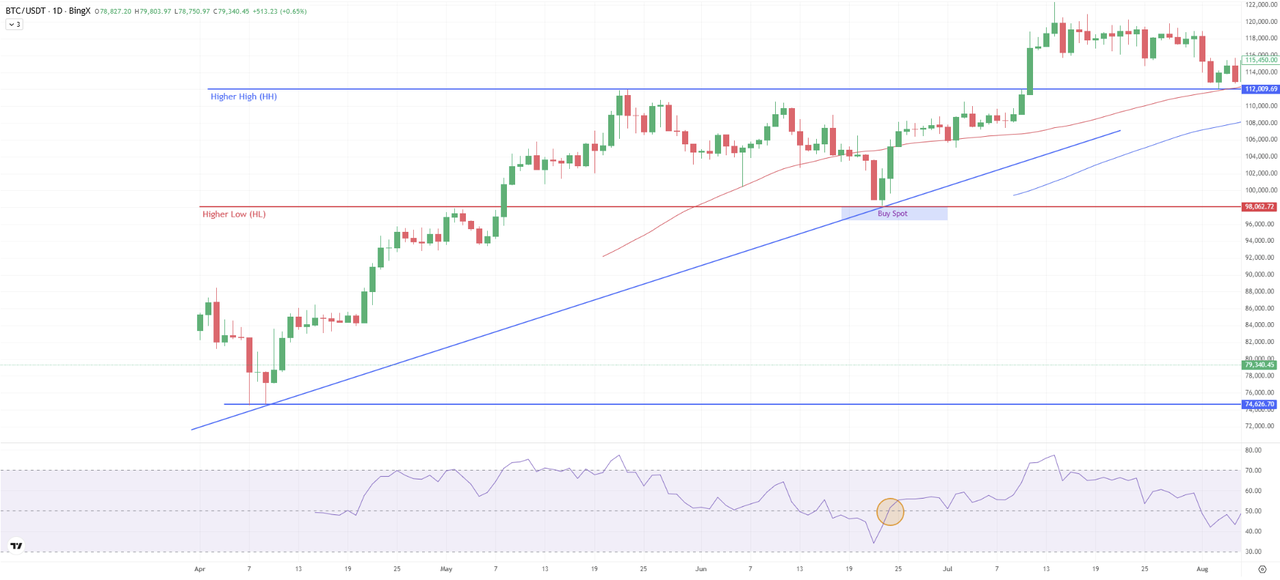
BTC/USD Price Chart - Source: BingX
Signals:
Price structure: HH/HL sequence intact
- Volume: rising on up days, falling on pullback days
- RSI: pulling back from overbought but not yet oversold
2. Ranging Market: Equal Highs, Equal Lows
Price is consolidating between a clear support zone and resistance zone.
Strategy: Accumulate at support, place limit orders near the bottom of the range. Set take-profit at the top of the range or hold if you believe a breakout is coming. Avoid buying in the middle of the range.
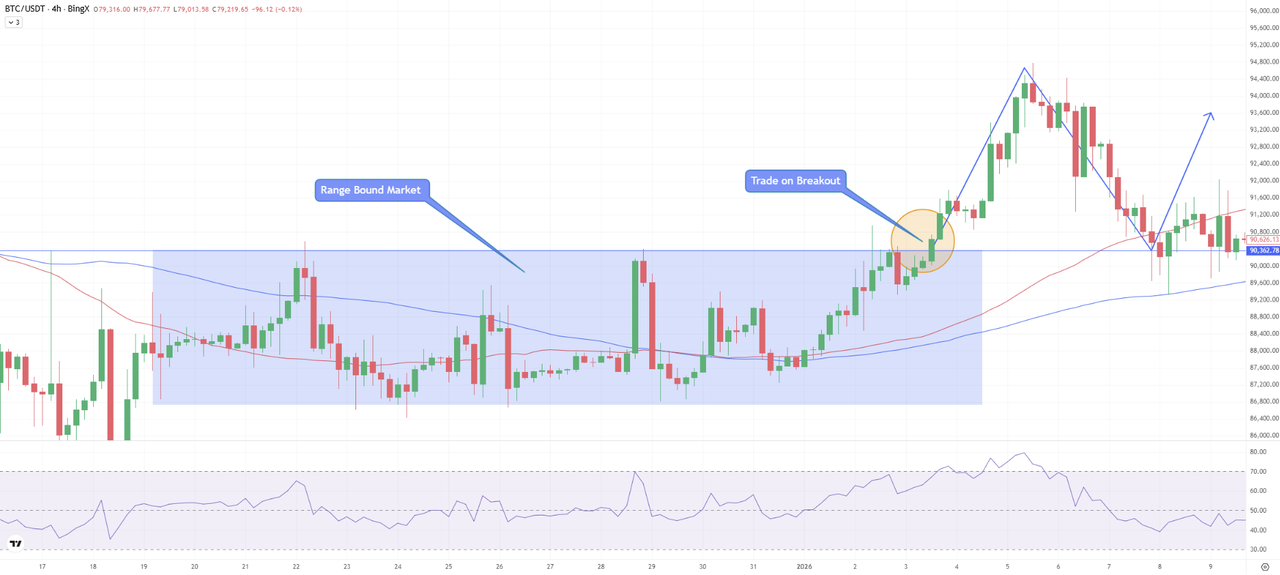
BTC/USD Price Chart - Source: BingX
Signals:
Equal highs and equal lows forming
- Volume decreasing, market is indecisive
- RSI oscillating between 40–60 without extremes
2. Downtrending Markt: Clear Lower Highs, Lower Lows
The most dangerous condition for spot buying. The temptation to "catch the bottom" is strong and frequently wrong.
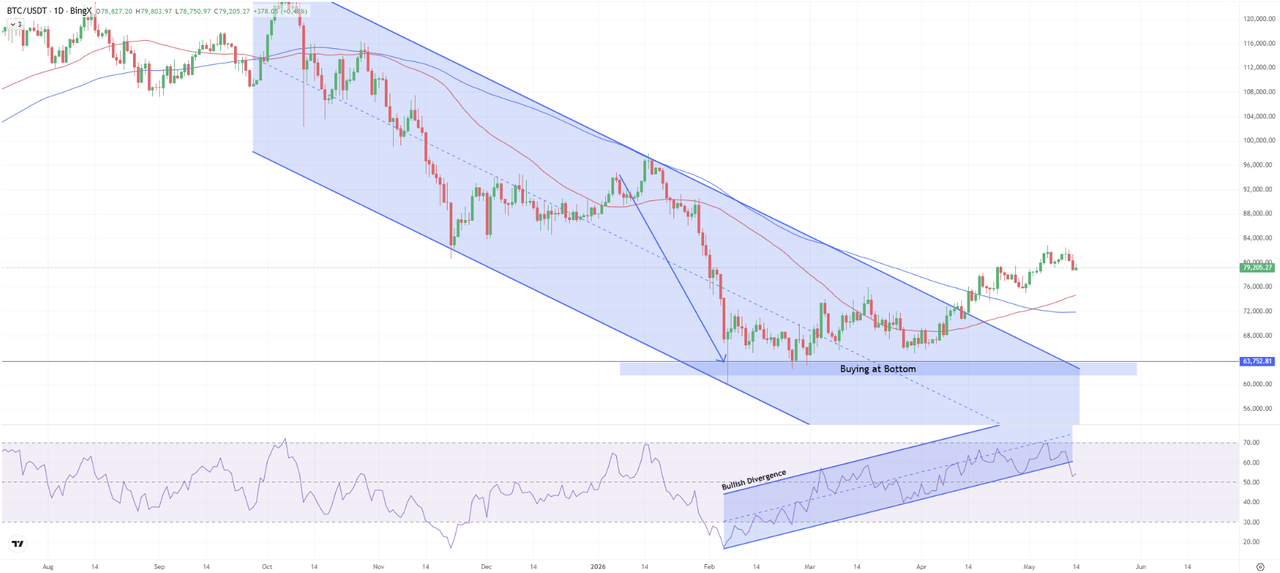
BTC/USD Price Chart - Source: BingX
Strategy: Scale in slowly using dollar-cost averaging (DCA), not single large buys. Never allocate your full intended position at once. Wait for structural confirmation (a higher low forming) before increasing exposure.
Signals to wait for before buying:
First higher low after a sequence of lower lows
- Volume spike on a strong bounce candle
- RSI showing bullish divergence (price making lower lows, RSI making higher lows)
Dollar-Cost Averaging (DCA): The Compounding Tool
The most reliable way to grow a spot portfolio in 2026 is the BingX Recurring Buy feature. By purchasing a fixed amount at set intervals, you mathematically lower your average entry price during downturns.
Why DCA Works for Spot Portfolio Growth
DCA doesn't guarantee a better outcome but it removes the single point of failure from timing a large entry.
|
Without DCA (lump sum at one price) |
With DCA (split into 4 purchases) |
|
Buy $4,000 of BTC at $85,000 |
Buy $1,000 at $85,000 / $1,000 at $78,000 / $1,000 at $72,000 / $1,000 at $80,000 |
|
Average cost: $85,000 |
Average cost: $78,750 |
|
Paper loss at $78,000: -$824 |
Paper loss at $78,000: -$954 (smaller position at risk) |
What Is the Best Portfolio Allocation Framework for Spot Trading?
A stable spot portfolio is not a collection of speculative bets, it is a structured allocation across risk tiers with clear position sizing rules.
Three-Tier Spot Portfolio Model
|
Tier |
Assets |
Allocation |
Risk level |
Strategy |
|
Core (Tier 1) |
BTC, ETH |
50–60% |
Low |
DCA + hold, reduce only at cycle tops |
|
Growth (Tier 2) |
SOL, BNB, ADA, XRP |
25–35% |
Medium |
Accumulate on dips, take profits at resistance |
|
Speculative (Tier 3) |
Mid-cap alts, new narratives |
10–15% |
High |
Smaller positions, strict stop-limits |
Position Sizing Rules
- No single Tier 2 position exceeds 10% of total portfolio
- No single Tier 3 position exceeds 3–5% of total portfolio
- Total Tier 3 exposure never exceeds 15%
- Always maintain at least 10–15% USDT as dry powder for opportunities
When to Rebalance Your Spot Portfolio
Rebalance when:
- A single position grows beyond its tier allocation (take partial profits)
- BTC dominance signals a regime change (rotate between tiers)
- A position's fundamental thesis changes (exit, don't hold out of hope)
The Daily Routine for Consistent Growth
- Market Structure (5 min): Check BTC Dominance. Is capital flowing into Alts or back to Bitcoin?
- Position Review (5 min): Are any Tier 2 or 3 assets hitting resistance?
- Order Placement (5 min): Replace expired limit orders.
- Journaling (5 min): Note your total portfolio value in both USDT and BTC.
Common Spot Trading Mistakes That Erode Portfolio Growth
Avoiding these common execution and psychological pitfalls is essential for maintaining the structural integrity and long-term profitability of your spot portfolio.
- Chasing price with market orders: Buying at market when price is already up 5% in a day means you are paying a premium entry and accepting slippage on top of fees. Use limit orders and let price come to you.
- Ignoring the spread on low-liquidity pairs: On pairs with thin order books, the spread between bid and ask can be 0.5–1%+ on its own. Before buying a low-cap token, check the spread. If it's wider than 0.3%, the implicit cost is already eating your margin.
- Overconcentration in Tier 3 assets: A portfolio of ten 10% positions in mid-cap speculative alts is not diversification, it is concentrated speculation. Tier 3 assets are correlated: when market sentiment turns, they all fall together.
- Measuring performance in USDT only: In a bull market, almost every alt gains in USDT terms. The real measure of spot trading skill is performance versus Bitcoin. If your portfolio gains 25% in USDT while BTC gains 40%, you underperformed the benchmark.
- Not tracking fees: Most traders have no idea how much they pay in fees monthly. Check your BingX trade history, export the CSV, and calculate your total fee spend quarterly. It is almost always higher than expected.
- Abandoning the routine during drawdowns: The temptation to stop following your process when the portfolio is down is exactly backwards. Drawdowns are when discipline matters most when the urge to panic-sell or revenge-buy is strongest.
How to Track Your Spot Portfolio Performance on BingX
Utilizing BingX’s native AI-driven analytics and exportable data sets allows you to transform raw transaction history into a strategic roadmap for long-term growth.
1. Direct Portfolio Visualization
Navigate to the BingX Portfolio section to access a real-time dashboard of your live spot holdings, including automated calculations for unrealized P&L and average entry prices. In 2026, the platform’s integrated AI Bingo assistant can provide instant natural-language summaries of your asset allocation and overall performance against the broader market.
2. Export Data for Advanced Analysis
For a deeper dive into your trading efficiency, use the Trade History and Export CSV function to download your complete transaction records. Importing this data into tools like Google Sheets or dedicated journals allow you to calculate critical metrics such as your win rate per asset, total fee-to-return ratio, and holding period performance.
3. Benchmarking Against BTC
A key professional practice is measuring your portfolio's growth not just in USDT, but relative to Bitcoin. Tracking your performance against a BTC benchmark reveals whether your active spot trading is actually outperforming a simple buy and hold strategy, providing the data needed to refine your Tier-2 and Tier-3 allocations.
4. Leveraging AI-Powered Insights
The BingX AI Master suite provides predictive alerts and sentiment heatmaps directly over your portfolio view, helping you distinguish between routine volatility and institutional shifts. By reviewing these AI-vetted metrics weekly, you can identify which of your setups are consistently profitable and where fee drag may be silently eroding your gains.
Conclusion
Spot portfolio growth is not about finding the next 10× coin. It is about making every trade slightly more efficient than the last, better entry prices through limit orders, lower fees through volume discipline, better timing through market structure awareness, and better compounding through DCA consistency.
The traders who outperform over a full cycle are those who treat spot trading as a repeatable process with measurable outputs, not a series of individual bets. The matching engine fills your orders fairly, the fees are predictable, and the market provides opportunities consistently. The only variable you fully control is your own execution quality.
Build the routine, measure it, and improve it quarterly. That is how stable spot portfolios grow.
Related Reading
- What Is High-Frequency Trading in the Crypto Market: The Ultimate Guide
- BingX Spot Fees: How to Save More as a Maker in 2026
- What Are the Different Order Types Supported on BingX Spot and How to Use Them?
- The Difference Between Fund Account, Spot Account, and Futures Account
- 2026 Guide to Risk Management on BingX Spot: Protect Your Capital with Professional-Grade Tools
FAQs on Portfolio Management in Spot Trading
1. Is spot trading better than futures for beginners?
Yes. Spot trading allows you to own the asset outright without the risk of your position being closed (liquidated) if the price moves against you temporarily.
2. How can I lower my trading fees on BingX?
You can significantly reduce your costs by increasing your 30-day trading volume or total asset balance to ascend the BingX VIP tiers, which unlock institutional-grade fee structures and exclusive rewards.
3. Does BingX support automated spot trading?
Absolutely. You can use the Recurring Buy feature for DCA or deploy Spot Grid Bots to automate buying low and selling high within a specific price range.
