

Navigating the lightning-fast world of Solana meme coins and micro-cap tokens in 2026 requires more than just analyzing a basic price chart. The rise of automated market-making algorithms and sophisticated Maximal Extractable Value (MEV) infrastructures has introduced a significant risk for retail investors: bundled transactions. Without proper on-chain forensic tools, buying a newly launched token exposes you to heavily rigged markets where malicious actors control the supply from block zero.
A Solana Bundle Checker serves as an essential utility for decentralized finance (DeFi) traders. It acts as an X-ray scanner for the blockchain, revealing whether a token's initial liquidity deploy, creation, and early buy transactions were tightly grouped together inside an atomic package.
By integrating tools like Birdeye, Axiom, Trench Bot, and Jito Explorer into your pre-trade workflow, you can accurately map holder distributions and bypass malicious project launches before committing your SOL.
What Is a Bundle Checker and Why Does it Matter for Solana Users?
A bundle checker is a specialized blockchain analytics tool designed to detect, group, and flag multiple transactions that are submitted simultaneously to the Solana network within a single block or a highly compressed slot window.
On Solana, developers and high-frequency trading bots routinely leverage MEV infrastructure, such as Jito Labs’ block engine, to bundle up to five individual transactions together. This structural setup ensures atomic execution, meaning either every transaction inside the envelope succeeds in sequential order, or the entire bundle fails completely.
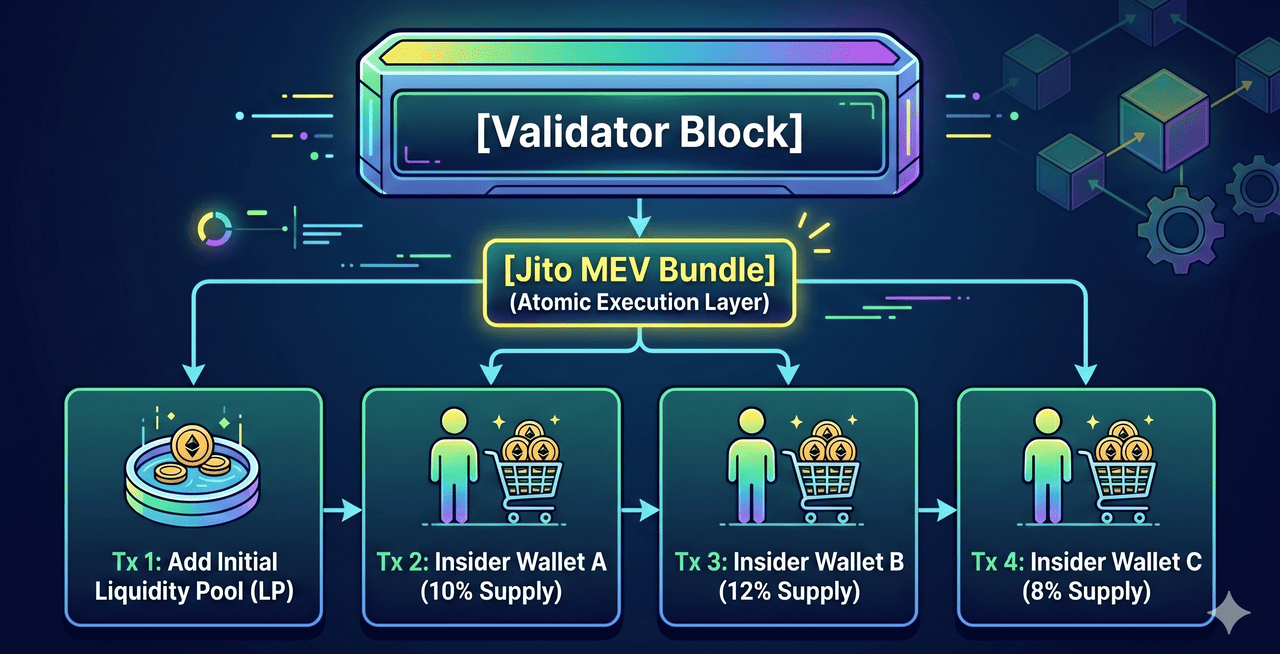
While bundling is fundamentally a neutral optimization tool used by legitimate market makers to add liquidity and execute balanced trades safely, it has become a primary instrument for market manipulation.
A bundle checker evaluates structural transaction relationships, tracking whether early market actions are organic or highly orchestrated. It helps retail traders answer a critical security question:
Are you buying into a decentralized community token, or are you simply providing exit liquidity for a single coordinator hiding behind multiple addresses?
How to Spot Dev Sniped Solana Tokens Before You Invest
The most dangerous threat on automated token launchpads is the dev snipe. In this scenario, a token creator launches a token and bundles the liquidity-provision transaction with multiple immediate buy orders from secondary wallets controlled by the exact same entity. Because this entire sequence occurs within the identical block, external retail traders and standard trading bots are completely bypassed, preventing a fair launch.
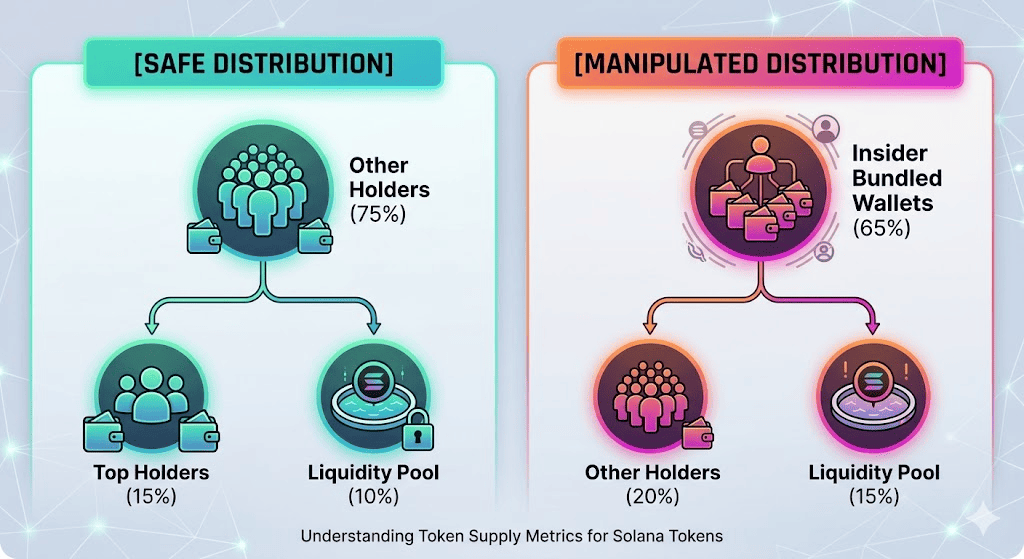
- Supply Cornering: The developer can instantly acquire 30% to 70% of the circulating token supply at the absolute lowest possible price tier.
- False Decentralization: The purchased tokens are automatically routed to dozens of unique, clean sub-wallets. On standard block explorers, it appears as though hundreds of independent buyers are organically aping into the launch.
- Coordinated Liquidation: Once public FOMO (Fear of Missing Out) drives the price up, the developer triggers a structural dump across all sub-wallets, completely draining the liquidity pool.
Using a bundle checker lets you review the precise transaction ancestry. If a tool flags that the initial liquidity injection and the first ten large buy orders were executed within the exact same Jito bundle ID, the token is highly likely to be a developer-sniped honeypot or an impending rug pull.
What Are the Best Solana Bundle Checker Tools to Use for Token Audits?
Conducting a professional-grade token audit in 2026 requires combining raw on-chain transaction data with specialized program execution analytics. Birdeye, Axiom, and Trench Bot provide an excellent multi-framework for deep-dive token audits.
|
Audit Metric |
Birdeye Platform |
Axiom Zero-Knowledge Circuits |
Trench Bot (@TrenchScannerBot) |
Jito Explorer |
|
Primary Use Case |
Visualizing holder activity, token flow, and real-time structural profiles. |
Cryptographic verification of historical states and developer fund roots. |
Bundle detection, strategy backtesting, and automated gem hunting. |
Ground-truth verification of MEV bundles, transaction ordering, and tip tracking. |
|
Data Analysis Layer |
Macro-level UI scanning (Top Holders, Bubble Maps, profiles). |
Micro-level computational analysis (Trustless balance roots and historical state logs). |
Coordinated wallet analysis, supply bundling %, and risk indicators. |
Raw instruction-level parsing, bundle IDs, and validator tip metrics. |
|
Latency |
Real-time streaming interface. |
Query-dependent processing (Batched proof verification). |
Near-instant Telegram alerts. |
Real-time block and slot indexing. |
|
Target User |
Everyday DeFi traders and momentum scouts. |
Quant analysts, developers, and advanced forensic auditors. |
Active meme coin traders, alpha hunters, and algorithmic strategists. |
Forensic researchers, MEV searchers, and advanced risk auditors. |
Birdeye for Tracking Coordinated Wallet Flows
Birdeye serves as an excellent front-end tool for tracking structural token movements. By navigating to a token's contract address (CA) on Birdeye, traders can view the Finders & Top Holders tabs alongside advanced visualization tools like bubble maps.
Birdeye allows you to visually inspect if a group of top holding wallets interacted with one another or were funded by a singular root address prior to token creation. If a cluster of twenty separate wallets all received their initial SOL funding from a shared source right before launch, they represent a unified insider cluster.
Axiom for Uncovering Historical Developer Lineage
For deep forensic audits, power users leverage Axiom. Axiom utilizes Zero-Knowledge (ZK) coprocessing to query historical data and verify transactions across Solana's timeline without relying on centralized APIs.
Traders can deploy custom Axiom queries to trustlessly read the historical states of a developer’s wallet, tracking whether the deployer has a cryptographic history of deploying malicious smart contracts, recycling developer keys, or systematically feeding automated bundling bots on alternative token launches.
Trench Bot for Proactive Bundle Detection and Strategy Validation
Trench Bot, known widely as @TrenchScannerBot on Telegram, is an essential tool for traders focused on the extremely volatile Solana meme coin market, particularly launches on Pump.fun and Raydium. While Birdeye visualizes existing distribution and Axiom verifies historical data, Trench Bot offers proactive bundle analysis that is critical for safer token buys.
Trench Bot allows traders to instantly paste a token's mint address to flag coordinated wallet activity, determine the precise percentage of supply that was bundled right at launch, and assess the potential holding power of those bundled wallets. By combining this high-value bundle scanner with precision filters, historical strategy backtesting, and AI insights, Trench Bot provides an institutional-grade edge to retail traders.
Jito Explorer for Ground-Truth Verification of Atomic MEV Bundles
When third-party bundle checkers or Telegram scanners flag a token launch as a potential risk, Jito Explorer acts as the ultimate platform for ground-truth verification. Because Jito's block engine handles the vast majority of bundled MEV execution on Solana, its official explorer offers an unedited, technical view of exactly how transactions were packed together within a single block or slot.
Traders use Jito Explorer to perform an exact audit by copying the transaction hash of a token's initial liquidity-provision event and pasting it directly into the search bar.
- Isolating Atomic Sequences: The explorer strips away abstraction, revealing the exact Bundle ID and the precise sequential array of transactions (up to 5 maximum) that occurred atomically alongside the liquidity add.
- Auditing Validator Tips: Jito Explorer exposes the exact Tipper address and the magnitude of the validator tip (in SOL) attached to the bundle. A phenomenally high tip on a brand new token launch is a definitive signature of a high-stakes insider setup designed to guarantee front-running success over the rest of the market.
- Instruction-Level Parsing: It enables advanced users to inspect internal program instructions and Bundle Playback timelines, confirming whether secondary wallets instantly routed extracted funds to clean accounts within millisecond time frames.
How to Read the Data From a Bundle Checking Tool: Holder Distribution and Liquidity Locks
When running a token audit through Birdeye or a bundle checker, focus on interpreting data indicators that point directly to security status:
The 10% Concentration Rule
Analyze the token's top 20 holders. If a cluster of unlabelled wallets holds a cumulative total exceeding 10% of the overall token supply without a verified explanation, such as a centralized exchange cold wallet or a locked staking pool, assume the token is highly centralized.
Evaluating Liquidity Lock Integrity
A high-conviction token project must permanently neutralize its liquidity pool (LP) tokens. Check whether the LP tokens have been routed to a recognized burn address (11111111111111111111111111111111) or locked within a verifiable time-release smart contract. If the LP remains unlocked in the deployer’s wallet, they can yank the pool assets at any moment.
Cross-Referencing Transfer Logs
Malicious teams often attempt to bypass basic bundle checkers by using automated dispersion software. Instead of buying tokens directly through a bundle at launch, they execute a single massive buy and immediately distribute those tokens out to 50 distinct sub-wallets over the course of 3 to 4 blocks. Always check the early transfer logs to ensure the deployer wallet isn't quietly spreading supply to mask insider concentration.
How to Avoid 2026 Rug Pull Trends on Pump.fun
Pump.fun and automated bonding-curve launchpads remain hotspots for creative exploit mechanisms. As market awareness has matured, malicious actors have evolved past basic rug pulls to exploit more nuanced structural vulnerabilities.
1. The Multi-Wallet Bonding Curve Hijack
In 2026, scammers rarely snipe a token using a single obvious wallet. Instead, they pre-program a script that spins up 20 to 30 completely clean Phantom or Solflare wallets.
When the token is launched on Pump.fun, the script distributes minor SOL amounts to these wallets and triggers simultaneous buy orders distributed along the bonding curve. By the time the token hits 50% of its bonding target, the developer already controls the majority of the supply across these hidden profiles.
Run the token mint address through a bundle checking tool. Look for a high Bundle Risk Index or structural alerts flagging that multiple wallets bought in the exact same slot.
2. Fake Volume Generation via Micro-Bundles
To climb the trend rankings on automated platform dashboards, developers utilize micro-bundles that execute hundreds of fractionated buy and sell orders within seconds. This creates artificial velocity, giving the illusion of immense retail interest while the overall unique trader count remains tiny.
Compare total trade volume against the unique trader count. Low unique trader counts paired with high transaction counts usually point to wash trading bots manipulating the platform's ranking algorithms.
3. Exploiting the Raydium Migration Window
The moment a token completes its bonding curve on Pump.fun, it automatically migrates over to Raydium, where a formal liquidity pool is seeded and burned. Scammers exploit this specific migration transition by utilizing a Jito bundle to execute a massive sell order at the exact block the Raydium pool goes live. This drops the token price to near-zero before retail traders can react on Raydium.
Before trading a newly migrated token, inspect the migration transaction block on Jito Explorer. If you see large sell instructions bundled directly into the initialization sequence, avoid trading the asset.
Final Thoughts: Navigate the Solana Ecosystem Safely with Bundle Checkers
Leveraging a Solana bundle checker is an essential component of on-chain security. While high transaction speeds and minimal network fees offer exceptional trading flexibility, they also facilitate rapid, automated market exploitation.
By treating every unverified token launch with structural skepticism and verifying transaction hashes across Birdeye, Axiom, and Jito, you can significantly reduce your exposure to insider manipulation. Protect your capital, look past social media hype, and always perform on-chain due diligence before hitting the buy button.
Related Reading
- What Are the Top 10 dApps and Crypto Projects in the Solana Ecosystem?
- What Are the Top 7 Solana DEXs to Trade in 2026?
- Top 8 Solana DeFi Projects to Watch in 2026
- What Are the Best Solana Wallets to Use in 2026?
FAQs on Solana Bundle Checkers
1. Can a token launch be bundled without being a malicious scam?
Yes. Bundling is an architectural efficiency feature on Solana. Legitimate project developers often use bundles to seamlessly initialize a liquidity pool and execute a predefined, transparent marketing or ecosystem airdrop in a single secure step to ensure network stability.
2. Is it possible for a developer to bypass a bundle checker?
Yes. Sophisticated actors can spread their transactions out across multiple sequential blocks instead of using a single atomic bundle, or they can utilize private RPC nodes to hide their transaction routing from public mempools. This is why you must combine bundle checkers with historical wallet analytics platforms like Birdeye.
3. What should I do if a token I hold shows high bundled activity?
If a bundle checker flags a high insider concentration or reveals that early top buyers are tightly linked to the developer's main wallet, you should carefully evaluate your risk exposure. High concentration means a single entity can collapse the token's price floor at any moment.
