



Uber (UBER) operates a global marketplace connecting consumers with drivers, couriers, restaurants, retailers and freight carriers across Mobility, Delivery and Freight. Its network had 208 million monthly active platform consumers in Q2 2026, while 10.2 million drivers and couriers earned more than $25 billion during the quarter. The breadth creates cross-platform advantages, but it also leaves the equity sensitive to local regulation, insurance costs, consumer demand and autonomous-vehicle disruption.
The latest quarter showed that user growth and profit conversion remain strong even as headline revenue comparisons were distorted by a UK business-model change. Uber Q2 gross bookings rose 24% to $58.02 billion and trips increased 18% to 3.87 billion, while revenue advanced 12% to $14.19 billion. Adjusted EBITDA grew faster at 33% to $2.82 billion, but management also committed more than $10 billion to robotaxi investments over the coming years.
The UBER stock forecast for 2026 now centers on two competing views:
- The platform-scale and autonomy case: Mobility and Delivery bookings continue compounding above 20%, free cash flow funds robotaxi partnerships, and Uber becomes the demand and dispatch layer connecting multiple autonomous fleets to more than 200 million active consumers.
- The capital-intensity and disintermediation case: The $14.8 billion Delivery Hero agreement and more than $10 billion of planned robotaxi investment absorb cash while Waymo, Tesla and other fleet operators build direct consumer relationships that weaken Uber's marketplace economics.
This guide breaks down the UBER stock forecast, 2026 price scenarios, key risks and analyst outlooks, drawing on Uber's August 5 Q2 2026 earnings release, quarterly filing and market data through September 23, plus how to trade UBER stock futures on BingX TradFi with USDT collateral.
Top 5 Things for Uber Investors to Know in September 2026
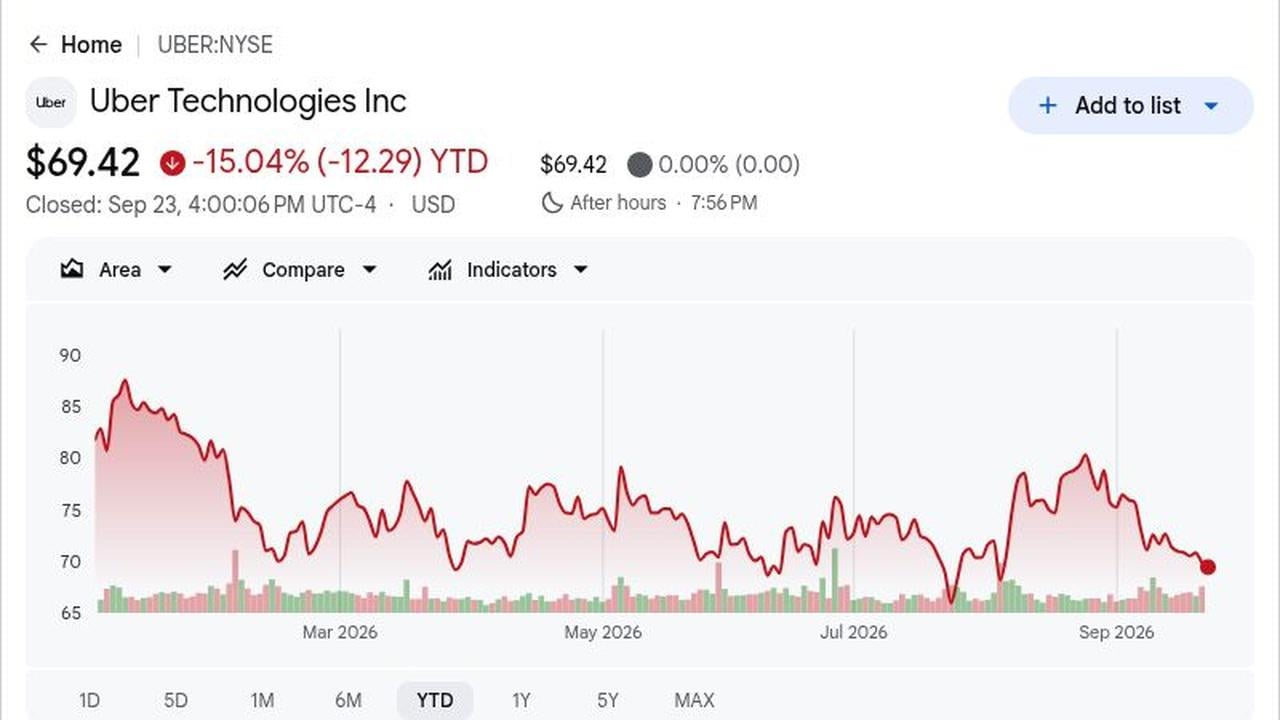
- UBER closed at $69.42 and was down 15.04% in 2026: The September 23 close sat about 31% below the $101.30 52-week high despite record bookings and cash flow. The gap shows investors are discounting robotaxi competition, the Delivery Hero deal, and softer near-term guidance more than current marketplace demand.
- Revenue reached $14.19 billion while non-GAAP EPS rose 35% to $0.81: Revenue increased 12% year over year but came in about $49 million below the $14.24 billion consensus. Adjusted EPS beat the $0.80 FactSet estimate by one cent, showing stronger operating leverage partly offset the revenue miss.
- Gross bookings rose 24% to $58.02 billion as trips increased 18%: Bookings beat the $57.06 billion LSEG estimate by about $962 million, while monthly active platform consumers grew 16% to 208 million. Higher user counts and a 2% increase in monthly trips per consumer show both reach and engagement improved.
- Adjusted EBITDA rose 33% to $2.82 billion and free cash flow reached $2.79 billion: EBITDA margin improved to 4.9% of gross bookings from 4.5%, while trailing 12-month free cash flow exceeded $10 billion for the first time. That cash generation supports buybacks, acquisitions, and autonomous-vehicle commitments.
- More than $10 billion of planned robotaxi investment follows a $14.8 billion Delivery Hero agreement: AV spending is expected to include partner equity, vehicle commitments, and fleet support, while Delivery Hero could extend the combined platform to nearly 100 markets. Both initiatives expand Uber's opportunity but make capital allocation increasingly important to per-share returns.
What Is Uber (UBER)?
Uber Technologies is a marketplace platform rather than a vehicle owner at the center of most transactions. Mobility connects riders with drivers across products including UberX, Reserve, Black, Uber for Business and lower-cost options. Delivery connects consumers with restaurants, grocery stores and retailers, while Freight matches shippers with carriers. Uber earns service fees and commissions from transactions, using shared identity, payments, routing, pricing and membership infrastructure across the network.
Its long-term direction is to deepen cross-platform use, broaden local commerce and become a distribution layer for autonomous mobility. Uber works with Waymo in Austin and Atlanta and has announced relationships with Zoox, Avride and Apollo Go, allowing multiple AV developers to reach its installed demand network. Grocery and Retail reached $15 billion in annualized bookings, supported by partners including Tesco, GameStop, Ulta Beauty and Decathlon, while the planned Delivery Hero acquisition would expand reach toward 100 markets.
Read More: Tesla (TSLA) Price Prediction 2026: Can Robotaxi and Optimus Push TSLA Stock to $500?
Uber (UBER) Q2 2026 Earnings Overview: Record Bookings and Strong Cash Flow Offset Softer EPS Outlook
Uber reported Q2 revenue of $14.191 billion versus a $14.24 billion consensus, while non-GAAP EPS of $0.81 edged above the $0.80 estimate. Gross bookings reached $58.022 billion, topping the $57.06 billion view, and adjusted EBITDA rose 33% to $2.819 billion. Q3 bookings guidance of $58.25 billion to $60.25 billion broadly matched consensus, but EPS guidance of $0.84 to $0.88 fell below the $0.89 estimate, leaving a clear growth-versus-investment tension.
Read More: Uber (UBER) Q2 FY2026 Earnings Overview: $14.2B Revenue Miss Triggers a 5.29% Price Selloff
|
Financial Metric |
Guidance / Consensus |
Reported / Actual |
Surprise |
|
Q2 2026 revenue |
$14.24B consensus |
$14.191B |
Miss. $49M below consensus; up 12% YoY. |
|
Q2 non-GAAP diluted EPS |
$0.80 consensus |
$0.81 |
Beat. One cent above consensus; up 35% YoY. |
|
Q2 GAAP diluted EPS |
– |
$1.17 |
Improved. Up 85% from $0.63 a year earlier. |
|
Q2 GAAP net income |
– |
$2.394B |
Increased. Included a $1.6B investment revaluation benefit. |
|
Q2 gross bookings |
$57.06B consensus |
$58.022B |
Beat. $962M above consensus; up 24% YoY. |
|
Q2 trips |
– |
3.867B |
Expanded. Up 18% YoY as MAPCs rose 16%. |
|
Q2 Mobility gross bookings |
– |
$28.988B |
Expanded. Up 22% reported and 20% constant currency. |
|
Q2 Delivery gross bookings |
– |
$27.463B |
Accelerated. Up 26% reported and 25% constant currency. |
|
Q2 adjusted EBITDA |
$2.78B consensus |
$2.819B |
Beat. Up 33% YoY; margin reached 4.9% of bookings. |
|
Q2 free cash flow |
– |
$2.792B |
Positive. Up 13% YoY; trailing FCF exceeded $10B. |
|
Q3 gross-bookings outlook |
$59.21B consensus |
58.25B-60.25B |
In line. Midpoint of $59.25B broadly matched consensus. |
|
Q3 non-GAAP EPS outlook |
$0.89 consensus |
0.84-0.88 |
Lower. Top end was one cent below consensus. |
- Revenue of $14.191 billion grew 12% but missed consensus by $49 million: The comparison understates underlying activity because a UK business-model change reduced reported growth by roughly eight percentage points without changing the economics. Gross bookings rose 24%, so the miss reflected accounting mix more than weaker consumer demand.
- Non-GAAP EPS of $0.81 beat consensus by one cent and rose 35%: Non-GAAP operating income increased 40% to $2.143 billion, far faster than revenue growth. That operating leverage supports the view that Uber can fund autonomous-vehicle investment without sacrificing near-term earnings growth.
- Gross bookings of $58.022 billion beat expectations by $962 million: Mobility bookings rose 22% to $28.988 billion, while Delivery bookings increased 26% to $27.463 billion. Growth across both major businesses reduces dependence on a single service and strengthens the broader platform.
- Adjusted EBITDA rose 33% to $2.819 billion as margin reached 4.9%: Margin improved 40 basis points from 4.5% of bookings, while free cash flow increased 13% to $2.792 billion. Operating leverage remains visible, though future AV and acquisition spending could redirect some cash away from buybacks.
- Q3 EPS guidance of $0.84 to $0.88 trailed the $0.89 consensus: Gross-bookings guidance centered near $59.25 billion, almost matching the $59.21 billion Street view, so demand was not the main concern. The softer profit range points instead to reinvestment timing and mix as near-term margin headwinds.
Uber (UBER) 2026 Investment Outlook: $120 Bull Case vs. $60 Bear Case
Uber's 2026 outlook depends on whether strong marketplace growth can continue while the company invests heavily in autonomous vehicles and integrates Delivery Hero. The upside comes from faster bookings, expanding margins, and robotaxi partnerships that strengthen Uber's network, while higher capital needs and direct AV competition remain the main risks.
The Bull Case: Strong Bookings and Robotaxi Growth Push UBER Toward $120
The Bull Case assumes gross bookings remain above 20% growth while Uber's 208 million active consumers make the platform a preferred demand channel for multiple autonomous fleets. Q2 bookings grew 24%, trips rose 18%, and adjusted EBITDA increased 33%, showing that network scale is already producing faster profit growth before AV services become material.
A move toward $120 would require partnerships with Waymo, Zoox, Avride, and Apollo Go to expand supply without bypassing Uber. Delivery Hero integration would also need to preserve free cash flow while EBITDA margin improves from 4.9% of bookings. Continued 20%-plus bookings growth and a declining share count would strengthen the case.
The Base Case: Steady Marketplace Growth Keeps UBER Between $80 and $105
The Base Case assumes bookings grow in the high teens to low 20s, trips continue rising faster than the consumer base, and operating leverage improves gradually. Delivery, grocery, and Uber for Business broaden monetization, though more than $10 billion of planned AV commitments and acquisition costs limit faster margin expansion.
UBER could trade mainly between $80 and $105 under these conditions. Gross-bookings growth near management's 18% to 22% Q3 range, positive free cash flow, and stable Mobility margins would support the range. Sustained growth below the mid-teens would weaken it.
The Bear Case: Higher AV Spending and Direct Competition Pull UBER Toward $60
The Bear Case assumes autonomous developers increasingly acquire riders directly while Uber still commits capital to partner equity, vehicles, and fleet support. If the $14.8 billion Delivery Hero transaction adds integration costs as AV commitments exceed $10 billion, cash conversion could weaken even if trips continue growing.
A move toward $60 would become more likely if bookings growth falls below 15%, Q3's softer EPS trend persists, or free cash flow drops materially from the $2.792 billion quarterly level. Regulatory costs, insurance pressure, or stronger direct competition from Waymo and Tesla could add further pressure.
UBER Stock Price Forecasts for 2026 By Wall Street Analysts
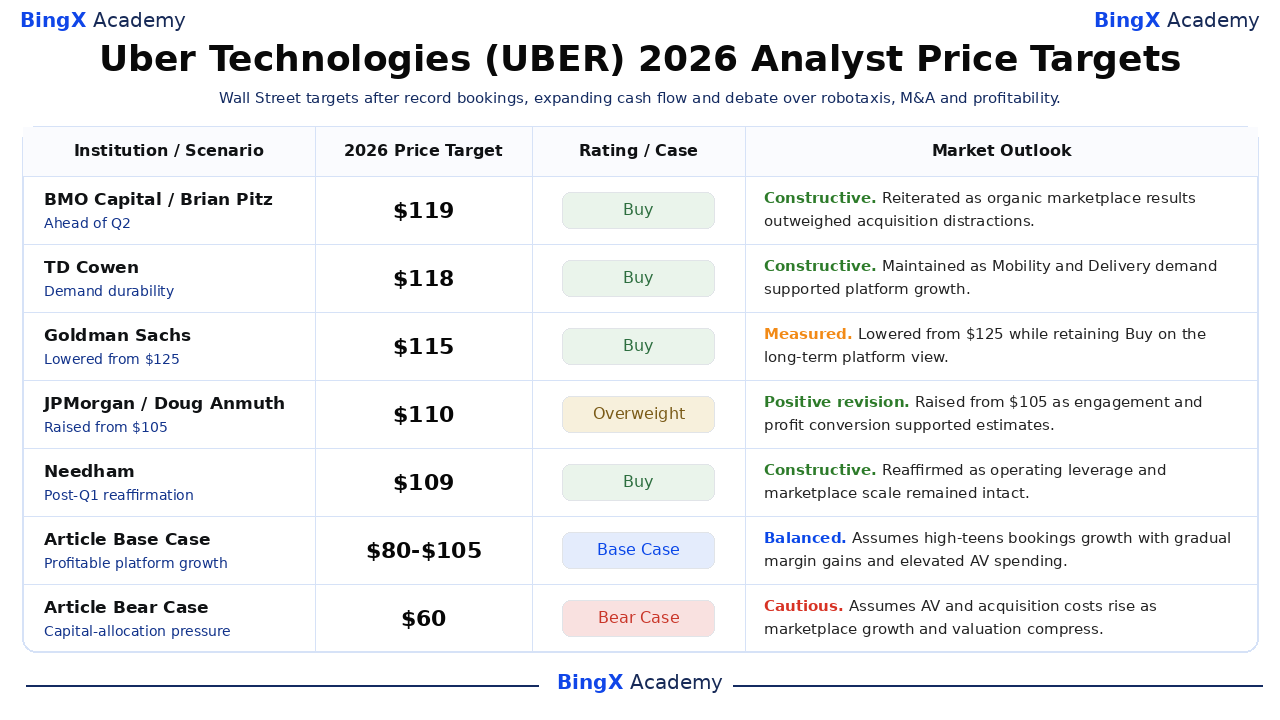
These are dated, named third-party analyst actions rather than guarantees, and their $105 to $119 spread shows meaningful uncertainty around capital allocation and autonomous mobility. The editorial Base and Bear cases are listed separately at the bottom so that article scenarios are not confused with institution-issued targets or a single consensus forecast.
|
Institution / Scenario |
2026 Price Target |
Rating / Case |
Market Outlook |
|
BMO Capital / Brian Pitz |
$119 |
Buy |
Constructive. August 4: reiterated ahead of Q2 as organic marketplace results outweighed acquisition distractions. |
|
TD Cowen / John Blackledge |
$118 |
Buy |
Constructive. July 17: maintained Buy as Mobility and Delivery demand supported the platform thesis. |
|
Goldman Sachs / Eric Sheridan |
$115 |
Buy |
Measured. May 7: lowered from $125 while retaining Buy on the long-term platform view. |
|
JPMorgan / Doug Anmuth |
$110 |
Overweight |
Positive revision. May 7: raised from $105 as engagement and profit conversion supported higher estimates. |
|
Needham / Bernie McTernan |
$109 |
Buy |
Constructive. May 7: reaffirmed Buy as operating leverage and marketplace scale remained intact. |
|
KeyBanc / Justin Patterson |
$105 |
Overweight |
Measured. July 14: lowered from $110 while citing mobility features and expanding grocery adoption. |
|
Article Base Case |
$80 to $105 |
Base Case |
Balanced. Assumes high-teens booking growth, gradual margin gains and elevated AV spending. |
|
Article Bear Case |
$60 |
Bear Case |
Cautious. Assumes AV and acquisition costs rise as growth and valuation compress. |
How to Trade Uber (UBER) Stock on BingX
Trade Uber's booking growth, robotaxi partnership and margin outlook using BingX TradFi and BingX AI tools. Because UBER can react sharply to earnings guidance, AV announcements and acquisition developments, traders should define both the catalyst and risk limits before entering a position.
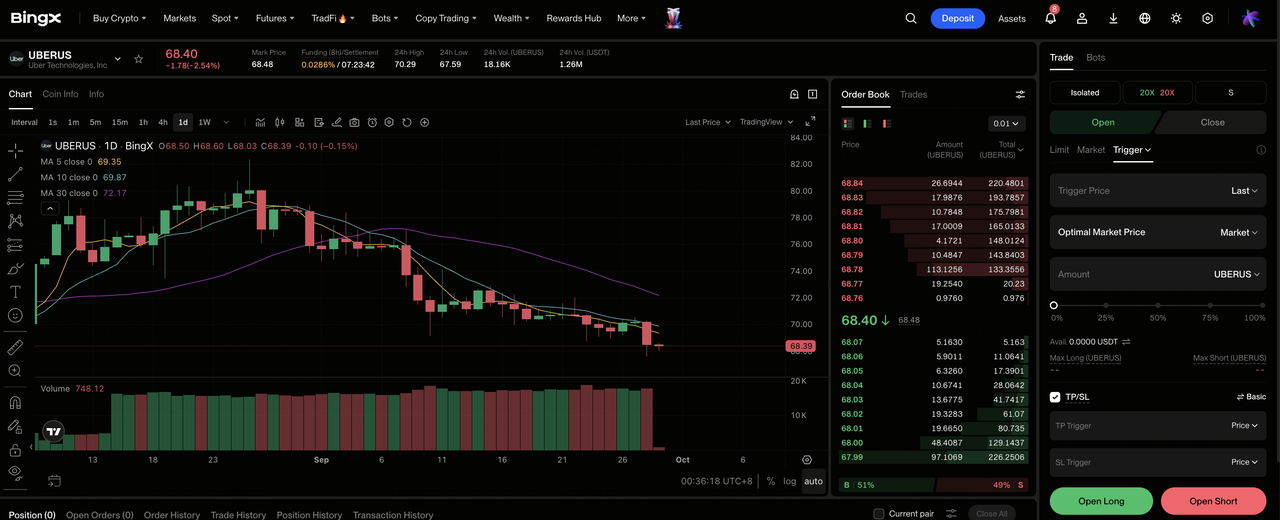
Step 1: Access BingX TradFi. Sign up and navigate to the specialized TradFi section on the BingX exchange dashboard.
Step 2: Select Uber (UBER). Search for and select the UBERUS-USDT perpetual futures contract.
Step 3: Choose your direction. Select Open Long if you expect bookings growth and margin expansion to outweigh AV spending. Select Open Short if you expect autonomous competition or acquisition costs to weaken earnings growth.
Step 4: Select leverage and margin mode. Choose Isolated or Cross-Margin based on your risk tolerance. The 15.04% YTD decline and 6% post-earnings move show why conservative leverage and clear position sizing are important.
Step 5: Execute strict risk protocols. Set Take-Profit and Stop-Loss (TP/SL) levels before or immediately after entering the trade. UBER can react quickly to booking trends, EPS guidance, robotaxi deployments, regulatory rulings and Delivery Hero transaction updates.
Top 5 Risks to Watch for Uber Investors in 2026
Uber's marketplace is growing and generating strong cash flow, but the outlook still depends on whether AV spending and acquisitions strengthen the platform without reducing per-share returns.
- Autonomous fleets could weaken Uber's marketplace role: Waymo and other developers may use Uber for distribution before shifting more riders to their own apps. Losing high-value urban trips could reduce network density and pressure take rates.
- More than $10 billion of AV investment raises capital-intensity risk: Equity stakes, vehicle commitments, and fleet support could consume cash before autonomous trips reach scale. Weak returns would compete with buybacks and reduce free cash flow per share.
- The $14.8 billion Delivery Hero deal creates integration risk: Expanding toward nearly 100 markets could strengthen engagement, but regulatory approvals, technology integration, and local competition may delay synergies. Higher costs would pressure margins.
- Driver regulation can raise operating costs: New requirements for benefits, wage floors, insurance, or employment status could increase costs in major markets. Uber may need to absorb those expenses or pass them to riders.
- Consumer demand, currencies, and insurance remain pressure points: Foreign exchange is expected to reduce reported Q3 bookings growth by about one percentage point. Weaker demand, higher insurance costs, or aggressive pricing by rivals could slow bookings and margin improvement.
Final Thoughts: Should You Invest in Uber Technologies in 2026?
What is not in dispute is the operating momentum: Q2 gross bookings rose 24% to $58.022 billion, trips increased 18% to 3.867 billion and adjusted EBITDA advanced 33% to $2.819 billion. Free cash flow of $2.792 billion also pushed the trailing total above $10 billion, giving Uber more financial flexibility than earlier growth phases.
The Bull Case depends on that cash funding AV access and Delivery Hero integration without sacrificing margins, while the Bear Case assumes capital intensity rises as autonomous fleets compete directly. More conservative traders may wait for evidence that Q3 EPS can exceed the $0.84 to $0.88 range and that robotaxi deployments add trips without weakening take rates.
Risk Reminder: Trading and investing in equities like UBER involves a high risk of capital loss. Uber is exposed to autonomous-vehicle competition, regulatory decisions, driver and insurance costs, acquisition integration, consumer demand and foreign-exchange volatility. Conduct independent research before allocating capital.
Related Reading
- Tesla (TSLA) Price Prediction 2026: Can Robotaxi and Optimus Push TSLA Stock to $500?
- Alphabet (GOOGL) Price Prediction 2026: Can 82% Cloud Growth and AI Push GOOGL Stock to $430?
- Amazon (AMZN) Price Prediction 2026: Can AWS and AI Growth Push AMZN Past $400?
- PayPal (PYPL) Price Prediction 2026: Can Venmo Growth and Margin Recovery Push PYPL Toward $80?
- Figma (FIG) Price Prediction 2026: Can AI Monetization Push FIG Toward $45?
