
On April 22, 2026, the USDai ecosystem continues to scale its mission of becoming the petrodollar of the AGI (artificial general intelligence) future. With over $343 million in Total Value Locked (TVL) as of April 2026 and institutional backing from firms like Bullish, Coinbase Ventures, and Framework Ventures, the protocol provides a transparent, GPU-backed alternative to traditional fiat-backed stablecoins.
This article examines how emerging credit market USDai tokenizes AI compute, the mechanics of its yield-bearing sUSDai token, the utility of the CHIP governance token, how to trade USDai (CHIP) on BingX.
What Is USDai (USDAI)?

An overview of USDai protocol | Source: USDai
USDai (USDAI) is a decentralized credit protocol that connects AI infrastructure operators like neoclouds and data centers with capital providers seeking yield. Unlike typical stablecoins backed by bank deposits or volatile crypto assets, USDAI is built on the physical backbone of AI: enterprise-grade GPUs like NVIDIA’s H200 and B200 series.
The platform's core thesis is that as AGI evolves, it will require a currency tied directly to its underlying productive capacity, compute. USDai targets this by offering:
- Non-Dilutive Financing: AI operators can secure loans against their hardware without giving up equity.
- Institutional Yield: Depositors access yield generated by interest payments from GPU-backed loans and U.S. Treasury bills.
- On-Chain Transparency: Every loan is represented as a Loan NFT, allowing for real-time verification of collateral and repayment status.
How Does the USDai Ecosystem Work?
USDai operates as a two-sided credit market using a hybrid on-chain/off-chain structure to ensure legal enforceability:
- The Depositor Layer (USDAI & sUSDai): Capital enters the protocol when users deposit PayPal’s regulated stablecoin PYUSD to mint USDAI. To earn yield, users stake USDAI for sUSDai. The value of sUSDai increases relative to USDAI as interest from GPU loans and Treasury yield accrues.
- The Lending Layer (GPU Financing): Borrowers or AI operators apply for financing via GPUloans.com. Loans are typically issued at 70–80% Loan-to-Value (LTV) and are secured by a bankruptcy-remote Delaware SPV.
- Hybrid Synchronization: While the legal contracts and UCC-1 liens exist in the physical world, they are mirrored on-chain. A Loan NFT is only minted once the servers are verified as installed and operational in a data center.
- Queue Extractable Value (QEV): Because real-world loans have long-term durations, USDai uses a 30-day epoch cycle for redemptions. QEV allows for auction-based priority bidding, providing a mechanism for faster exits during high-demand periods.
What Is the $USDAI Token Used For?
Within the ecosystem, there is a clear distinction between the stable unit of account and the yield-bearing instrument:
- USDAI Synthetic Dollar: A stable, liquid, and composable asset pegged 1:1 to the US dollar. It serves as the primary entry point and a stable medium of exchange within DeFi.
- sUSDai Yield-Bearing Token: The primary credit instrument. It automatically captures yield from the protocol's loan book. Holders do not need to manually claim rewards; the exchange rate between USDAI and sUSDai simply moves in the holder's favor over time.
- CHIP Governance Token: The brain of the protocol. CHIP holders vote on hardware eligibility, e.g., approving the latest Blackwell GPUs, interest rate tiers, and protocol fee allocations.
What Is USDai (CHIP) Tokenomics?
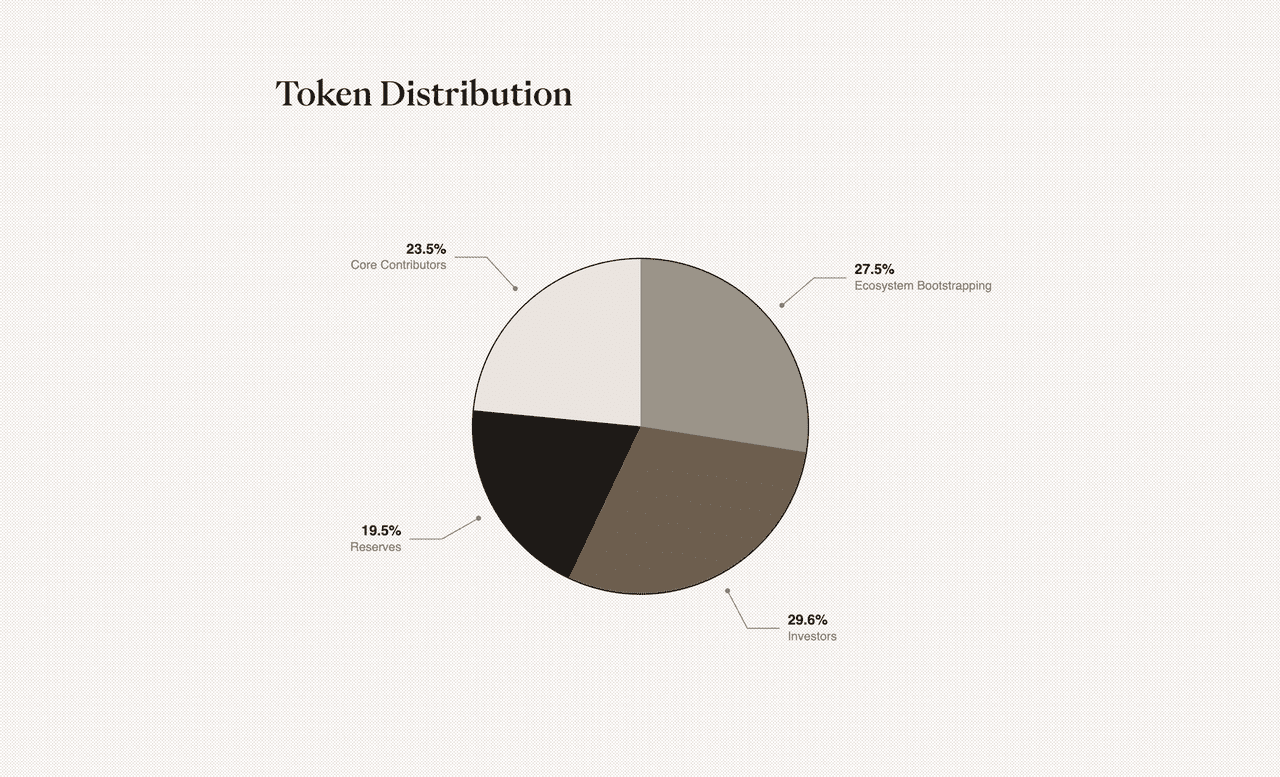
CHIP token distribution | Source: USDai docs
The CHIP token has a fixed total supply of 10,000,000,000 (10 billion) tokens, ensuring a capped framework for its governance and utility roles within the USDai ecosystem.
- Ecosystem Bootstrapping (27.5%): This allocation is dedicated to protocol liquidity, yield origination, and capital formation. The first 10% was distributed during Season 1 (The Allo Game). The remaining funds are earmarked for future airdrops, growth initiatives, and incentives targeting the hard-to-bootstrap components of the dual-sided compute market.
- Reserve (19.5%): Managed by the USDai Foundation, these are residual reserves for future grants, R&D, and strategic partnerships. The goal is to establish the USDai protocol as the definitive benchmark for the interest rate of artificial intelligence.
- Core Contributors (33% combined with Investors): Specifically reserved for Permian Labs, the technical team, and future contributors. To align with the protocol's long-term health, this allocation follows a strict vesting schedule: 0% for the first 12 months, a 33% cliff at month 12, and the remaining 67% released inequal monthly installments over the following 24 months.
- Investors: This allocation covers the early backers who financed the technology build-out. Like the core contributors, investors are subject to a 1-year lock, followed by a 33% unlock at month 12, and a 2-year linear monthly unlock thereafter.
How Does USDAI's InfraFi Model Differ From Traditional Stablecoins?
|
Feature |
USDai (USDAI) |
Traditional Stablecoins (USDT/USDC) |
|
Collateral Base |
GPU Hardware + US Treasuries |
Cash + Commercial Paper/Treasuries |
|
Yield Source |
AI Compute Credit + T-Bills |
Internalized by Issuer (usually 0% to user) |
|
Transparency |
On-chain Loan NFTs & Real-time Monitoring |
Monthly/Quarterly Attestations |
|
Primary Use |
Financing AI Infrastructure |
General Trading & Liquidity |
Traditional stablecoins like Tether's USDT and Circle's USD Coin (USDC) primarily function as tokenized fiat, where the value is derived from static reserves like bank deposits and U.S. Treasuries. While these are essential for liquidity and settlement, they are inherently passive; the yield generated by the underlying reserves is typically internalized by the issuer or distributed through highly diluted DeFi pools. In contrast, USDAI introduces a productive collateral model. By backing the synthetic dollar with high-performance GPU infrastructure, USDAI effectively turns the CAPEX-heavy AI industry into a source of on-chain credit. This allows for an Expected APR of 13.10% as of April 2026, significantly higher than the standard 4–5% T-bill yield often seen in regulated fiat-backed alternatives.
From a practical risk management perspective, the difference lies in the transparency of the Lender Register. Traditional stablecoins rely on monthly or quarterly attestations to prove reserves, which offers a retrospective and often opaque view of solvency. USDAI utilizes an on-chain/off-chain hybrid structure where each loan is represented by a Loan NFT. This provides real-time, granular visibility into the health of the underlying hardware clusters, their uptime, and their cash-flow generation. While USDT remains the liquidity king for high-frequency trading, USDAI serves a strategic role for investors who want their stable holdings to benefit directly from the AI supercycle's financing gap, essentially acting as the petrodollar for the AGI era by linking currency value to compute productivity rather than just sovereign debt.
Read more: USDC vs. USDT: Key Differences and Which Stablecoin to Choose in 2026?
How to Trade USDai (CHIP) on BingX
To maximize your trading efficiency, utilize BingX AI to analyze real-time market sentiment and technical indicators for $CHIP during its high-volatility launch phase. Following its public listing on April 21, 2026, CHIP is available for both instant spot acquisition and leveraged futures trading.
Buy, Sell, or HODL CHIP on the Spot Market
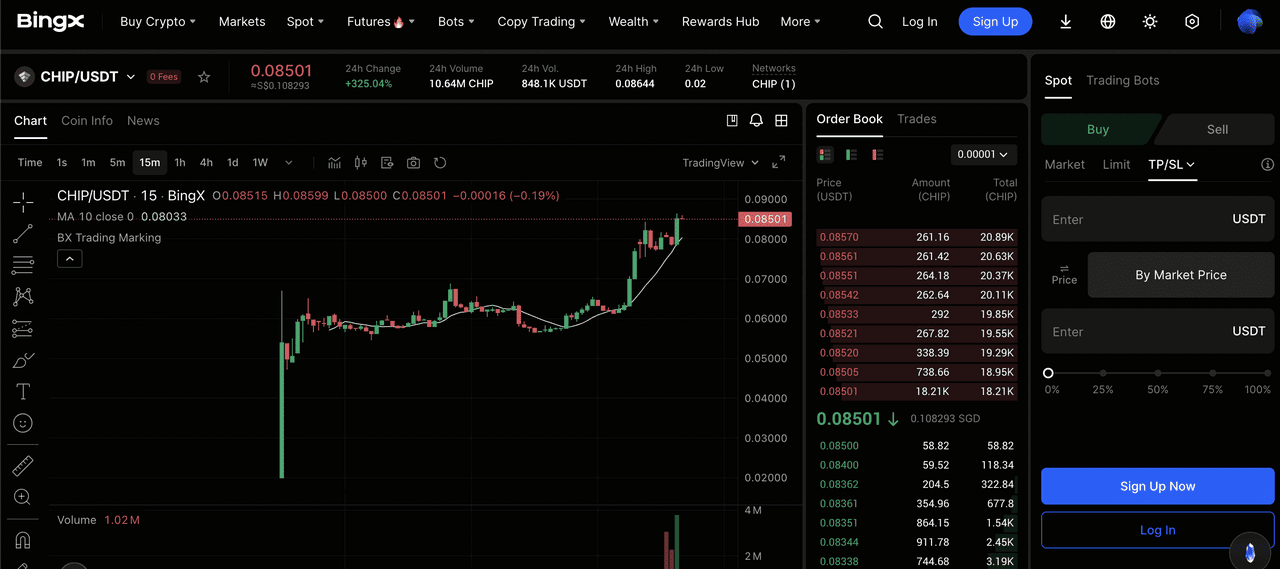
CHIP/USDT trading pair on the BingX spot market
Spot trading is ideal for long-term holders looking to acquire CHIP tokens for protocol governance or staking into the sCHIP backstop module.
- Access the Terminal: Log in to the BingX app or website, navigate to the Spot tab, and search for the CHIP/USDT trading pair.
- Select Your Order Type:
- Market Order: Use this for instant execution at the best available current price.
- Limit Order: Set a specific price at which you wish to buy; the trade will only execute if $CHIP hits your target.
- Enter Amount and Confirm: Input the amount of USDT you wish to spend or the amount of CHIP you want to buy. Review the transaction fees and tap Buy CHIP to finalize.
- Manage Assets: Once filled, your tokens will appear in your Fund Account. You can keep them there or transfer them to the Wealth section for potential flexible interest.
Long or Short CHIP Perpetuals on the Futures Market
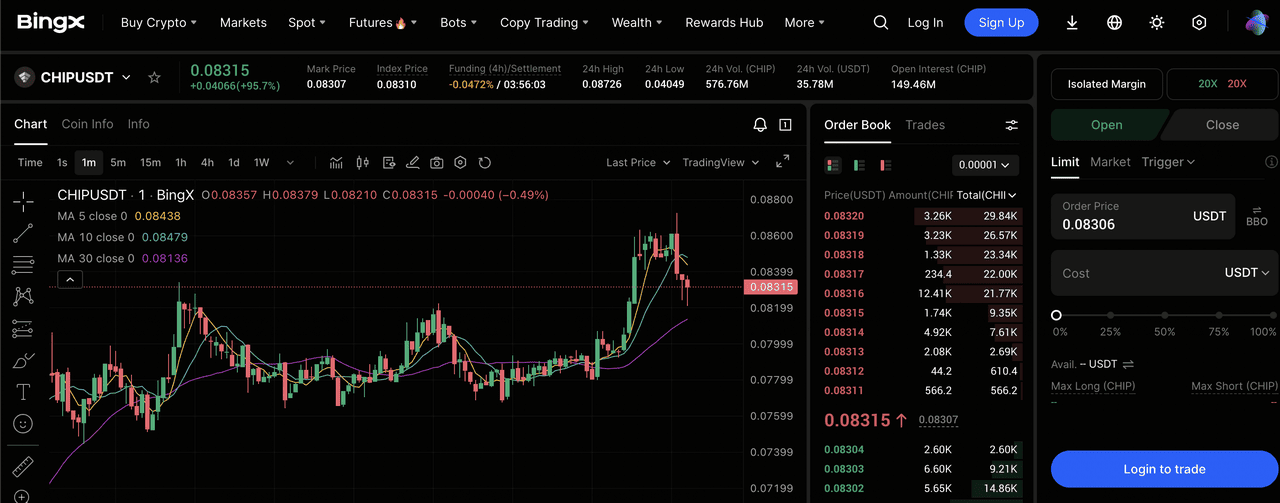
CHIP/USDT perpetuals on the BingX futures market
With the launch of CHIPUSDT Perpetual Futures, BingX users can trade the CHIP token with institutional-grade liquidity and leverage.
- Access the Futures Tab: Go to the Futures section and select Perpetual Futures. Search for the CHIPUSDT perpetual contract.
- Choose Margin Mode:
- Isolated Margin: Limits your risk to the specific amount allocated to that single position.
- Cross Margin: Uses your entire futures account balance to prevent liquidation, better for complex hedging strategies.
- Adjust Leverage: Set your desired leverage, of up to 50x. Remember: leverage amplifies both potential gains and potential losses.
- Execute Strategy:
- Open Long: If you anticipate the InfraFi narrative and GPU demand will drive the price up.
- Open Short: If you are looking to hedge your USDai airdrop rewards or expect a technical correction.
- Set Protection: Always input Take Profit (TP) and Stop Loss (SL) orders immediately to manage risk against the inherent volatility of AI-sector tokens.
5 Key Considerations Before Investing in USDai (CHIP)
Before allocating capital to the $CHIP ecosystem, it is essential to evaluate the structural risks of its GPU-backed credit model and the technical nuances of the protocol's long-term hardware dependencies.
- Hardware Depreciation: GPUs are depreciating assets. Ensure the protocol’s amortization schedules and Barkr value insurance are sufficient to cover potential shortfalls.
- Liquidity Cycles: sUSDai redemptions operate on a 30-day epoch. This is not an instant swap environment like a standard DEX pool.
- Counterparty Risk: While loans are non-recourse and secured by hardware, the productivity of that hardware depends on the borrower's ability to find compute customers.
- Regulatory Landscape: As a protocol bridging on-chain finance with physical equipment liens, changes in RWA regulations could impact operations.
- Technical Dependency: The protocol relies on Aravolta for hardware monitoring and Wilmington Trust for escrow. These centralized points of failure are mitigated by multi-sig controls and on-chain records.
Final Thoughts: Is USDai the Future of AI Finance?
As of April 2026, USD.AI has successfully transitioned the Real World Asset (RWA) narrative from static, low-yield assets to the high-growth sector of AI infrastructure. By standardizing GPU-backed debt, the protocol offers a practical solution to the estimated $490 billion financing gap facing the AGI revolution. For the strategic participant, the system’s value lies in its hybrid architecture: it provides the institutional-grade security of Delaware SPVs and UCC-1 filings while maintaining the DeFi composability of a yield-bearing synthetic dollar. The long-term viability of the protocol will depend on its ability to scale its loan book across diverse hardware generations from H200s to the latest Blackwell series while maintaining the 70–80% LTV safety buffer.
For users, the practical utility of $CHIP and $USDAI extends beyond simple speculation into a new category of InfraFi (infrastructure finance). Whether utilizing sUSDai as high-fidelity collateral in lending markets like Morpho or participating in governance to set interest rate benchmarks for the compute industry, USD.AI functions as a foundational layer for on-chain commerce. Success in this ecosystem requires a balanced approach: leveraging the protocol’s data-driven transparency for yield generation while remaining mindful of the 30-day redemption epochs and the underlying hardware's depreciation cycles.
Risk Reminder: Digital asset investments, particularly in niche hardware-backed protocols like USD.AI, carry significant market risk and technical complexity. The value of $CHIP and the yield of $USDAI are subject to GPU market demand, hardware obsolescence, and regulatory shifts in RWA frameworks. Always perform your own research, monitor the Verified Reserves dashboard on the USDai dApp, and only trade capital you can afford to lose. BingX is not responsible for any trading losses incurred.
Related Reading
- Top Real-World Asset (RWA) Tokenization Projects of 2026
- What Are the Top 10 AI Crypto Projects to Watch in 2026?
- What Is Allora (ALLO), the Decentralized AI Network Powering Collective Intelligence?
- What Is Unibase (UB) Decentralized AI Memory Layer and How to Buy UB?
- What Is Bitvia (BITVIA) AI-Powered Crypto Investing Platform for Automated Wealth Management?
