

Ethereum (ETH) as the second-largest crypto asset by market cap after Bitcoin, has long been one of the core holdings for Taiwanese investors. With Ethereum's transition to Proof of Stake (PoS) mechanism, ETH applications have expanded from simple token holding to staking rewards, Layer 2 network usage, lending, and liquidity mining scenarios. Each activity may involve different tax treatments, making tax planning for ETH investors more complex than general cryptocurrency investments.
Taiwan has not yet enacted specialized legislation for cryptocurrency taxation. Like other non-securities virtual currencies, Ethereum investment gains are classified as "property transaction income" under Article 14, Paragraph 1, Item 7 of the Income Tax Act. For investors who only buy and sell ETH spot, tax treatment is relatively straightforward; however, when involving staking and DeFi operations, current regulations provide incomplete guidance for these scenarios, and most cases are handled by analogy with accounting principles in practice.
This article begins with Ethereum's legal positioning, sequentially explaining ETH taxation timing, domestic versus overseas income classification, treatment methods for staking and decentralized finance (DeFi) income, declaration procedures, and introduces trading platforms and tax assistance tools suitable for ETH investors, helping you establish a stable and practical Ethereum tax reporting workflow. This content is for general reference only; please consult accountants or the National Taxation Bureau for professional advice based on your individual circumstances for actual declarations.
Key Takeaways
- Ethereum is classified as "non-securities virtual currency" in Taiwan, with investment gains falling under "property transaction income" that must be declared according to Article 14, Paragraph 1, Item 7 of the Income Tax Act, not applicable to the securities transaction tax exemption for stock trading.
- Taxation timing is triggered by "converting ETH to fiat currency and withdrawing to bank accounts." Simply holding ETH in wallets or exchanges, or conducting coin-to-coin exchanges, does not realize gains or losses.
- ETH staking rewards, liquidity mining, and DeFi income currently lack clear tax guidance. Conservative approach is to recognize as income when received at current market price, and use that market price as cost basis when selling later.
- Domestic income (converting ETH to TWD through Taiwanese exchanges) is included in comprehensive income tax, while overseas income (wire transfers back to Taiwan through overseas platforms) applies to the Alternative Minimum Tax system, with overseas income under NT$1 million exempt from declaration.
- BingX provides Traditional Chinese interface for ETH spot and perpetual futures trading, with comprehensive profit and loss statement export functions, suitable for Taiwanese ETH investors as a primary trading and record-keeping platform.
Do You Need to Pay Tax on ETH in Taiwan? Rules and Legal Classification
Before understanding tax rules, it's important to understand Taiwan's regulatory authorities' legal positioning of Ethereum. The Financial Supervisory Commission classifies ETH together with Bitcoin and other mainstream cryptocurrencies as "non-securities virtual currencies." This classification directly determines ETH's taxation method: it is not applicable to the securities transaction tax exemption for stock trading, and investment gains are treated as "income from selling or exchanging property and rights," which must be declared under comprehensive income tax or Alternative Minimum Tax according to relevant provisions of the Income Tax Act.
The Ministry of Finance submitted a written report on cryptocurrency taxation to the Legislative Yuan's Finance Committee in January 2025, confirming that individual cryptocurrency trading gains should be handled according to Article 14, Paragraph 1, Item 7 of the Income Tax Act as "property transaction income," with the transaction price minus costs and related expenses as taxable income. As of December 13, 2024, the National Taxation Bureau has identified NT$130 million in unreported virtual currency income, collecting over NT$34 million in back taxes and penalties, with regulatory authorities having established actual enforcement cases.
Tax law adopts the "exit settlement method" to calculate ETH gains and losses, meaning gains and losses are realized only when Ethereum is converted back to fiat currency (TWD or foreign currency). In other words, if ETH remains in exchanges or personal wallets, regardless of how much the book value increases or exchanges between different tokens, no tax obligation is incurred. Only when ETH is withdrawn to personal bank accounts and fiat conversion is completed does it need to be included in that year's income declaration.
How to Distinguish Domestic vs. Overseas Income: Based on Withdrawal Method
Ethereum taxation judgment is the same as other cryptocurrencies, determined as domestic or overseas income based on the "withdrawal platform." The two have vastly different applicable tax systems: domestic income is included in comprehensive income tax under progressive tax rates, while overseas income applies to the Alternative Minimum Tax system, enjoying relatively lenient tax exemptions. For ETH investors, choosing withdrawal channels is essentially part of tax planning.
1. Domestic Income: Withdraw via Taiwan Exchanges
Using compliant Taiwanese exchanges like MAX and BitoPro to convert ETH to TWD and transfer to personal TWD bank accounts, this profit is treated as "domestic income" under individual comprehensive income tax regulations. Taiwanese compliant exchanges follow real-name systems and Anti-Money Laundering regulations with complete transaction records, allowing the National Taxation Bureau to access specific individuals' transaction data under Article 30 of the Tax Collection Act. Domestic income calculation method:
Domestic Property Transaction Income = ETH Sale Amount - Purchase Cost - Trading Fees
The calculated income is included in individual annual comprehensive income total, taxed under progressive rates (5% to 40%). For ETH investors with modest gains, domestic income's lower-tier tax rate thresholds are relatively friendly; however, for high-income groups, the 40% progressive tax rate ceiling is significantly higher than overseas income's Alternative Minimum Tax.
Extended Reading:Complete Comparison of Taiwan Cryptocurrency Fiat On/Off-Ramps: Which Platform Has the Cheapest Deposits and Fastest Withdrawals? (2026)
2. Overseas Income: Transfer Funds Back to Taiwan from Foreign Platforms
If using overseas exchanges to trade ETH and converting gains to USD or stablecoins, then wire transferring to Taiwan foreign currency bank accounts, this income is treated as "overseas income." Overseas income is not included in comprehensive income tax but applies to the Income Basic Tax Act. When funds are repatriated, banks require filling out remittance nature forms; it's recommended to declare "268 Sale of Overseas Virtual Assets" for easy classification as overseas income during tax filing.
Overseas income tax exemptions are relatively lenient. Individual annual overseas income totaling under NT$1 million is exempt from declaration; over NT$1 million requires Alternative Minimum Tax declaration. Basic income amount minus NT$7.5 million (applicable for 2026) multiplied by 20% equals basic tax amount. If basic tax amount exceeds comprehensive income tax amount, the difference must be paid; if comprehensive tax amount is greater than or equal to basic tax amount, no basic tax payment is required. Note that basic income amount includes not only overseas income but also specific insurance benefits, securities transaction income, etc., so consider these items when calculating tax exemption space.
Extended Reading:Which Platform Has the Lowest Fees for Converting ETH to USD in Taiwan? 5 Major Exchanges' Fee and Withdrawal Cost Comparison (2026)
When Do You Pay ETH Taxes in Taiwan? Common Scenarios
Ethereum ecosystem's diverse applications make ETH tax treatment more complex than general cryptocurrencies. From spot trading, staking to DeFi operations, each activity may affect final gain and loss calculations. While Taiwan tax law currently lacks clear guidance for some scenarios, conservative handling principles can reduce dispute risks during future audits.
- ETH Spot Trading: The most common scenario is buying ETH and selling for profit when prices rise, then withdrawing to bank accounts. Such gains are property transaction income, classified as domestic or overseas income based on withdrawal channels. Calculation method is "Sale Amount - Purchase Cost - Trading Fees," included in that year's comprehensive income tax or Alternative Minimum Tax declaration. It's recommended to download transaction records immediately after each buy or sell transaction and backup for future calculation basis. For batch entries, the same ETH batch can use FIFO or average cost method, but maintain consistency within the same year.
- ETH Perpetual Futures Trading: Ethereum perpetual futures gains also fall under property transaction income. Due to involvement of margin, funding rates, and forced liquidation mechanisms, calculation methods differ from spot trading. In practice, platform-provided profit and loss statements are often used directly. Some platforms (like BingX) provide comprehensive futures profit and loss export functions, with net gains after closing positions automatically calculated as declaration basis. If trading through overseas platforms and repatriating funds to Taiwan, it's usually classified as overseas income.
- ETH Staking Rewards: After Ethereum's transition to Proof-of-Stake (PoS) mechanism, holding ETH can earn approximately 2-4% annual rewards through staking. Whether through exchanges, liquid staking protocols (like Lido, Rocket Pool), or running validator nodes independently, conservative handling is commonly adopted: recognize as income at current market price when rewards are received; when selling that ETH in the future, use the market price recognized at that time as cost basis to calculate subsequent gains and losses.
- DeFi Lending and Liquidity Mining: In lending protocols like Aave and Compound, using ETH as collateral to borrow stablecoins usually constitutes collateralized lending rather than asset disposal, not immediately generating taxation. However, if collateral is liquidated, it equals asset being sold, requiring gain and loss calculation at current market price. Fee sharing or reward tokens obtained from providing liquidity on Uniswap, Curve, etc., are handled similarly to staking, recognized as income at market price when received. Also note impermanent loss, as asset quantities upon final redemption may differ from initial deposits.
- Layer 2 Cross-chain and Coin-to-Coin Exchanges: Transferring ETH from mainnet to Arbitrum, Optimism and other Layer 2 networks is essentially asset movement between different networks, usually not considered disposal. Similarly, coin-to-coin exchanges are often treated as unrealized gains and losses before converting back to fiat currency. However, these operations still affect subsequent cost calculations. In practice, cross-chain records, exchange records, and gas fee expenses should be retained for complete cost basis calculation when withdrawing funds in the future.
ETH Tax Rules by Transaction Type in Taiwan
|
Trading Scenario |
Triggers Taxation |
Tax Treatment Recommendation |
|
ETH spot trading with bank withdrawal |
Yes |
Classify as domestic/overseas income based on withdrawal channel, calculate property transaction gains and losses |
|
ETH exchanged for other tokens |
No (unrealized) |
Retain transaction records, calculate complete cost basis when withdrawing funds later |
|
ETH staking reward receipt |
Recommended to recognize as income |
Recognize at current market price when received, use as cost basis for future sales |
|
Layer 2 cross-chain bridging |
No |
Retain on-chain transaction records and gas fee expense proof |
|
DeFi lending collateral (not liquidated) |
No |
Retain lending records, calculate gains and losses at liquidation price when liquidated |
|
Liquidity mining rewards |
Recommended to recognize as income |
Recognize at current market price when received, note impermanent loss calculations |
Best ETH Tax Tools for Taiwan Users
For Taiwanese ETH investors with frequent transactions or operations across multiple platforms, manually organizing profit and loss data usually involves considerable workload. The following tools can help integrate transaction records and calculate gains and losses.
Most tools are international services with limited support for Taiwan's tax system, mainly used for calculating profit and loss figures. For actual declarations, data still needs to be reorganized according to Taiwan's format. Additionally, current mainstream tools are mostly English-interface based without complete Traditional Chinese support, requiring some adaptation during use.
- Koinly: Supports most mainstream exchanges and wallets, provides API and CSV import methods, can automatically organize transaction records and categorize as trading, transfers, fees, etc., reducing manual organization burden. Supports FIFO, LIFO, and average cost methods, can generate profit and loss reports and tax summaries, suitable for users with high transaction volumes or cross-platform operations.
- CoinTracker: Focuses on automatic synchronization and portfolio tracking, supports most exchange API connections, also allows CSV data import. System automatically calculates holding costs and realized gains and losses, supports FIFO and LIFO, suitable for users with relatively simple transaction records or those wanting to quickly grasp overall asset status. Free version has transaction limit restrictions; upgrade required when transaction volume increases.

- Blockpit (formerly Accointing): Provides transaction record integration, profit and loss calculation, and tax report functions, supports FIFO and average cost methods. Former Accointing has been merged into Blockpit with continued and integrated functions, suitable for medium transaction volume scenarios. Output still mainly follows international tax systems, usually requiring reorganization for Taiwan declarations.

- Excel/Google Sheets: No reliance on third-party tools, can directly import exchange CSV files, build your own fields and calculation logic, organize data completely according to Taiwan declaration requirements. Suitable for users with moderate transaction volumes or those wanting to control the complete calculation process, with advantages in format control and flexibility.
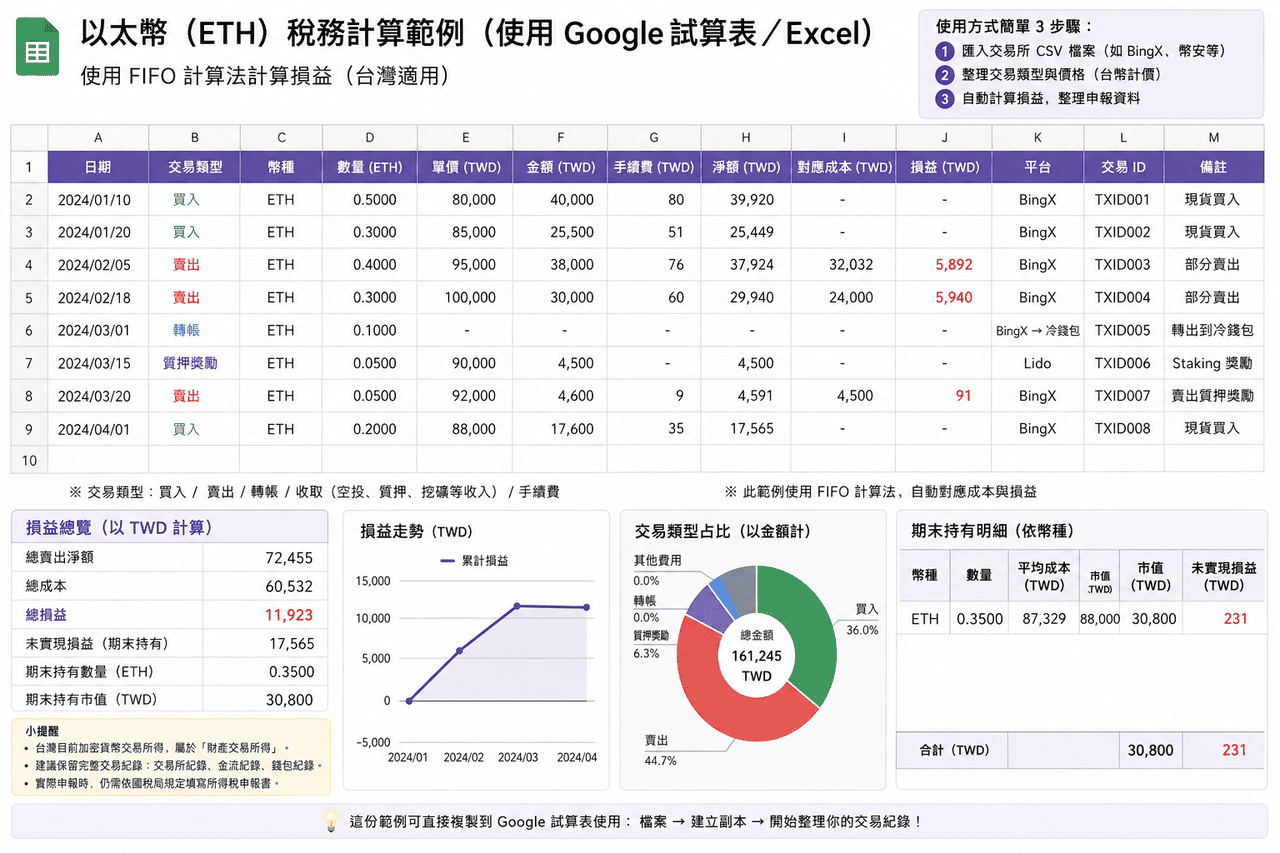
For Taiwanese general investors with moderate transaction frequencies (fewer than 50 transactions annually), using Excel or Google Sheets for manual organization is usually more practical than paid third-party tool subscriptions, as you can organize data completely according to Taiwan declaration format requirements without additional format conversion from tool outputs. High-volume or multi-chain operation advanced users can consider tools like Koinly to reduce organization workload, but should still verify calculation result accuracy independently.
ETH Tax Tool Comparison: Taiwan-Friendly Tools with Chinese Interface
|
Tool |
Traditional Chinese Interface |
Taiwan Tax Format |
BingX Import Support |
Supported Calculation Methods |
Cost |
|
Koinly |
No |
Partial Support (Can generate P&L reports) |
Manual CSV upload required |
FIFO, LIFO, Average Cost |
Free basic version, paid plans from ~$49 USD/year |
|
CoinTracker |
No |
Partial Support |
Manual CSV upload required |
FIFO, LIFO |
Free 25 transactions, paid plans from ~$59 USD/year |
|
Blockpit |
No |
Partial Support |
Manual CSV upload required |
FIFO, Average Cost |
Free basic version, paid plans from ~$79 USD/year |
|
Excel/Google Sheets |
Yes |
Fully Flexible (Self-designed) |
Direct CSV import |
Customizable (FIFO, LIFO, Average Cost, etc.) |
Free |
How to Export ETH Trade History from BingX for Tax Filing
BingX's Traditional Chinese interface significantly simplifies record organization work before tax filing. The following is the standard process for exporting complete ETH trading records from BingX, suitable for continuous daily recording and annual tax organization.
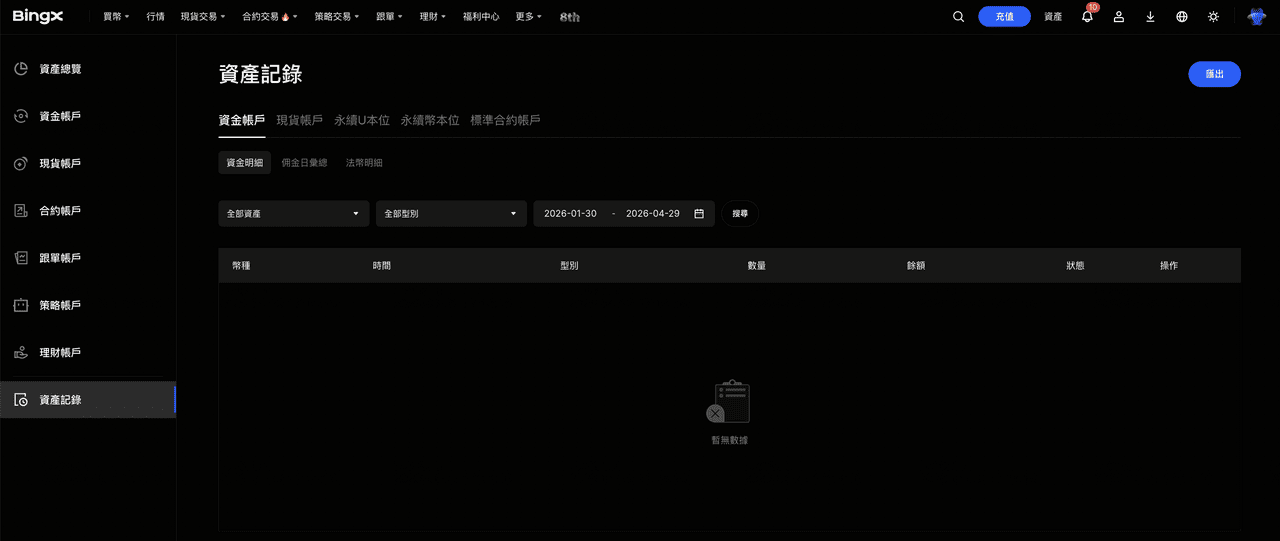
- Log into BingX account and access trading history page: After logging into BingX, go to "Assets" or "Orders" page to view complete trading history of personal account. ETH-related transactions include spot ETH/USDT trading, perpetual futures positions, and funding rate records.
- Select export time range: On the trading history page, select "Export" function and set the current year's time range (January 1 to December 31). It's recommended to export quarterly as backup to avoid missing large amounts of data when processing everything at year-end.
- Download CSV or Excel reports: BingX supports exporting trading records as CSV or Excel format, including transaction time, buy/sell direction, quantity, price, fees, and transaction amount. This report can be directly used to calculate ETH property transaction income or imported into tools like Koinly for automatic processing.
- Organize withdrawal records: BingX's "Withdrawal History" page shows all withdrawal records to external addresses or Taiwanese exchanges. Match these records with bank-side remittance certificates as basis for determining domestic or overseas income.
- Backup to personal devices: Downloaded reports should be stored for at least 7 years for future National Taxation Bureau audits. It's recommended to backup to both personal computers and cloud services to avoid losing critical data from single device damage.
5 Key Things to Know Before Filing ETH Taxes in Taiwan
Ethereum tax treatment is more complex due to diverse application scenarios. The following summarizes five key attention points to help investors reduce risks and uncertainties during tax filing.
- Maintain complete records for staking and DeFi income: ETH staking rewards, liquidity mining income, DeFi interactions, etc., currently lack clear tax guidance in Taiwan, but this doesn't mean records can be omitted. It's recommended to record time, quantity, and current ETH/USD market price each time rewards are received, as basis for future market price recognition as income or cost basis calculation. Complete records are much easier than post-hoc reconstruction and can effectively reduce audit disputes.
- Coin-to-coin exchanges don't trigger taxation, but cost basis needs tracking: Converting ETH to other tokens or conducting L2 cross-chain theoretically doesn't realize gains and losses, not immediately generating tax obligations. However, when calculating cost basis for future withdrawals, tracking back to original fiat purchase costs is needed. If there are multiple exchanges or cross-chain transactions in between, complete transaction records are key to reasonable cost calculation.
- Anti-money laundering risks for large withdrawals: When single ETH withdrawal and fiat transfer to personal accounts exceeds NT$500,000, banks must report to the Investigation Bureau of the Ministry of Justice according to regulations. However, amounts below NT$500,000 don't guarantee absolute safety; frequent deposits/withdrawals in short periods, abnormal amounts, or suspicious transaction patterns may also trigger bank risk control mechanisms. Maintaining stable withdrawal frequency and amounts helps reduce special scrutiny possibilities.
- Overseas income tax exemption isn't the full NT$7.5 million available: Many ETH investors mistakenly believe overseas cryptocurrency gains are tax-free as long as they don't exceed NT$7.5 million, but basic income amount includes other items like specific insurance benefits, securities transaction income, etc. When planning tax savings, first check how much exemption space other items have already occupied, rather than simply judging by ETH gain amounts.
- Legal risks of non-declaration exceed back tax amounts: Failure to declare ETH income according to law not only faces back taxes but may also incur 15% annual late fees and 0.5-3x penalty fines. If tax evasion amounts are large, it may even involve criminal liability. For high-frequency trading or large-gain ETH investors, honest declaration and maintaining complete records is the most stable approach for long-term compliant market participation.
Conclusion: How to File ETH Taxes in Taiwan
Ethereum's application scenarios are more diverse compared to simple spot trading, from perpetual futures to staking and DeFi operations. Different types of transactions may all affect final tax determinations. While relevant regulations in Taiwan continue to develop, a more stable approach is to establish a traceable and consistent record-keeping method, such as regularly downloading trading records, consistently using the same cost calculation method, completely retaining every transaction and fee record, and clearly distinguishing domestic and overseas income sources. This basic data affects not only individual transaction gain and loss calculations but also annual overall declaration results, so establishing organization habits early reduces subsequent processing burden.
For tools and processes, different needs can be divided: trading platforms serve as sources for original transactions and fund flows, third-party tools organize multi-platform or on-chain operation data, and spreadsheets handle final organization and verification according to Taiwan declaration formats. Through such processes, efficiency can be maintained while ensuring clear and verifiable data structures. Also, allowing organization time before tax season can reduce error risks from last-minute processing. For larger transaction scales or multiple operation scenarios, early discussion with professionals familiar with crypto assets can integrate tax organization into daily management rather than concentrated processing before tax filing.
Extended Reading
- How to Buy Ethereum in Taiwan? 2026 Ethereum Exchange Recommendations and Complete Purchase Tutorial
- Which Platform Has the Lowest Fees for Buying Bitcoin in Taiwan? BTC Spread, Fee, and Liquidity Comparison (2026)
- How to Conduct Ethereum Arbitrage in Taiwan? DeFi Strategy Comparison and BingX Operation Tutorial (2026)
- Which Exchange is Best for Large Volume Ethereum Trading in Taiwan? Complete Platform Fee and Liquidity Comparison Recommendations (2026)
- Complete Comparison of Taiwan Cryptocurrency Futures Trading Platforms (2026): Fee, Liquidity, and Security Comparison
